Tintagel Castle
Cornwall England England
castle, chateau
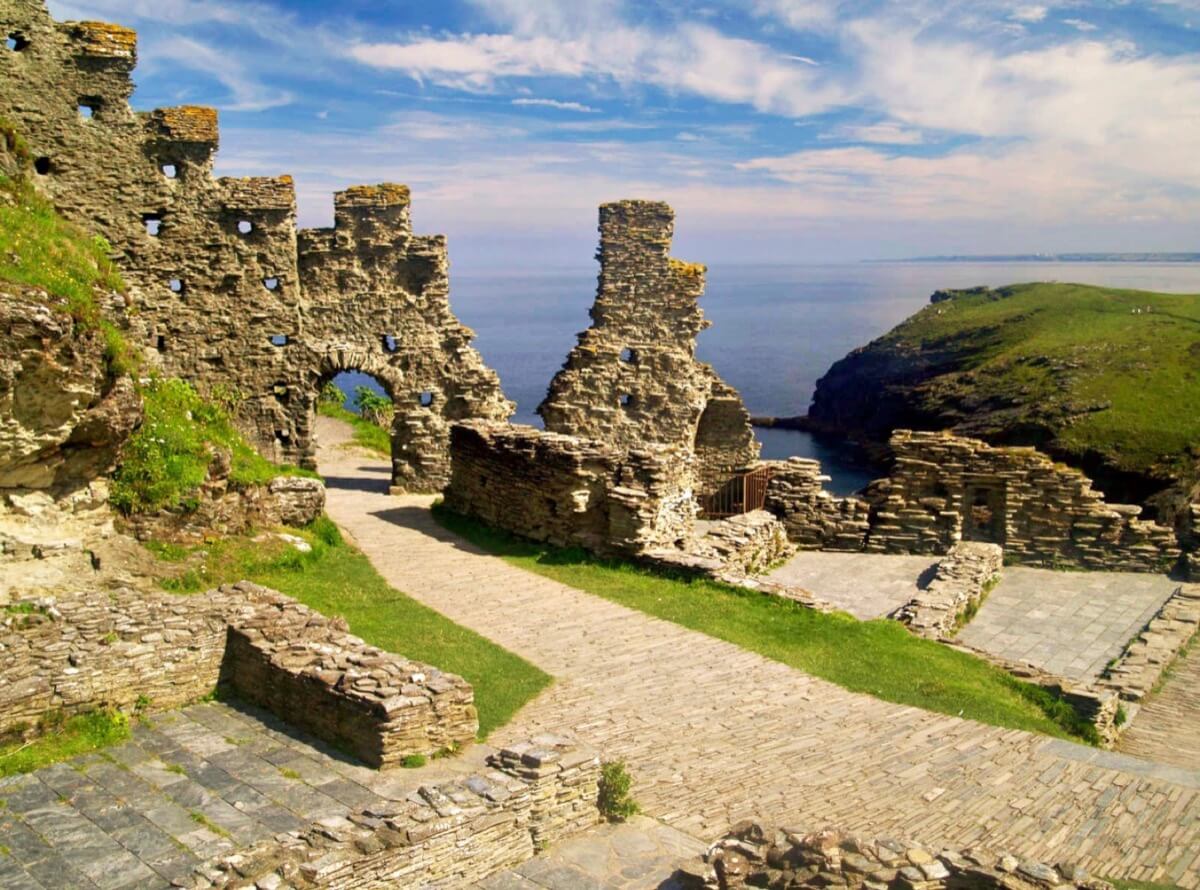
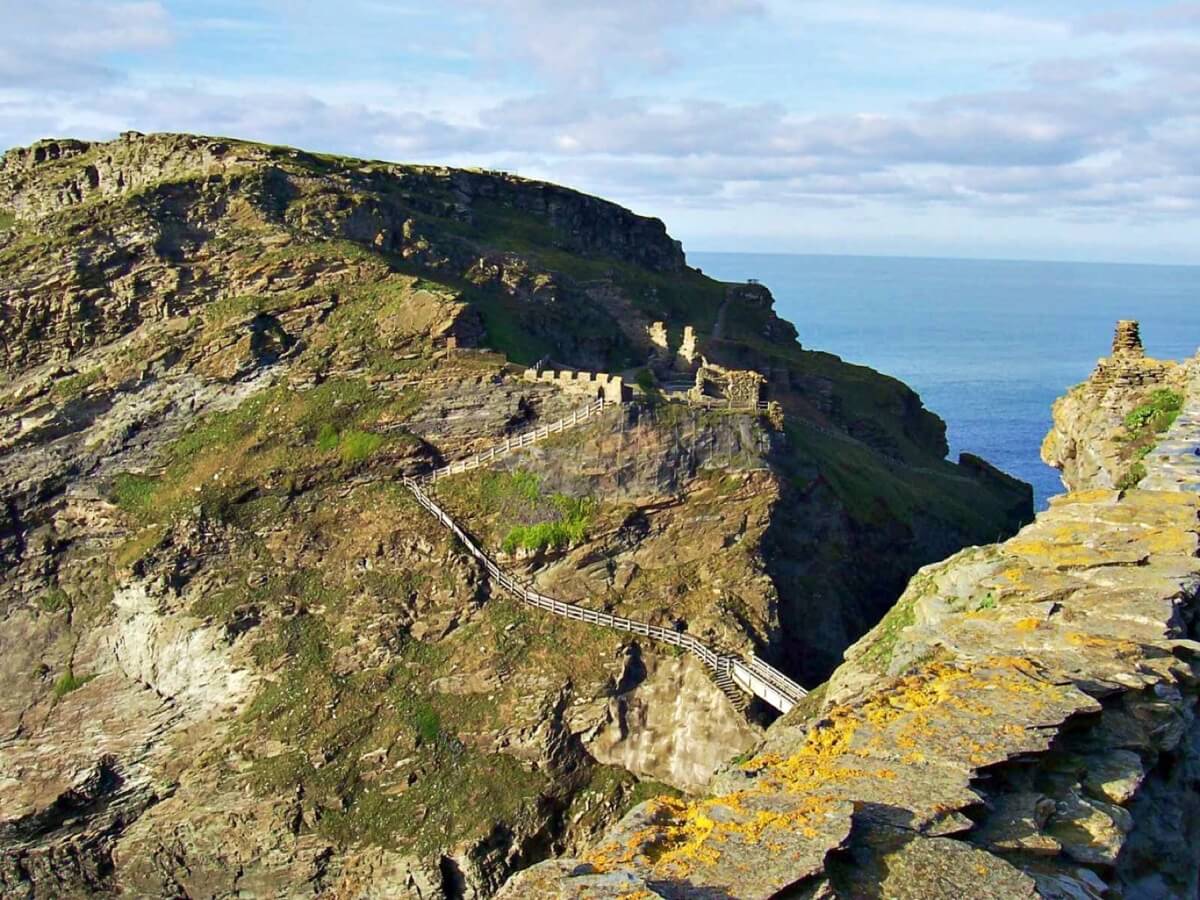
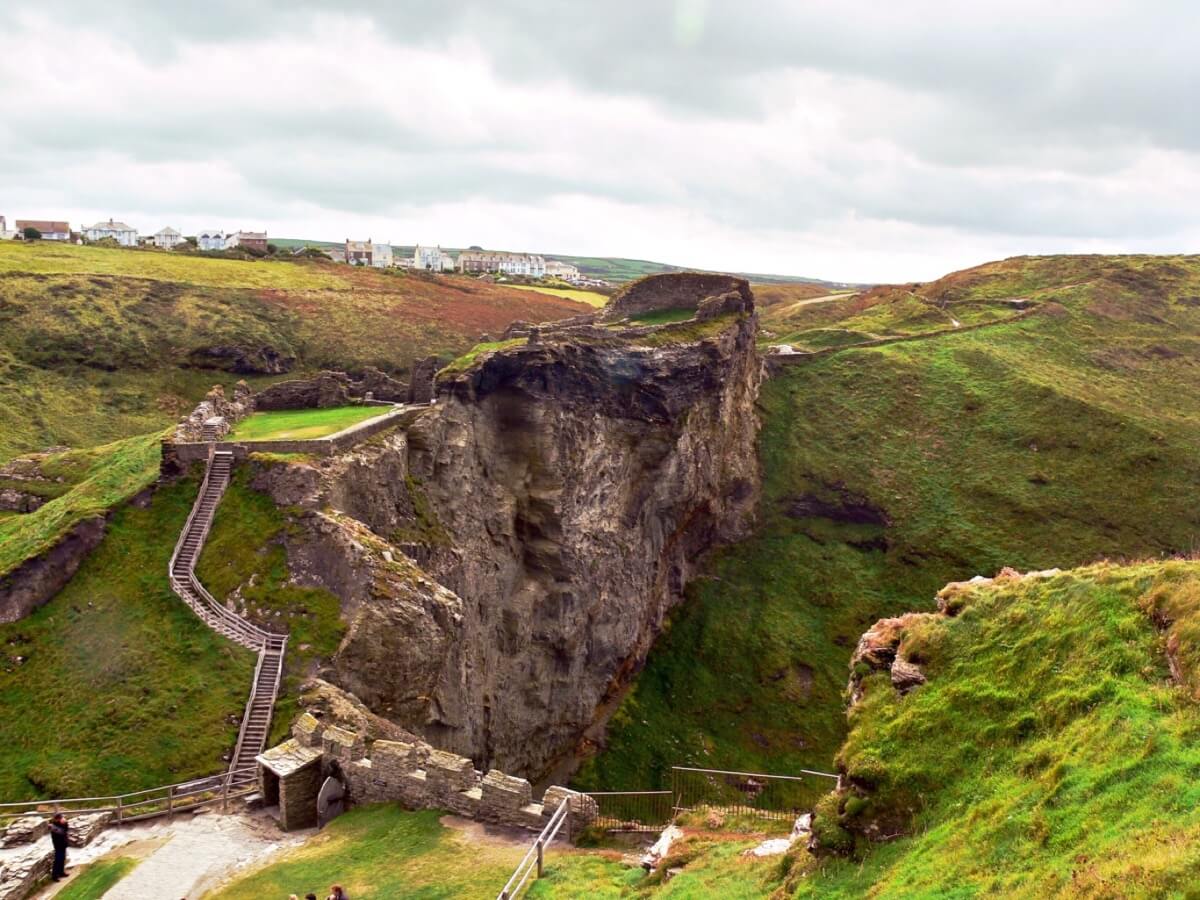
Tintagel Castle (Cornish: Dintagel, meaning "fort of the constriction") is a medieval fortification located on the peninsula of Tintagel Island adjacent to the village of Tintagel, North Cornwall in the United Kingdom
Previous names
Tintagel Castle
Description
Tintagel Castle (Cornish: Dintagel, meaning "fort of the constriction") is a medieval fortification located on the peninsula of Tintagel Island adjacent to the village of Tintagel, North Cornwall in the United Kingdom. The site was possibly occupied in the Romano-British period, as an array of artefacts dating to this period have been found on the peninsula, but as yet no Roman era structure has been proven to have existed there. It was settled during the Early Medieval period, when it was probably one of the seasonal residences of the regional king of Dumnonia. A castle was built on the site by Richard, 1st Earl of Cornwall in the 13th century, during the Later Medieval period. It later fell into disrepair and ruin.
Archaeological investigation into the site began in the 19th century as it became a tourist attraction, with visitors coming to see the ruins of Richard's castle. In the 1930s, excavations revealed significant traces of a much earlier high status settlement, which had trading links with the Mediterranean during the Late Roman period.
The castle has a long association with legends related to King Arthur. This began in the 12th century when Geoffrey of Monmouth described Tintagel as the place of Arthur's conception in his fictionalized account of British history, the Historia Regum Britanniae. Geoffrey told the story that Arthur's father, King Uther Pendragon, was disguised by Merlin's sorcery to look like Gorlois, Duke of Cornwall, the husband of Igraine, Arthur's mother.
Tintagel Castle has been a tourist destination since the mid-19th century. Owned by Charles, Prince of Wales as part of the landholdings of the Duchy of Cornwall, the site is managed by English Heritage.
Arthurian legends
The castle has a long association with the Arthurian legends, being first associated with King Arthur by Welshman Geoffrey of Monmouth in his book the Historia Regum Britanniae ("History of the Kings of Britain'"), written circa 1135–38, which includes a detailed account of the legend. According to Geoffrey and the legend, Arthur's father was Uther Pendragon, the king of all Britain. He goes to war against Gorlois, the Duke of Cornwall, to capture Gorlois' wife Igraine, with whom Uther has fallen in love. Gorlois defends himself against Uther's armies at his fort of Dimilioc, but he sends Igraine to stay safely within Tintagel Castle which is his most secure refuge, according to the legend and the Historia Regum Britanniae. Uther besieges Dimilioc, telling his friend Ulfin how he loves Igraine, but Ulfin replies that it would be impossible to take Tintagel, for "it is right by the sea, and surrounded by the sea on all sides; and there is no other way into it, except that provided by a narrow rocky passage—and there, three armed warriors could forbid all entry, even if you took up your stand with the whole of Britain behind you." Geoffrey of Monmouth's story goes on to explain how the wizard Merlin is summoned and magically changes Uther's appearance to that of Gorlois to help get them into Tintagel Castle, while also changing his own and Ulfin's appearances to those of two of Gorlois's companions. Disguised thus, they are able to enter Tintagel where Uther goes to Igraine, and "in that night was the most famous of men, Arthur, conceived."
Geoffrey's History mentions Tintagel Castle as the site of Arthur's conception, but "it nowhere claims that Arthur was born at Tintagel, or that he ever visited the place in later life, or that in any sense the stronghold became his property when he was king." However, the legend and the book continued to become hugely popular, spreading across Britain in the Late Medieval period, when more Arthurian texts were produced, many of them continuing to propagate the idea that Arthur himself was actually born at Tintagel. There is now a footpath from the site to Cadbury Castle in Somerset called Arthur's Way.
However, many continue to argue against these legends. For example, archaeologist C.A. Ralegh Radford refused to believe in the legend and all of the associations, declaring in 1935 that "no concrete evidence whatsoever has yet been found to support the legendary connection of the Castle with King Arthur". Charles Thomas, a specialist in Cornish history, was unable to find solid links, mainly due to the fact that legends and stories would have been handed down only verbally during this period. Thomas stated in 1993 that "there simply is no independently attested connection in early Cornish folklore locating Arthur, at any age or in any capacity, at Tintagel." Many others disagree, maintaining that the legendary figure would essentially have been an Early Medieval British leader, involved in fighting the migrating Anglo-Saxons who were settling in Britain at that time. A stone was found at Tintagel bearing the inscription PATERN[--] COLI AVI FICIT ARTOGNOU , and it has been claimed by some to provide evidence for a historical Arthur, but most historians reject this view.
Tintagel is used as a locus for the Arthurian mythos by the poet Alfred, Lord Tennyson in the poem Idylls of the King.
Algernon Charles Swinburne's Tristram of Lyonesse is a literary version of the Tristan and Iseult legend in which some events are set at Tintagel. Thomas Hardy's The Famous Tragedy of the Queen of Cornwall at Tintagel in Lyonnesse, a one-act play which was published in 1923, is another version of the same legend with events set at Tintagel (the book includes an imaginary drawing of Tintagel Castle at the period).
Excavations
In the 1930s, it was decided to begin a major archaeological excavation at the site, and so HM Office of Works employed Devon archaeologist Courtenay Arthur Ralegh Radford (1900–1999) to work as site director. He had been employed as the Inspector of Ancient Monuments in Wales and Monmouthshire from 1929 and 1934, and from 1936 was Director of the British School at Rome. Excavation began in 1933, and in 1935 Ralegh Radford wrote an interim report and a guidebook entitled Tintagel Castle, published by H. M. Stationery Office. The excavators employed former quarry workers (the last Tintagel cliff quarry was closed in 1937) who worked under a trained foreman. They were instructed to clear the land on the Island, following and exposing any walling that they came across and keeping any finds. Excavation was forced to cease in 1939 due to the outbreak of the Second World War. Radford was required to take part in the war effort abroad, and many of the original site reports were destroyed when his house in Exeter was bombed by the Luftwaffe during the conflict.
In the mid-1980s, a fire on Tintagel Island led to considerable erosion of the topsoil, and many more building foundations could be seen than those recorded by Ralegh Radford. In 1998, the "Artognou stone", a slate stone bearing an incised inscription in Latin, was discovered on the island, demonstrating that Latin literacy survived in this region after the collapse of Roman Britain.
Excavations during the summer of 2016 found the remains of various Dark Ages structures including well-constructed buildings of relatively large size dated to the 5th & 6th centuries, with pottery and glass finds indicating that the people who lived at Tintagel were of an elite status, drinking wine imported from the eastern Mediterranean and using food vessels from North Africa and Gaul.
Useful information
No parking on site. Pay and display parking (not operated by English Heritage) in the village, 600 metres away.
http://www.english-heritage.org.uk/visit/places/tintagel-castle/prices-and-opening-times
http://www.english-heritage.org.uk/visit/places/tintagel-castle/prices-and-opening-times
http://www.english-heritage.org.uk/visit/places/tintagel-castle/prices-and-opening-times
External links