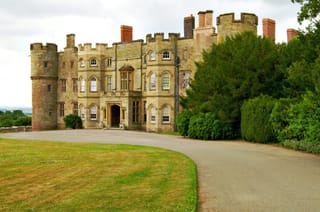
Ludlow Castle
Shropshire England England
castle, chateau
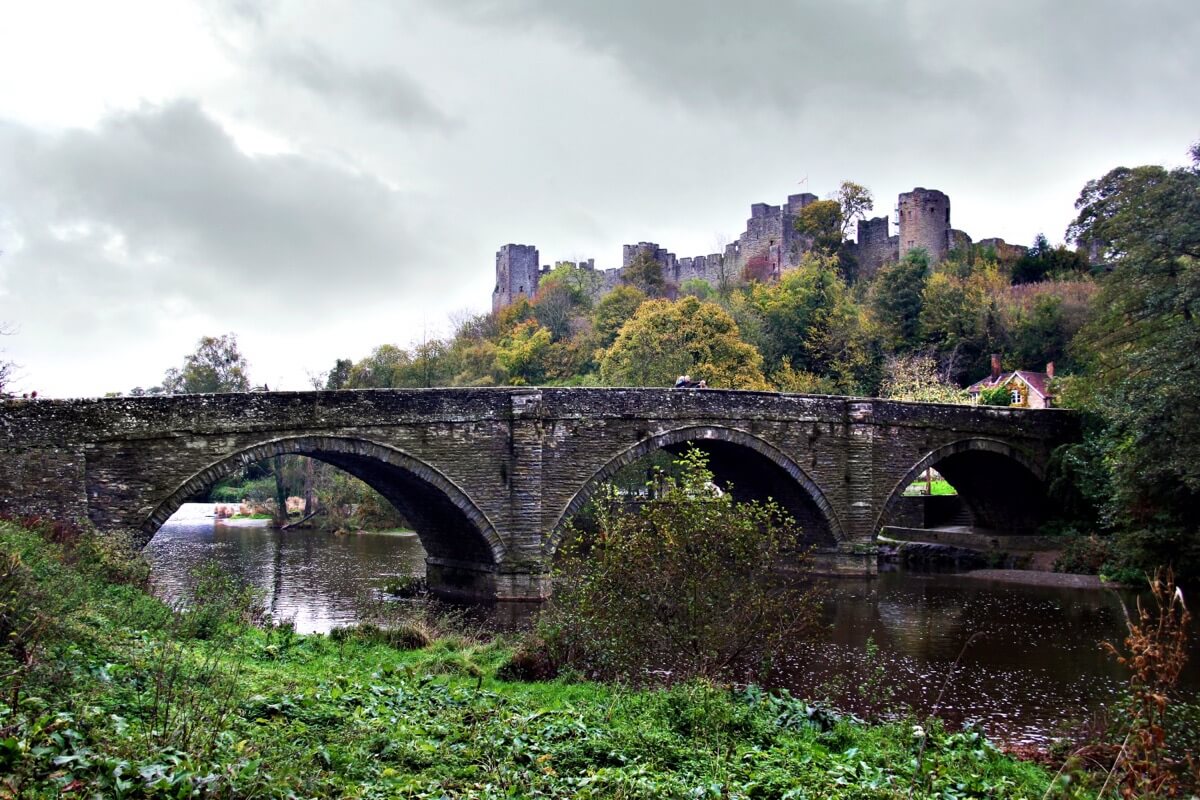
Ludlow Castle is a ruined medieval fortification in the town of the same name in the English county of Shropshire, standing on a promontory overlooking the River Teme
Previous names
Ludlow Castle
Description
Ludlow Castle is a ruined medieval fortification in the town of the same name in the English county of Shropshire, standing on a promontory overlooking the River Teme. The castle was probably founded by Walter de Lacy after the Norman conquest and was one of the first stone castles to be built in England. During the civil war of the 12th century the castle changed hands several times between the de Lacys and rival claimants, and was further fortified with a Great Tower and a large outer bailey. In the mid-13th century, Ludlow was passed on to Geoffrey de Geneville who rebuilt part of the inner bailey, and the castle played a part in the Second Barons' War. Roger Mortimer acquired the castle in 1301, further extending the internal complex of buildings, and the Mortimer family went on to hold Ludlow for over a century.
Richard, the Duke of York, inherited the castle in 1425, and it became an important symbol of Yorkist authority during the Wars of the Roses. When Richard's son, Edward IV, seized the throne in 1461 it passed into the ownership of the Crown. Ludlow Castle was chosen as the seat of the Council in the Marches of Wales, effectively acting as the capital of Wales, and it was extensively renovated throughout the 16th century. By the 17th century the castle was luxuriously appointed, hosting cultural events such as the first performance of John Milton's masque Comus. Ludlow Castle was held by the Royalists during the English Civil War of the 1640s, until it was besieged and taken by a Parliamentarian army in 1646. The contents of the castle were sold off and a garrison was retained there for much of the interregnum.
With the Restoration of 1660, the Council was reestablished and the castle repaired, but Ludlow never recovered from the civil war years and when the Council was finally abolished in 1689 it fell into neglect. Henry Herbert, the Earl of Powis, leased the property from the Crown in 1772, extensively landscaping the ruins, and his brother-in-law, Edward Clive, bought the castle outright in 1811. A mansion was constructed in the outer bailey but the remainder of the castle was left largely untouched, attracting an increasing number of visitors and becoming a popular location for artists. After 1900, Ludlow Castle was cleared of vegetation and over the course of the century it was extensively repaired by the Powis Estate and government bodies. In the 21st century it is still owned by the Earl of Powis and operated as a tourist attraction.
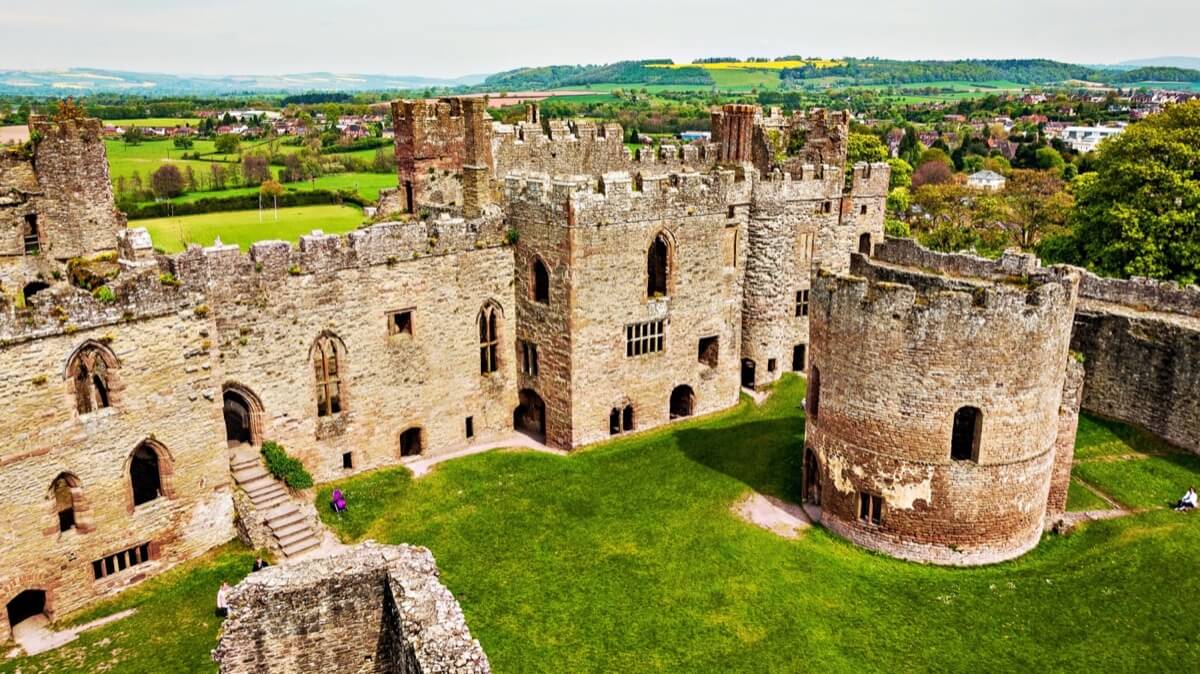
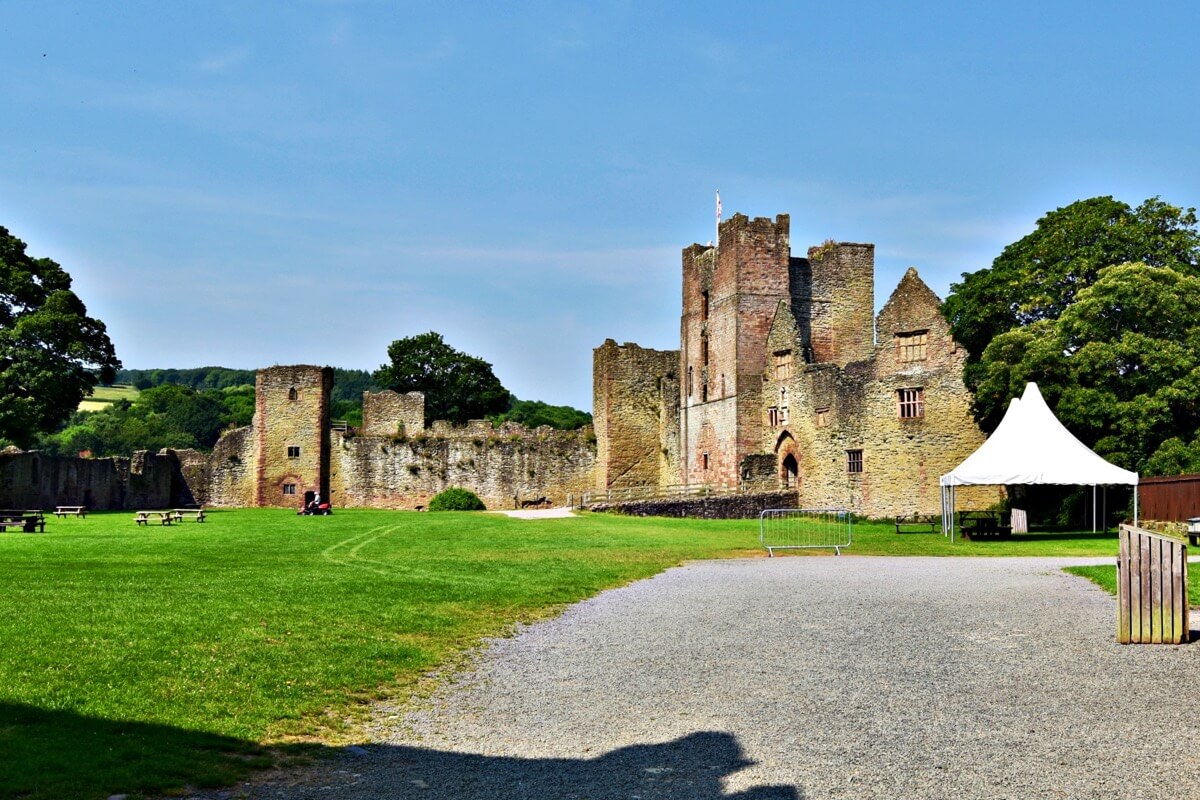
The architecture of Ludlow reflects its long history, retaining a blend of several styles of building. The castle is approximately 500 by 435 feet (152 by 133 m) in size, covering almost 5 acres (2.0 ha). The outer bailey includes the Castle House building, now used by the Powis Estate as offices and accommodation, while the inner bailey, separated by a trench cut out of the stone, houses the Great Tower, Solar block, Great Hall and Great Chamber block, along with later 16th century additions, as well as a rare, circular chapel, modelled on the shrine in the Church of the Holy Sepulchre. English Heritage notes that the ruins represent "a remarkably complete multi-phase complex" and considers Ludlow to be "one of England's finest castle sites".
Architecture
Ludlow Castle sits on a rocky promontory, overlooking the modern town of Ludlow on lower ground to the east, while the ground slopes steeply from the castle to the rivers Corve and Teme to the south and west, about 100 feet (30 m) below. The castle is broadly rectangular in shape, and approximately 500 by 435 feet (152 by 133 m) in size, covering almost 5 acres (2.0 ha) in total. The interior is divided into two main parts: an inner bailey which occupies the north-west corner and a much larger outer bailey. A third enclosure, known as the innermost bailey, was created in the early 13th century when walls were built to enclose the south-west corner of the inner ward. The castle's walls are linked to Ludlow's medieval town wall circuit on the south and east sides. The castle is built from a range of different types of stone; the Norman stone work is constructed from greenish-grey siltstone rubble, with the ashlar and quoin features carved from red sandstone, with the later work primarily using local red sandstone.
Outer bailey
The outer bailey is entered through a gatehouse; inside, the space within the curtain walls is divided into two. On the north side of the outer bailey is Castle House and its gardens; the house is a two-storeyed property, based around the old walls of the tennis court and the Castle Inn, and the curtain wall. The north end of Castle House butts onto Beacon Tower, overlooking the town.
The other half of the outer bailey houses the 16th-century porter's lodge, prison and stable block which run along its eastern edge. The porter's lodge and prison comprise two buildings, 40 feet (12 m) and 58 by 23 feet (17.7 by 7.0 m) across, both two-storeyed and well built in ashlar stone, with a stable block on the far end, more crudely built in stone and 66 by 21 feet (20.1 by 6.4 m) in size. The exterior of the prison was originally decorated with the coats of arms of Henry, the Earl of Pembroke, and Queen Elizabeth I, but these have since been destroyed, as have the barred windows which once protected the property.
Along the south of the bailey are the remains of St Peter's, a former 14th-century chapel, approximately 21 by 52 feet (6.4 by 15.8 m) in size, later converted to a courthouse by the addition of an extension reaching up to the western curtain wall. The courtroom occupied the whole of the combined first floor with records kept in the rooms underneath. The south-west corner of the outer bailey is cut off by a modern wall from the rest of the bailey.
The western curtain wall is approximately 6-foot-5-inch (1.96 m) thick, and guarded by the 13th-century Mortimer's Tower, 18 feet (5.5 m) across externally, with a ground floor vaulted chamber inside, 12-foot-9.5-inch (3.899 m) large. When first built, Mortimer's Tower was a three-storey gateway with an unusual D-shaped design, possibly similar to those at Trim Castle in Ireland, but in the 15th century the entrance way was blocked up to turn it into a conventional mural tower, and in the 16th century an additional internal floor was inserted. The tower is now roofless, although it was roofed as late as the end of the 19th century.
Inner bailey
The inner bailey represents the extent of the original Norman castle and is protected by a curtain wall between 5-foot (1.5 m) and 6-foot (1.8 m) thick. On the south and west sides the wall is protected by a ditch, originally up to 80-foot (24 m) deep, cut out of the rock and navigated by a bridge which still contains part of the ashlar stone of its 16th century predecessor. Within the inner bailey, a separate area, called the innermost bailey, was created by the addition of a 5-foot (1.5 m) thick stone wall around the south-west corner in the early 13th century.
The gatehouse to the inner bailey has the coats of arms of Sir Henry Sidney and Queen Elizabeth I displayed over it, dating to 1581, and was originally a three-storeyed building with transomed windows and fireplaces, probably used as the lodgings for the judges. There were probably additional heraldic supporters displayed alongside the arms, since lost. A porter's lodge would have been on the right hand side of the entrance to control access, with the rooms accessed by a spiral staircase in a protruding tower, with prominent triple chimneys, since lost.Alongside the gatehouse was originally a half-timbered building, possibly a laundry, approximately 48 by 15 feet (14.6 by 4.6 m), which has since been lost.
On the east side of the bailey is the 12th-century chapel of Saint Mary Magdalene. The circular, Romanesque design of the chapel is unusual, with only three similar examples existing in England, at Castle Rising, Hereford and Pevensey. Built from sandstone, the circular design imitates the shrine at the Church of the Holy Sepulchre. Originally the chapel had a nave, a square presbytery, 3.8 by 3.8 metres (12 by 12 ft) in size, and a chancel, but this design was heavily altered in the 16th century and only the nave survives. Although roofless, the nave survives to its full height and is 26 feet 3 inches (8.00 m) in diameter, visibly divided into two sections by different bands of stonework, and with some plaster surviving on the lower level. Around the inside of the nave are 14 arcaded bays in the walls.
The north end of the bailey is occupied by a range of buildings, the Solar block, the Great Hall and the Great Chamber block, with the Tudor Lodgings in the north-east corner. The Tudor Lodgings take the form of two rhomboids to fit into the space provided by the curtain wall, divided by a cross-wall, the west side being approximately 33 by 15 feet (10.1 by 4.6 m), and the east side 33 by 21 feet (10.1 by 6.4 m). They were entered by a shared spiral staircase, a design used in various episcopal palaces in the 16th century, and originally provided sets of individual offices and personal rooms for the court officials, later being converted into two distinct apartments.
The Great Chamber block adjoining the Tudor Lodgings dates from around 1320. Another rhomboid design, approximately 53 by 34 feet (16 by 10 m) across, this originally had its main chamber on the first floor, but has been much altered over the subsequent years. The carved corbel heads that survive on the first floor may represent Edward II and Queen Isabella. Behind the Great Chamber block is the Guardrobe Tower, a four storeyed construction, providing a combination of bed chambers and guardrobes.
In the 13th-century Great Hall, the hall itself was also positioned on the first floor, originally fitted with a wooden floor supported by stone pillars in the basement, and a massive wooden roof. It was 60 by 30 feet (18.3 by 9.1 m) across: this 2:1 ratio between length and width was typical for castle halls of this period. The hall was reached by a flight of stone steps at the west end, and lit by three tall, trefoiled windows, each originally with its own window seat and south-facing to receive the sunlight. Originally the hall had an open fire in the centre, which was normal for the 13th century, but the middle window was turned into a more modern fireplace around 1580.
To the west of the Great Hall is the three-storeyed Solar block, an irregular oblong measuring up to 26 by 39 feet (7.9 by 11.9 m) in size. The first floor chamber would probably have been used as a solar, with the cellar being used as a service area. The Great Hall and Solar block were built at the same time in the 13th century, the builders carving out the inside of the old Norman tower behind them in the process.They were probably built in two phases and were originally intended to be smaller, less grand buildings, only for the design to be changed about halfway through construction; they were finished in a rushed manner, the traces of which can still be seen, along with other changes made in the 16th and 17th centuries.
The North-West and North-East towers behind the northern range are Norman in origin, from the 11th and early 12th century. When first built, they were created by pushing or folding the line of the curtain wall outwards to create the desired external shape, and then adding timber floors and a timber wall at the back, rather than being designed as individual buildings. The timber parts of the towers were later replaced in stone, and incorporated into the later range of buildings. The North-East Tower, also known as the Pendover Tower, was originally two-storeys high, with a third floor added on in the 14th century, followed by an extensive remodelling of the inside in the 16th century. It has chamfered angles on the external corners to make it harder to attack the stonework, although this has weakened the structural strength of the tower as a whole. The North-West Tower had similar chamfered corners, but the Closet Tower was built alongside it in the 13th century, altering the external appearance. Two more Norman towers survive in the innermost bailey, the West Tower, also known as the Postern Tower, because it contained a postern gate, and the South-West tower, also called the Oven Tower, on account of its cooking facilities. The Norman towers looked out towards Wales, probably to make a symbolic statement.
A range, now lost, once stretched from the innermost bailey towards the Great Hall, including a large stone house running along the curtain wall, 54 by 20 feet (16.5 by 6.1 m) in size, and on the other side of the innermost bailey, the Great Kitchen, 31 by 23 feet (9.4 by 7.0 m) in size, built around the same time as the Great Hall, and an oven building, since lost, 21 by 27 feet (6.4 by 8.2 m).
The Great Tower, or keep, is on the south side of the innermost bailey. A roughly square building, four storeys tall, most of its walls are 8-foot-6-inch (2.59 m) thick, with the exception of its newer northern facing wall, only 7-foot-6-inch (2.29 m) thick. The Great Tower was constructed in several stages. Originally it was a relatively large gatehouse in the original Norman castle, probably with accommodation over the gateway, before being extended to form the Great Tower in the mid-12th century, although still being used as a gatehouse for the inner bailey. When the innermost bailey was created in the early 13th century, the gateway was then filled in and a new gateway cut into the inner bailey wall just to the east of the Great Tower. Finally, the north side of the tower was rebuilt in the mid-15th century to produce the Great Tower that appears today. The keep has a vaulted basement, 20-foot (6.1 m) high, with Norman wall arcading, and a row of windows along the first floor, since mostly blocked. The arcading echoes that in the chapel, and probably dates from around 1080. The windows and large entrance-way would have looked impressive, but would also have been very hard to defend; this form of tower probably reflected earlier Anglo-Saxon high-status towers and was intended to display lordship. The first floor originally formed a tall hall, 29 by 17 feet (8.8 by 5.2 m) across, which was subsequently subdivided into two separate floors.
Useful information
No parking
info@ludlowcastle.com
Ruined
External links
Nearby castles