Longford Castle
Salisbury England England
castle, chateau
Longford Castle is located on the banks of the River Avon south of Salisbury, Wiltshire, England
Previous names
Longford Castle
Description
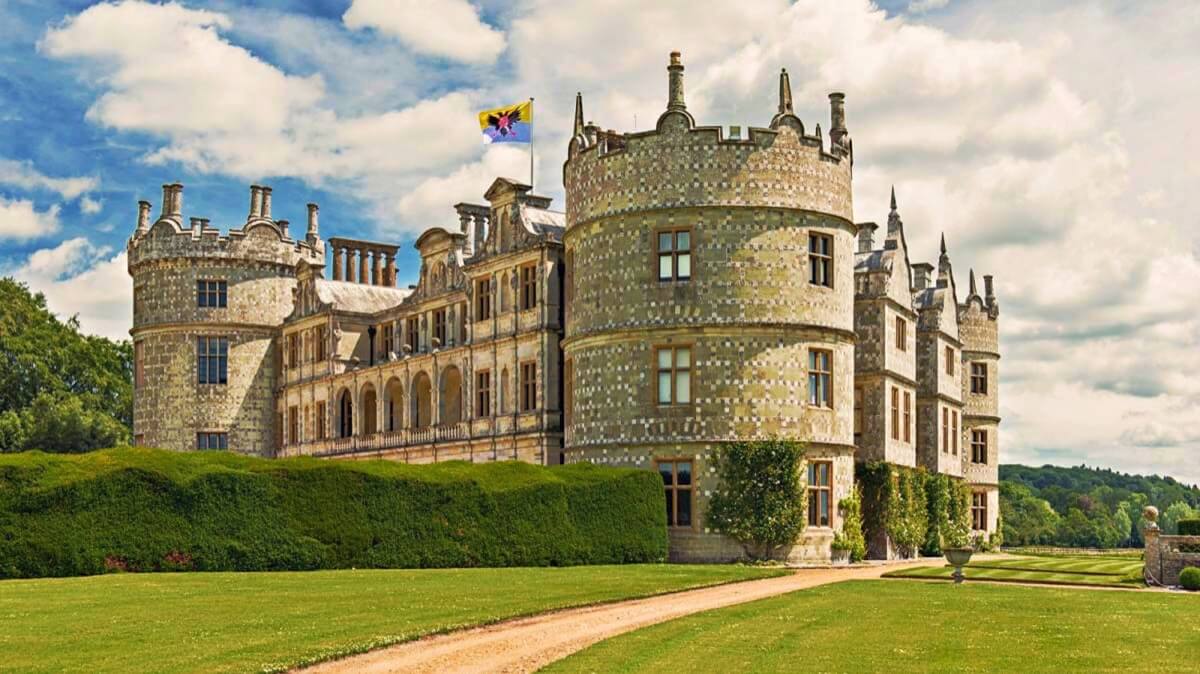
Longford Castle is located on the banks of the River Avon south of Salisbury, Wiltshire, England. It is the seat of the Earl of Radnor, and an example of the Elizabethan prodigy house.
In 1573 Thomas Gorges acquired the manor (at the time written "Langford"), which was originally owned by the Servington (or Cervington) family. Prior to this the existing mansion house had been damaged by fire. In c.1576 Thomas Gorges married Helena Snakenborg, the Swedish born dowager Marchioness of Northampton and Lady-in-waiting to Queen Elizabeth. They rebuilt the Longford property as a triangular Swedish pattern castle on the banks of the River Avon. The building work became very expensive due to problems with the subsoil. Sir Thomas Gorges, who was now governor of Hurst Castle, persuaded his wife to beg of the Queen a shipwreck he knew from the defeated Spanish Armada. The gift was granted and the gold and silver retrieved from the shipwreck funded the completion of the castle under the final supervision of John Thorpe in 1591. The family lived in the castle for several years before its final completion.
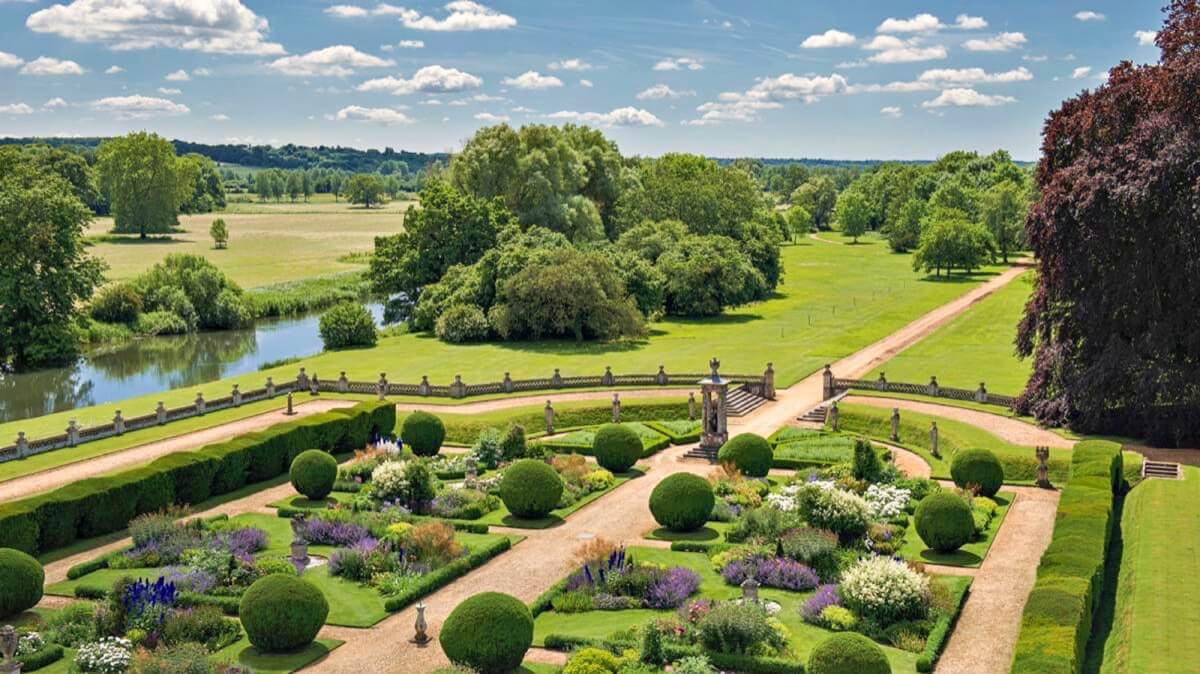
The main building had several floors and was triangular with a round tower in each corner; the three towers representing the Father, the Son and the Holy Ghost. There was a chapel, kitchen department, several boudoirs and sitting rooms, as well as bedrooms. Fresh cold water was pumped to various floors and there were water closets operating with rainwater. A park, fruit garden and kitchen garden were attached.
In 1717 Longford Castle became the Bouverie home, purchased by Sir Edward des Bouverie from the Coleraines. It is said that Sir Edward saw and fell in love with the castle in the valley as he rode past, having enough money in his saddle bags to effect the purchase there and then. Subsequent generations of the family beautified the interior of the castle and surrounding park. However, Jacob, 2nd Earl of Radnor (1749-1828), employed James Wyatt to change Longford from a reasonably modest chateau into a hexagonal palace "to the despair of future generations". He destroyed one of the Elizabethan towers and replaced it with a larger one of his own design, added two more towers and linked each to each other. The palace concept was not finished. It was Jacob, 4th Earl of Radnor (1815-1889), who oversaw the last significant changes to the castle architecture, undertaken by Anthony Salvin. These included the formation of a second courtyard, the doming over of the central courtyard and the addition of a square tower that can be seen in the aerial photograph.
The castle is Grade I listed
It is currently the seat of William Pleydell-Bouverie, 9th Earl of Radnor, and is open to the public for pre-booked tours on 28 days of each year.
The Family
Longford Castle has been the residence of one family for almost 300 years.
The Huguenot, Laurens Des Bouverie, having fled from religious persecution during the Reformation, settled in London and became a prosperous silk merchant. His enterprising descendants became wealthy landowners in England. The family was ennobled in 1747 with Sir Jacob Des Bouverie becoming First Viscount Folkestone while his son, William, was created an Earl in 1765. Longford has continued to be home to the Earls of Radnor ever since.
The Castle
Longford was originally built in the late 16th century to an unusual triangular plan. Then, in the 18th century, the second Earl of Radnor, employed the architect James Wyatt to transform it into a hexagonal palace. Abandoned part way through this project, it was left to the fourth Earl of Radnor and Victorian architect Anthony Salvin to complete Longford.
The Collection
The Longford Castle collection, formed by successive generations of the family, is one of the finest in the United Kingdom. It includes paintings by van Dyck, Claude, Teniers and Hals, together with British pictures by Reynolds and Gainsborough, as well as oriental porcelain, Brussels tapestries, and exceptional 18th century English and continental furniture.
Longford Castle and the National Gallery
The collection at Longford has had a long association with the National Gallery. Some very great pictures from Longford Castle are on loan to the National Gallery in London: Holbein’s ‘Erasmus’; Sebastiano del Piombo’s majestic ‘Portrait of a Lady’ and Jan de Beer’s triptych of ‘The Virgin and Child with Saints’. In addition, some of the finest paintings belonging to the National Gallery came from this collection – notably, Holbein’s Ambassadors and Poussin’s Adoration of the Golden Calf . Studying the history of collections of this kind is a major theme in the National Gallery's programme of research.
By helping to organise visits to the Castle the National Gallery is delighted to support the Longford Estate in measures taken to preserve major works in the settings created for them.
We wish you a most enjoyable and memorable visit to Longford Castle.
https://www.nationalgallery.org.uk
Useful information
Parking at The Radnor Arms.
sitours@longford.org.uk
- Photographs are permitted in the gardens only
- Food, drink, and smoking is not permitted in the house
External links