Launceston Castle
Cornwall England England
castle, chateau
Launceston Castle is located in the town of Launceston, Cornwall, England
Previous names
Launceston Castle
Description
Launceston Castle is located in the town of Launceston, Cornwall, England. It was probably built by Robert the Count of Mortain after 1068, and initially comprised an earthwork and timber castle with a large motte in one corner. Launceston Castle formed the administrative centre of the new earldom of Cornwall, with a large community packed within the walls of its bailey. It was rebuilt in stone in the 12th century and then substantially redeveloped by Richard of Cornwall after 1227, including a high tower to enable visitors to view his surrounding lands. When Richard's son, Edmund, inherited the castle, he moved the earldom's administration to Lostwithiel, triggering the castle's decline. By 1337, the castle was increasingly ruinous and used primarily as a gaol and to host judicial assizes.
The castle was captured by the rebels during the Prayer Book Rebellion of 1549, and was garrisoned by the Royalists during the English Civil War in the 17th century. Towards the end of the civil war it was stripped for its building materials and rendered largely uninhabitable. A small gaol was erected in the centre of the bailey, which was also used for executions. The castle eventually became the county gaol for Cornwall, but was heavily criticised for its poor facilities and treatment of inmates. By 1842, the remaining prisoners had been moved to Bodmin Gaol and the site was closed, the castle being landscaped to form a park by the Duke of Northumberland. During the Second World War, the site was used to host United States Army soldiers and, later, by the Air Ministry for offices. The ministry left the castle in 1956 and the site was reopened to visitors.
In the 21st century, Launceston is owned by the duchy of Cornwall and operated by English Heritage as a tourist attraction. Much of the castle defences remain, including the motte, keep and high tower which overlook the castle's former deer park to the south. The gatehouses and some of the curtain wall have survived, and archaeologists have uncovered the foundations of various buildings in the bailey, including the great hall.
Architecture
Launceston Castle is built on a ridge that slopes from the east down to its west, where it meets a sharp incline. To the north, the ground drops away to the River Kensey. The castle comprises a curtain wall enclosing a bailey, with the remains of a north and south gatehouse. The inside of the bailey, 110 by 120 metres (360 by 390 ft) across, contains the foundations of various buildings, including the castle's great hall. In the north-east corner is a motte, topped by a keep and the high tower. The majority of the fortifications are built from shale stone, with the detailing carried out in granite and Polyphant stone.
The castle is now entered through the 13th-century southern gatehouse, which faces towards the former deer park. This entrance was once protected by a 14th-century fortified bridge, also called a barbican, but only one set of stone arches remain, showing two surviving arrow slits in arched recesses. The south gatehouse has two drum towers on either side of a gateway, protected by a portcullis, and would have had three floors, linked to a wall walk around the castle. It would originally have been faced with dressed stonework, which has since been removed. The north gatehouse on the opposite site of the bailey originally led into the town of Launceston. The first floor of the building was probably first used as the porter's room, then by the castle's constable, and finally later as a prison.
The rectangular bailey forms a courtyard, the level part of which is called the Castle Green. When first built, the bailey was protected by earth ramparts, until a later stone curtain wall was built around it, protected by at least three mural towers, the foundations of some of which still survive. Much of the wall, including the south-eastern tower–called the Watch or Witch Tower–has been destroyed, although around a stretch 50 metres (160 ft) long survives on the south-west side. The foundations of various, mostly 13th-century buildings excavated during the 20th century can be seen within the bailey, including the great hall, 22 by 7 metres (72 by 23 ft) across; a long narrow hall, possibly used as a courtroom; and a large kitchen. A Victorian cottage is positioned by the south gatehouse, probably on the site of the earl's hall and chamber[79]
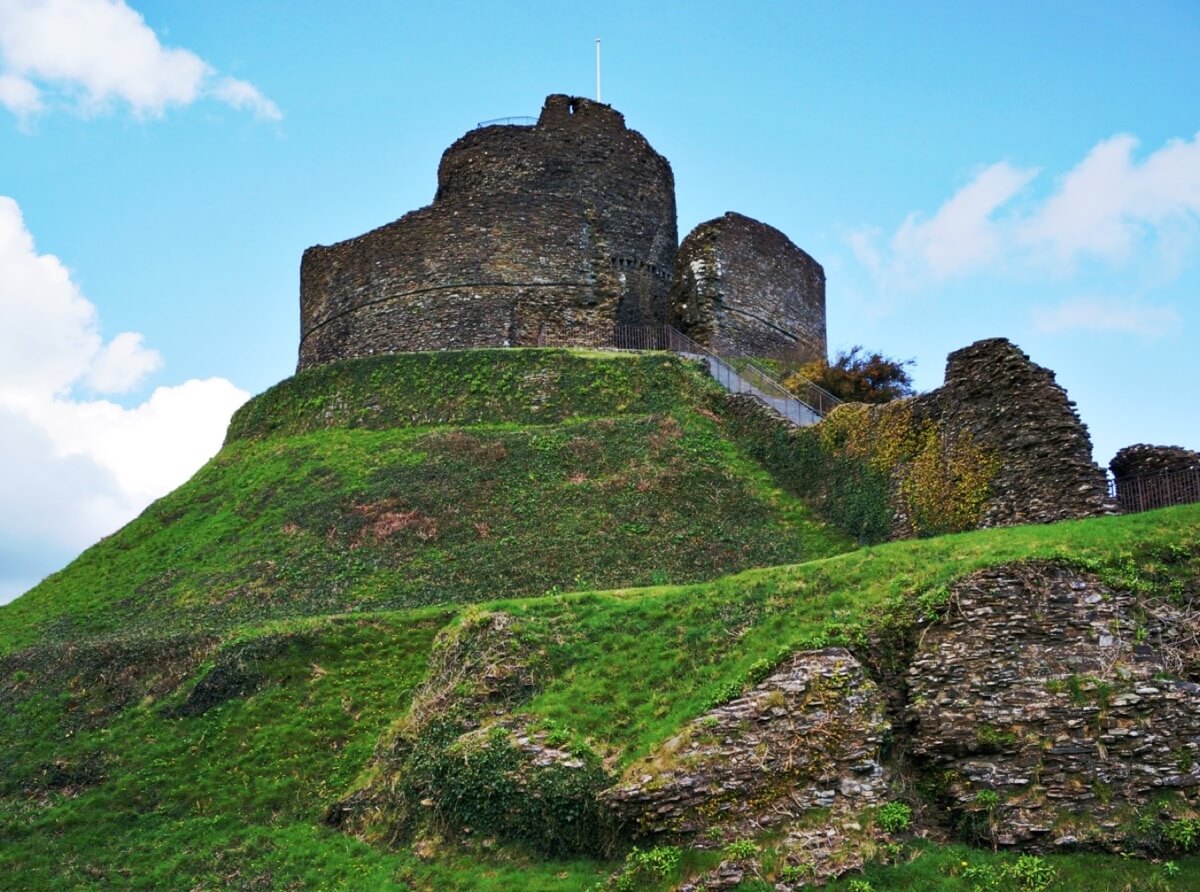
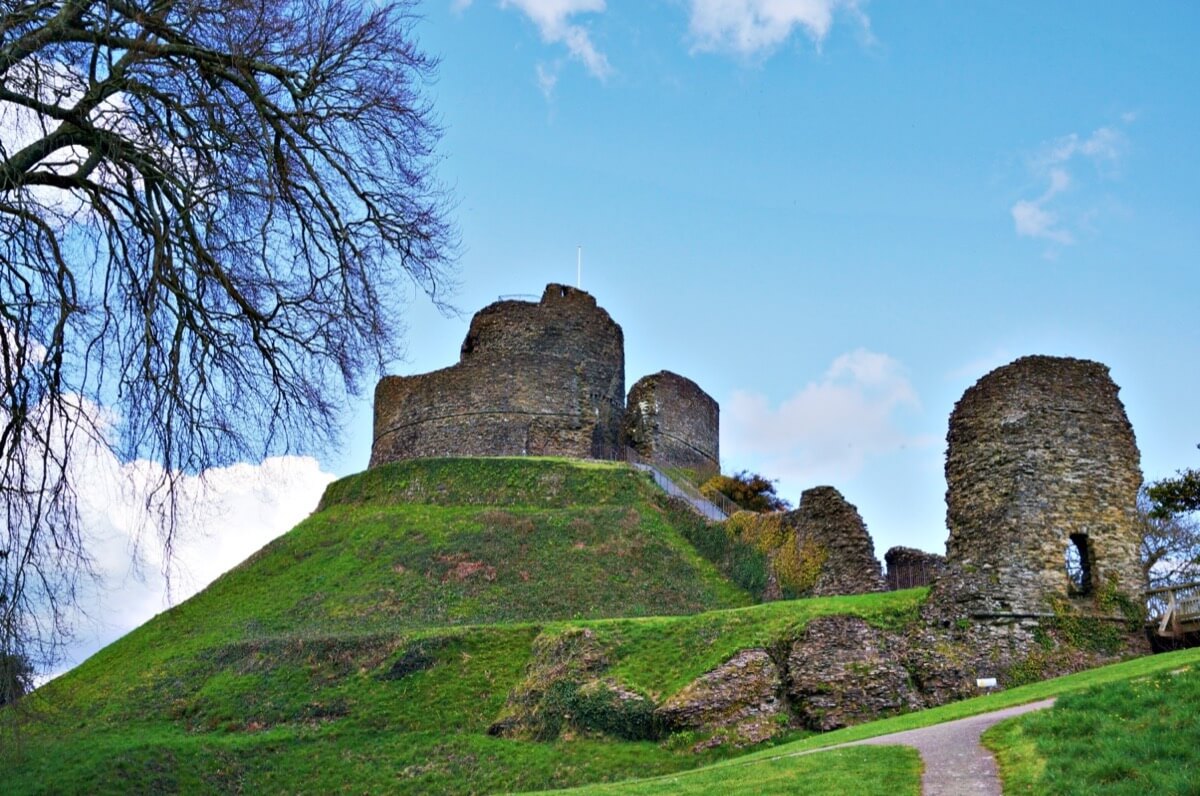
The castle motte was built up in several stages, originally being lower in height than today, before being built up during the medieval period and scarped by cutting away at the surrounding stone. It was then reinforced in 1700 with the addition of clay, before having large quantities of earth dumped on it in the late 18th century, and then being terraced in the mid-19th century. The motte is separated from the bailey by a ditch, now crossed by a modern bridge. In the 13th century this point was protected by a D-shaped tower, which still survives, located to one side of the gateway. The causeway steps up to the top of the mound were originally a roofed, stone corridor. There are the foundations of the castle well on the west side of the causeway.
A circular shell keep, 26 metres (85 ft) across, was constructed on the motte in the 12th century, complete with a gateway; that was later replaced, and the current entrance dates from the 13th century. Rising up through the keep is the 13th-century high tower, 12 metres (39 ft) in diameter, constructed from dark shale. This replaced any internal rooms that the shell keep might have had, instead creating a small, cramped and unlit chamber at the base of the keep. The upper chamber of the high tower was fitted with a large window and a fireplace, overlooking the deer park, and the historian Oliver Creighton suggests the tower was intended to be used a "private grandstand", with the parapet below being used for other forms of "lordly display" over the local community. The tower now leans slightly.
The keep appears to lie on the highest ground in the area, although this is actually located to the south, within in the deer park. Visitors would have been funnelled around the edge of the park and by the town wall towards the south gate of the castle, a route dominated by the views of the keep and tower. The addition of the high tower had made the castle visible to anyone entering from Devon, framing it strikingly against the hills. The keep, park and town walls probably symbolised Richard's authority as earl, and the historian Andrew Saunders has argued that the keep and high tower were also intended to resemble Richard of Cornwall's crown in his role as the King of the Romans.
Useful information
No parking on site, pay and display car park opposite the entrance.
http://www.english-heritage.org.uk/visit/places/launceston-castle/prices-and-opening-times
http://www.english-heritage.org.uk/visit/places/launceston-castle/prices-and-opening-times
http://www.english-heritage.org.uk/visit/places/launceston-castle/prices-and-opening-times
Dogs are welcome
External links