Framlingham Castle
Suffolk England England
castle, chateau
Framlingham Castle is a castle in the market town of Framlingham in Suffolk in England
Previous names
Framlingham Castle
Description
Framlingham Castle is a castle in the market town of Framlingham in Suffolk in England. An early motte and bailey or ringwork Norman castle was built on the Framlingham site by 1148, but this was destroyed by Henry II of England in the aftermath of the revolt of 1173–4. Its replacement, constructed by Roger Bigod, the Earl of Norfolk, was unusual for the time in having no central keep, but instead using a curtain wall with thirteen mural towers to defend the centre of the castle. Despite this, the castle was successfully taken by King John in 1216 after a short siege. By the end of the 13th century, Framlingham had become a luxurious home, surrounded by extensive parkland used for hunting.
During the 15th and 16th centuries Framlingham was at the heart of the estates of the powerful Mowbray and Howard families. Two artificial meres were built around the castle, which was expanded in fashionable brick. With a large, wealthy household to maintain, the castle purchased supplies from across England and brought in luxury goods from international markets. Extensive pleasure gardens were built within the castle and older parts redesigned to allow visitors to enjoy the resulting views. By the end of the 16th century, however, the castle fell into disrepair and after the final Howard owner, Theophilus, entered into financial difficulties the castle and the surrounding estates were sold off.
Framlingham Castle was given to Pembroke College as a philanthropic gesture in 1636, after which the internal buildings were taken down to make way for the construction of a poorhouse within the site. The castle was used in this way until 1839 when the facility was closed; the castle was then used as a drill hall and as a county court. In 1913, Pembroke College placed Framlingham into the guardianship of the Commissioner of Works. During the Second World War, Framlingham Castle was used by the British military as part of the regional defences against a potential German invasion. Today, Framlingham Castle is managed by English Heritage and run as a tourist attraction. It is protected under UK law as a grade I listed building and a scheduled monument.
Architecture
Design
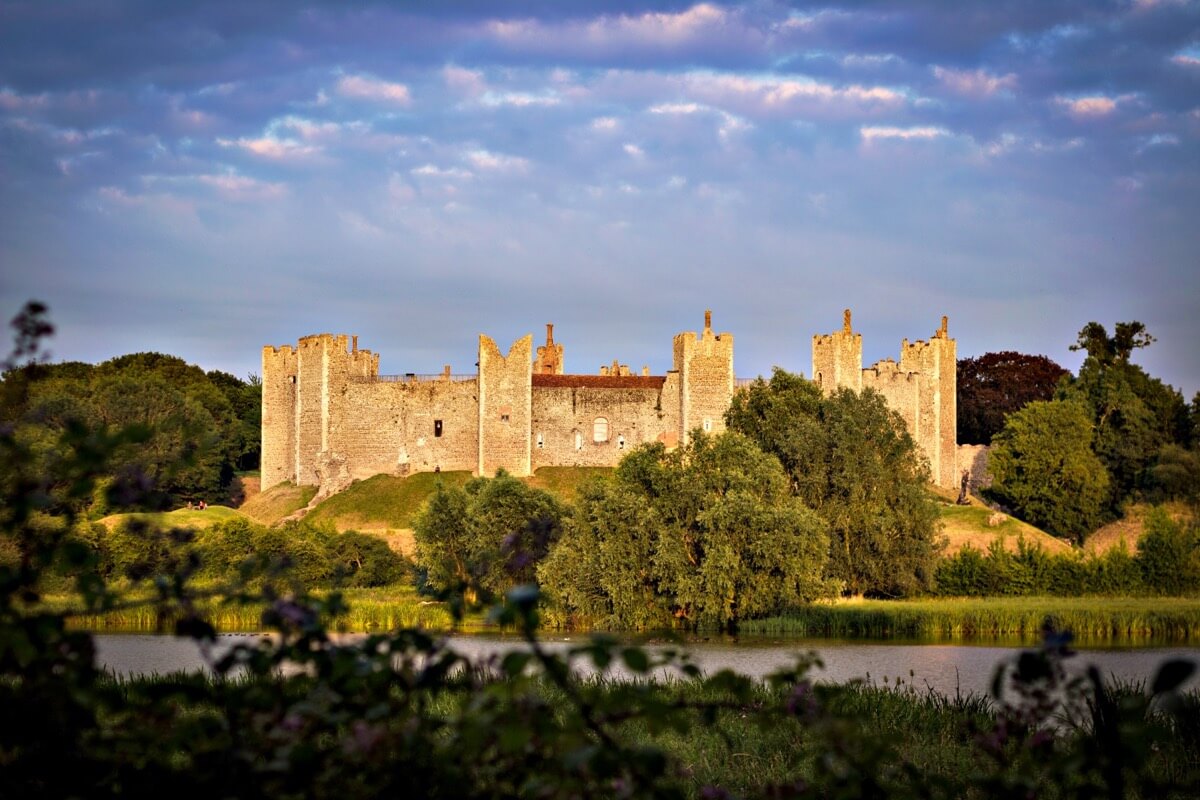
Framlingham Castle is located on a bluff overlooking the River Ore, and today is made up of three distinct parts, the Inner Court, the Bailey and the Lower Court, surrounded by the remaining mere and farmland.
The Bailey lies to the south of the walled Inner Court and was originally topped by a wooden palisade and earthworks, of which only the latter survive. The Bailey would have entered from an eastern gate and contained a range of buildings, probably including a Sergeant's Chamber, a Knights' Chamber, the Great Stable, barns and a granary. Modern visitors to the castle enter the complex through the Bailey from the south, which also contains the modern car park for the castle.
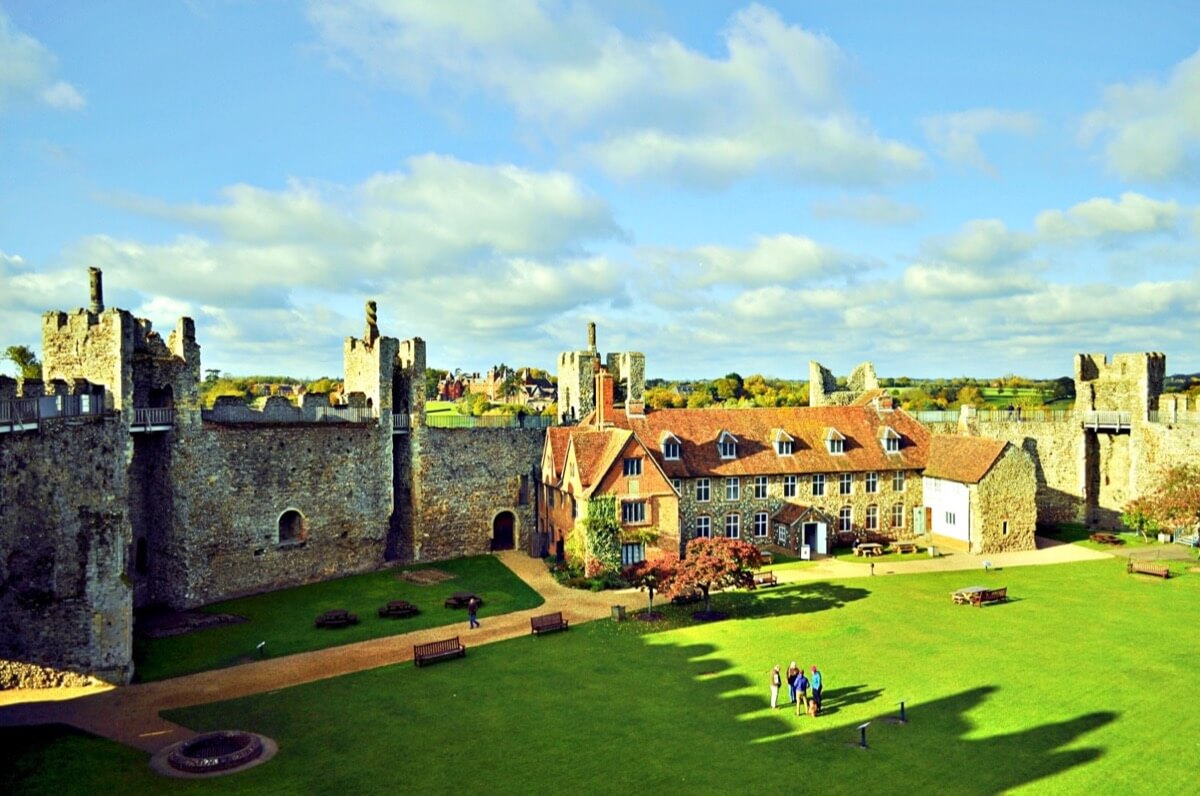
The Inner Court, or the Castle, lies beyond the Bailey across the 15th-century bridge that replaced the earlier drawbridge on the site. The gate tower that forms the entrance is a relatively simple design from the 12th century: the fashion for much grander gatehouse designs began shortly afterwards. The 2nd Duke of Norfolk, Thomas Howard, however, had it remodelled in the 16th century, adding his coat of arms and additional ornamentation to the walls. The Inner Court is formed around a stone curtain wall of local flint and septaria stone, 10.5 m (34 ft) high and 2.3 m (7.5 ft) thick, protected by thirteen square mural towers with open backs, each around 14.3 m (47 ft) high, with corners made of sandstone. A wall-walk runs around the top of the towers and wall.
Originally various buildings were built around the curtain wall. Moving clockwise from the entrance to the Inner Court, the shape of the 12th-century castle chapel can still be made out on the curtain wall. Convention at the time required a chapel to point along a north-east/south-east axis; in order to achieve this, the chapel had to extend out considerably into the bailey, similar to the design at White Castle. The chapel is adjacent to the site of the first stone hall in the castle, built around 1160; in the 16th and 17th centuries the chapel tower was probably also used as a cannon emplacement.
On the far side of the Inner Court is the poorhouse, built on the site of the 12th-century Great Hall. The poorhouse forms three wings: the 17th century Red House to the south, the 18th-century middle wing, and the northern end which incorporates part of the original Great Hall; all of the building was subject to 19th-century renovation work.Five carved, medieval stone heads are set into the poorhouse, taken from the older medieval castle buildings. Next to the poorhouse is the Postern Gate, which leads to the Prison Tower. The Prison Tower, also called the Western Tower, is a significant defensive work, redesigned in the 16th century to feature much larger windows. In the middle of the Inner Court is the castle well, 30 m (98 ft) deep.
A number of carved brick chimneys dating from the Tudor period can be seen around the Inner Court, each with a unique design; all but three of these were purely ornamental, however, and historian R. Allen Brown describes them as a "regrettable" addition to the castle from an architectural perspective.Two of the functional Tudor chimneys make use of original mid-12th century flues; these two chimneys are circular in design and are the earliest such surviving structures in England.
One of the castle meres can still be seen to the west of the castle, although in the 16th century there were two lakes, much larger than today, complete with a wharf. This dramatic use of water to reflect the image of the castle is similar to that used at several other castles of the period, including Bredwardine and Ravensworth Castle. Water castles such as Framlingham made greater use of water than was necessary for defence and enhanced the appearance of the castle. The view from the Great Hall in the Inner Court would originally have included the gardens of the Lower Court, and these would have then been framed by the mere and the Great Park beyond. The area around the castle today remains a designed and managed landscape; although the Great Park is now covered by fields, the view still gives a sense of how the castle and landscape was meant to appear to its late medieval owners.
Interpretation
The late 12th-century defences at Framlingham Castle have invoked much debate by scholars. One interpretation, put forward for example by historian R. Allen Brown, is that they were relatively advanced for their time and represented a change in contemporary thinking about military defence. Framlingham has no keep, for example – this had been a very popular feature in previous Anglo-Norman castles, but this castle breaks with the tradition, relying on the curtain wall and mural towers instead. The pattern of ground-level arrowslits at Framlingham were similarly innovative for their time, enabling interlocking and flanking fire against attackers.The design of Framlingham's defences is similar in many ways to Henry II's innovative work at Dover and Orford.
The defensive architecture of the castle also contains various weaknesses. The Inner Court is overlooked by the Bailey, for example; the north of the Inner Court is largely exposed, while the positioning of arrow-slits in the curtain wall ignores much of the castle.The open-backed mural towers, whilst cheaper to build than closed towers, could not have been easily defended once the wall had been penetrated, and because they projected only a little way from the wall, they provided very little options for enfilading fire against attackers close to the walls. These weaknesses have been used by historians such as Robert Liddiard to argue that the architecture of castles such as Framlingham were influenced by cultural and political requirements as well as purely military intent.
Focusing on the cultural and political use of the architecture at Framlingham, historian D. Plowman has put forward a revisionist interpretation of the castle's architecture in the late medieval period. Plowman suggests that the castle was intended to be entered from the north end of the Lower Court, passing through the ornamental gardens, with travellers then entering through the gate by the Prison Tower – in this interpretation, more of a barbican than a tower – and then up into the Inner Court. This would have provided high status visitors with dramatic views of the castle, reinforcing the political prestige of the owners. Historian Magnus Alexander disputes the practicality of this arrangement, although agrees that the route would have been more practical for hunting parties proceeding to the local parklands.
Useful information
Parking FREE (300 m)
http://www.english-heritage.org.uk/visit/places/framlingham-castle/prices-and-opening-times
http://www.english-heritage.org.uk/visit/places/framlingham-castle/prices-and-opening-times
http://www.english-heritage.org.uk/visit/places/framlingham-castle/prices-and-opening-times
External links
Nearby castles