Conisbrough Castle
South Yorkshire England England
castle, chateau
Conisbrough Castle is a medieval fortification in Conisbrough, South Yorkshire, England
Previous names
Conisbrough Castle
Description
Conisbrough Castle is a medieval fortification in Conisbrough, South Yorkshire, England. The castle was initially built in the 11th century by William de Warenne, the Earl of Surrey, after the Norman conquest of England in 1066. Hamelin Plantagenet, the illegitimate, parvenu son of Henry II, acquired the property by marriage in the late 12th century. Hamelin and his son William rebuilt the castle in stone, including its prominent 28-metre (92 ft)-high keep. The castle remained in the family line into the 14th century, despite being seized several times by the Crown. The fortification was then given to Edmund of Langley, passing back into royal ownership in 1461.
Conisbrough fell into ruin, its outer wall badly affected by subsidence, and was given to the Carey family in the 16th century. Its derelict state prevented it from involvement in the English Civil War of the 17th century and the remains were bought by the Duke of Leeds in 1737. Sir Walter Scott used the location for his 1819 novel Ivanhoe and by the end of the 19th century the ruins had become a tourist attraction, despite the increasing industrial character of the area.
The state took over the management of the property in 1950, but by the 1980s the visitor facilities were felt to be unsuitable, leading to a three-way partnership being created between the local council, the state agency English Heritage and a local charitable trust to develop the castle. The keep was re-roofed and re-floored in the 1990s with the help of European Union funding. English Heritage took over control of the castle in 2008 and continues to operate the property as a tourist attraction.
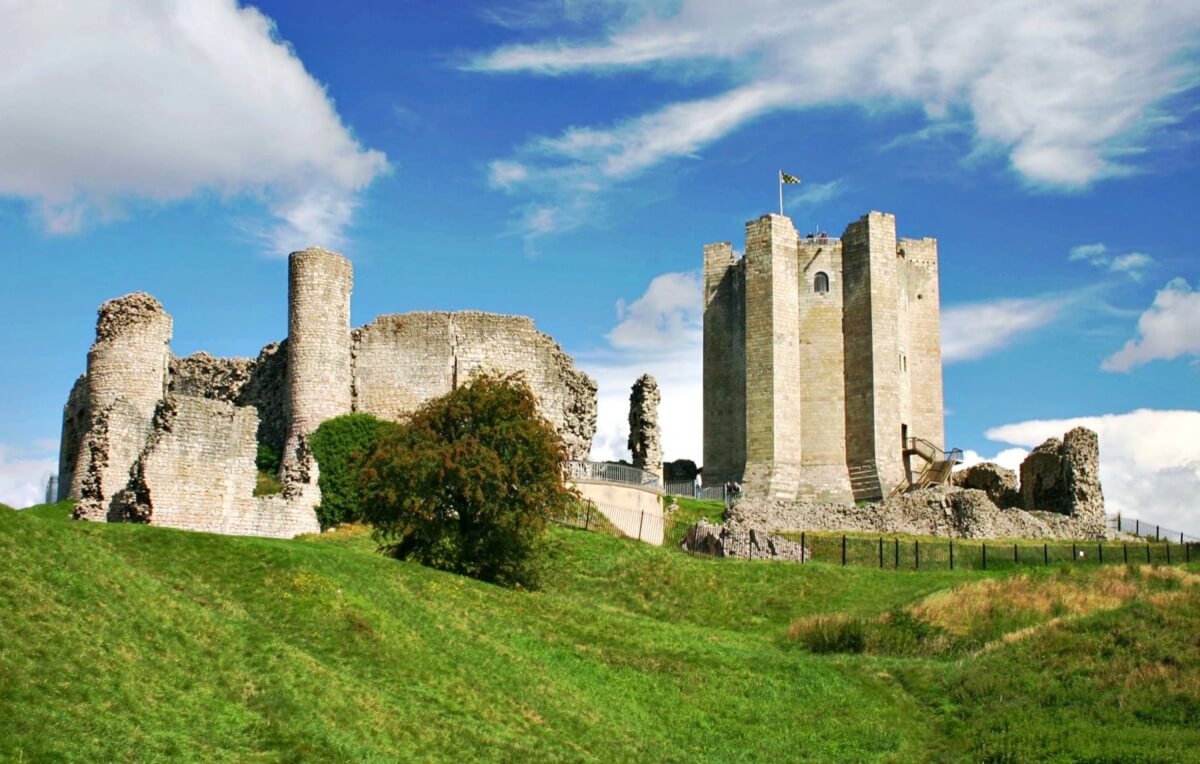
The castle is made up of an inner and an outer bailey, the former surrounded by a stone curtain wall defended by six mural or fortified towers and the castle keep. The inner bailey would have included a hall, solar, chapel and other service buildings of which only the foundations survive. The design of Conisbrough's keep is unique in England, and the historians Oliver Creighton and Stephen Johnson consider it an "architectural gem" and "one of the finest examples of late Norman defensive architecture". The keep comprises a circular central tower with six massive buttresses; its four floors would have included a main chamber and a private chamber for the lord above it. Although militarily weak, the design would have been a powerful symbol of Hamelin Plantagenet's new social status as a major lord.
Architecture
Inner and outer baileys
Conisbrough Castle has an outer and an inner bailey, approximately 260 by 120 feet (79 by 37 m) and 290 by 205 feet (88 by 62 m) across respectively. The castle was entered through the outer bailey, a rectangular enclosure protected by earthworks, which would have contained the castle's barns, stables, and other service facilities. A drawbridge on the northern side of the outer bailey, now replaced by an earth causeway, linked it with the inner bailey.
The oval inner bailey was formed by scarping and counter-scarping the natural contours of the hill, producing a bank, now largely destroyed, and a protective ditch. The early 13th-century curtain wall is mostly of roughly dressed, coursed stone, up to 7 feet (2.1 m) thick and 35 feet (11 m) high, with two sections repaired with ashlar facings. The wall was defended by six mural towers along its southern and western sides, of which three still survive reasonably intact, and strengthened with pilaster buttresses along the northern edge. The bases of the walls and the towers were splayed, spreading their weight out more broadly, but their footings are only 0.6 metres (2 ft 0 in) deep in places. A barbican protected the link from the drawbridge to the gatehouse of the inner bailey, complete with an additional corner turret. The remains of the collapse of the curtain wall are still visible in the ditch.
Various buildings were constructed along the inside of the inner bailey wall of similar rough stonework to the curtain wall, but only their foundations remain today. In the south-west corner was the solar block, containing the solar and various chambers. Along the north side was the hall, pushed into an awkward corner of the curtain wall, 70 by 30 feet (21.3 by 9.1 m) in size and originally probably built two storeys high. Initially constructed with a central hearth, a fireplace was added into the outer wall in the later 13th century. Alongside the hall were a kitchen and pantry, the former with a cellar. On the south-east side of the inner bailey was the castle chapel, 20 by 40 feet (6.1 by 12.2 m) across.
Keep
Conisbrough's keep was positioned on the north-east side of the inner bailey. It is an important medieval survival: the historian Sidney Toy considered it to be "one of the finest keeps in England", the archaeologist Oliver Creighton describes it as an "architectural gem" and Stephen Johnson as "one of the finest examples of late Norman defensive architecture".
The keep comprises a central circular tower, 62 feet (19 m) in diameter, with six, large solid buttresses projecting outwards to form an hexagonal design, unique in England. It was made from magnesian limestone and 28 metres (92 ft) tall with walls up to 15 feet (4.6 m) thick in places. It has four floors: a ground floor that serves as a basement and a vaulted stone support for the chamber above; the first floor, through which the keep was accessed; two upper floors and a roof walk, which was probably covered by a pentice and defended by battlements.
The current concrete stairs to the keep are modern, and the original medieval stairway, made from timber and stone, would have incorporated a drawbridge just before the castle doors. The basement contained a well, which could also be drawn from the 1st floor through a hole in the stone floor.
The keep was designed as a private tower for Hamelin Plantagenet, rather than a grander residence. As a result, it was not designed to accommodate several different households and its layout was simpler than that seen at the contemporary keep of Orford Castle, for example. The 2nd and the 3rd floor would have served as the main chamber and the lord's private chamber, forming a vertical sequence of rooms, with a vaulted, hexagonal chapel leading off the private chamber, cut into one of the buttresses.
Most of the castle would have been very dark due to the lack of natural light. The main chamber, however, had a large window, 1 foot 10 inches (0.56 m) by 4 feet 8 inches (1.42 m), with deep recesses to allow for the thickness of the walls; two carved seats sat alongside the window. A similar window was placed above it in the private chamber.The keep had relatively advanced fireplaces and flues for this period, the fireplace in the main chamber being exceptionally large and decorated with stone columns and carved capitals.
Conisbrough Castle was probably similar to two other castles owned by the Warren earls. Hamelin Plantagenet was also responsible for the development of Mortemer Castle in France, where a similar keep was built on top of a motte, and Conisbrough might also have had resemblances to Sandal Castle in the north of England, also owned by the earls. The design of the keep was poor from a military perspective. The central circular tower provided defensive advantages but the buttresses introduced 12 vulnerable corners into the stonework, and the keep itself had no arrow slots to permit the defenders to fire on any attackers. Rather than being designed primarily for military defence, it was constructed to symbolise and reinforce Hamelin's lordship and new social status.
Useful information
Parking is available roughly 200 metres from the visitor centre. The car park is free of charge.There is parking for four coaches off site, and a drop off area located roughly 100 metres from the visitor centre.
http://www.english-heritage.org.uk/visit/places/conisbrough-castle/prices-and-opening-times
http://www.english-heritage.org.uk/visit/places/conisbrough-castle/prices-and-opening-times
http://www.english-heritage.org.uk/visit/places/conisbrough-castle/prices-and-opening-times
External links