Castle Rising Castle
Norfolk England England
castle, chateau
Castle Rising is a ruined medieval fortification in the village of Castle Rising, Norfolk, England
Previous names
Castle Rising Castle
Description
Castle Rising is a ruined medieval fortification in the village of Castle Rising, Norfolk, England. It was built soon after 1138 by William d'Aubigny II, who had risen through the ranks of the Anglo-Norman nobility to become the Earl of Arundel. With his new wealth, he constructed Castle Rising and its surrounding deer park, a combination of fortress and palatial hunting lodge. It was inherited by William's descendants before passing into the hands of the de Montalt family in 1243. The Montalts later sold the castle to Queen Isabella, who lived there after her fall from power in 1330. Isabella extended the castle buildings and enjoyed a regal lifestyle, entertaining her son, Edward III, on several occasions. After her death, it was granted to Edward, the Black Prince, to form part of the Duchy of Cornwall.
During the 15th century, the castle became increasingly valued for its hunting facilities rather than its military defences. It fell into disrepair and, despite the construction of new living quarters and service facilities, by the middle of the 16th century it was derelict. Henry VIII sold the property to Thomas Howard, the Duke of Norfolk, and most of the castle buildings were demolished. It was not until the 19th century, when Mary and Fulke Greville Howard inherited the property, that the castle was renovated and restored. Victorian scholars examined the site, and it was opened to the public. In 1958 the castle passed into the custody of the state, which carried out further stabilisation work and a programme of archaeological investigation. In 1998 English Heritage passed the management of the site back to its current owner, Baron Howard of Rising, who continues to operate the castle as a tourist attraction.
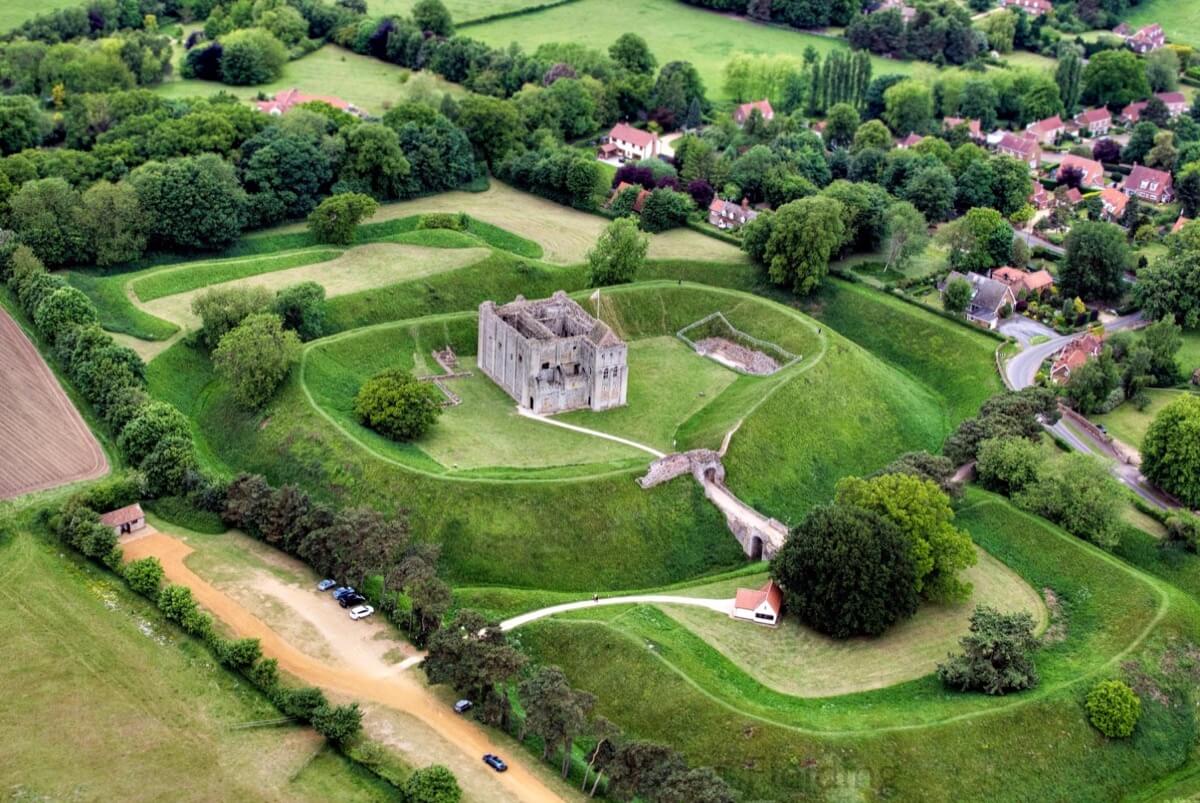
Castle Rising comprises three baileys, each defended by large earthworks, covering a total area of 5 hectares (12 acres), which archaeologists Oliver Creighton and Robert Higham consider to be among the most impressive in Britain. In the inner bailey is the great keep, probably modelled on that of Norwich Castle. It features extensive Romanesque designs, including pilaster buttresses and arcading. Historians Beric Morley and David Gurney believe this to be "one of the finest of all Norman keeps", and its military utility and political symbolism have been extensively discussed by academics. The castle was originally surrounded by a carefully managed landscape, from the planned town in front of the castle, to the deer park and rabbit warrens that stretched out behind it, intended to be viewed from the lord's chamber in the great keep.
Architecture and landscape
Landscape
The fortification of Castle Rising was constructed in a carefully designed landscape. In front of the castle was the town of Castle Rising, moved to its new site when the castle was built. The settlement appears to have been laid out to a grid-plan design, possibly bounded by ditches; with the castle positioned just behind it, in a similar fashion to that at New Buckenham and Malton Castle. A dovecot and a religious house were founded nearby; both of these were important symbols of lordship at the time, and were considered essential parts of a properly established castle.
The castle's deer park, which merged into the larger Rising Chase, was positioned behind the castle in a similar way to that at Devizes Castle. The castle effectively formed an interface between the town and the park; the great hall in the keep faced the settlement, and the lord's chamber overlooked the park, creating a symbolic divide between the public and private aspects of the building.
Rising Chase was around 16 miles (26 km) in circumference, enclosing around 20 square miles (52 km2). It utilised marginal farm-land, which may have contributed to its design; the heathland and light woodland south of the castle would have been ideal for grazing deer. The park was also designed with aesthetics in mind, being shaped so that its boundaries stretched beyond the horizon when viewed from the keep, in a similar design to that at Framlingham, Ludgershall and Okehampton Castles. Indeed, while the park would originally have provided the castle venison and other products, it was probably more ornamental than practical in character, including a space of open grazing in the centre of the park, designed to be visible from the castle chamber. The castle also incorporated a large rabbit warren, an important source of food and fur in this period, which stretched 5 kilometres (3.1 mi) away south-west from the castle.
Architecture
Baileys
Castle Rising is made up of two rectangular baileys to the west and east, and an oval inner bailey in the middle, each with their own substantial earthwork defences and ditches. The earthworks of Castle Rising cover a total area of 5 hectares (12 acres), and are considered by archaeologists Oliver Creighton and Robert Higham to be among the most impressive in Britain. The interior of the western bailey has been levelled up to form a platform, and is no longer directly connected to the rest of the castle.The eastern bailey is 82 metres (269 ft) by 59 metres (194 ft) across, and formed a protective buffer, covering the entrance way to the inner bailey.
A stone bridge connects the eastern bailey to the inner bailey, and is 24 metres (79 ft) across, still retaining some of its original stonework at its base, although the remainder of it has since been rebuilt many times. The bridge leads onto a stone gatehouse, dating from around 1138; when it was first built it was substantially taller and longer than today. It was originally equipped with a portcullis, and a stone barbican was later built outside it for additional protection.
Beyond the gatehouse is the inner bailey, which forms a ringwork 73 metres (240 ft) by 60 metres (200 ft) in size, with a circumference of 320 metres (1,050 ft); the banks are now 18 metres (59 ft) high from the bottom of the defensive ditch, although they were originally only half this height.It is uncertain what was placed around the top of this bank when it first built; there may have been a wooden palisade, or possibly a timber revetment. Some of the remains of the 14th-century brick wall, built on an additional 1 metre (3 ft 3 in) layer of limed sand for stability, have survived along part of the bank. There were three towers built along the walls during the medieval period, two of which have left their mark in the earth banks; the location of the third is uncertain.
The main architectural focus of the inner bailey was the great keep, but it also contained a Norman chapel and, from at least the 14th century onwards, a complex of smaller residential and service buildings. The visible stone foundations on the north side of the keep belong to the chapel and range built for Queen Isabella around 1330. The bailey well can also still be seen.
On the north side of the bailey are the remains of the Norman chapel, which comprised a nave, a square tower and an apsidal chancel, 12.7 metres by 6 metres (42 ft by 20 ft), 4 metres square (13 ft square) and 4.6 metres by 4 metres (15 ft by 13 ft) respectively.It was built from local grey sandstone, and Roman tiles from one of the nearby villas were used to construct its roof and incorporated into the walls. Originally the tower would have had a church bell, and the casting pit for this is buried under the floor of the nave.A stone bench runs around the base of the walls, and in the 19th century there was also a stone base for a font in the nave, but this has since been lost. A piece of early medieval graffiti, possibly depicting a Norman soldier, has survived on the south exterior wall. A fireplace was added to the chapel during the Tudor period, although this was only in use for a few years before being abandoned.
Keep
Historians Beric Morley and David Gurney consider Castle Rising to have "one of the finest of all Norman keeps". It is an early example of the longer, oblong form of these buildings, called a hall-keep, and would have taken huge resources to erect. Externally, it resembles Henry I's keeps at Norwich and Falaise, although Norwich appears to have inspired the latter design, and Rising's internal layout was probably based on that at Norwich as well. In imitating Norwich, which was then the only royal castle in the county, Castle Rising may have been intended to symbolise D'Albini's loyalty to the Crown during the troubled years of the Anarchy.
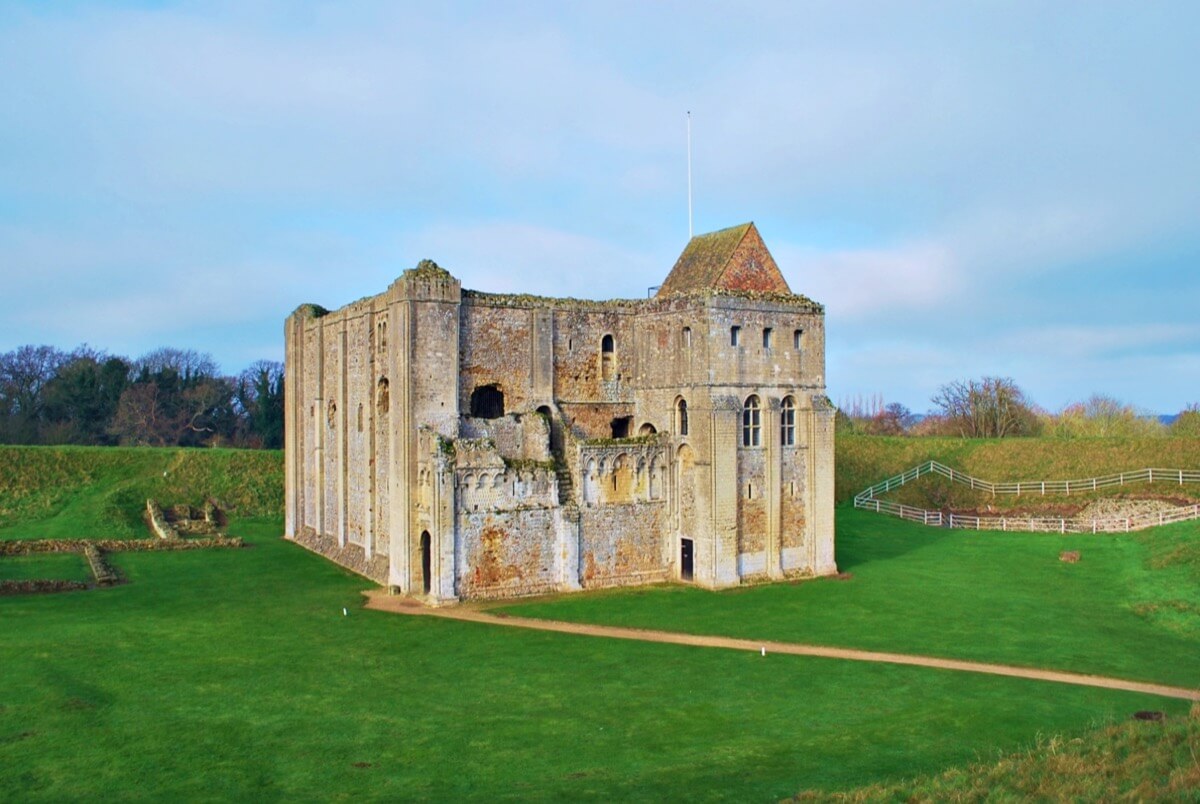
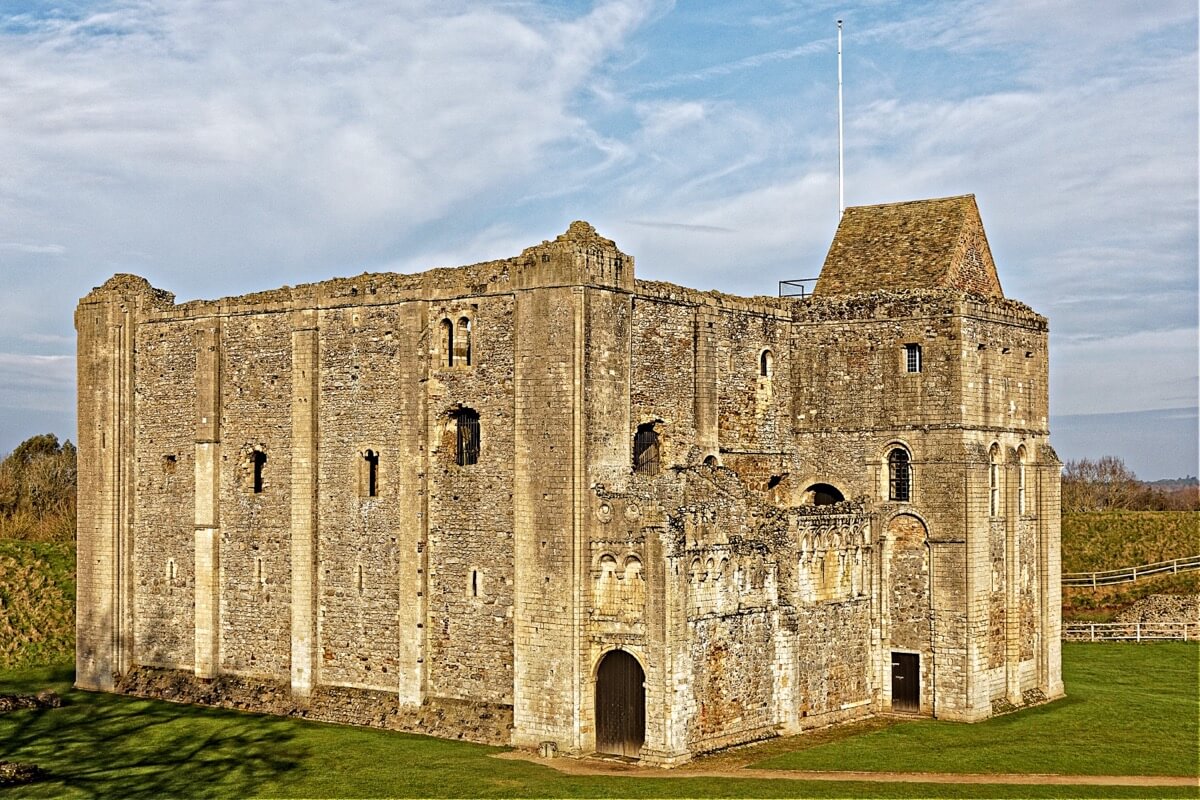
The keep is built from courses of local, brown carrstone rubble with oolite ashlar facings, and is strengthened with intramural timbers, laid down within the stone walls to reinforce the structure. Its main body is 24 metres (79 ft) by 21 metres (69 ft) wide, with walls approximately 15 metres (49 ft) high, with a forebuilding running along the east side.[108] It has prominent pilaster buttresses, giving the keep what Sidney Toy describes as an "impression of strength and dignity"; the corners have clasping buttresses, forming four turrets. There is extensive Romanesque detail on the outside of the keep, including arcading along the west side and decorative stonework on the forebuilding.
The interior of the keep is divided by an internal wall to improve its structural strength, the division running north-south through the building. The basement of the keep has two main sections, the north room 18 metres (59 ft) by 8 metres (26 ft), with pillars supporting the great hall above, and the south chamber 18 metres (59 ft) by 5 metres (16 ft) in size. The forebuilding leads from the ground to the first floor, up a passageway 2.4 metres (7 ft 10 in) wide with 34 steps and through three arched doorways. At the top is a waiting room; the glazed windows are a mixture of Tudor and more modern insertions.
On the first floor is the great hall, 14 metres (46 ft) by 7 metres (23 ft), now floorless and open to the sky. Its original entrance way was blocked up by a chimney when the forebuilding was converted into a separate apartment in the Tudor period, and an additional entrance way inserted into the castle wall. The fireplace itself was later filled in with Tudor tiles around 1840. A mural passageway, dug out in the Tudor period, leads through to the kitchen and service quarters. On the southern side is the great chamber with a large, original 12th-century fireplace, and a mixture of original tri-lobed windows and 19th-century additions. At the far end of the great chamber is an ornate chapel, with Norman arcading and arching. The keep was originally built to have been relatively self-contained, and would not have needed many additional outbuildings to function as a residence.
The second floor of the keep is limited in space, and contains only one small room above the chapel which was possibly used the chaplain or by castle guards. The forebuilding was later equipped with an additional room on this level, 4.8 metres (16 ft) by 4.8 metres (16 ft), which remained inhabited longer than the rest of the castle keep, and which contains a 19th-century fireplace. The upper 3.7 metres (12 ft) of the keep's walls are different in design to the main body of the building; as described above, this may be the result of either a final phase of construction between 1200 and 1230, or a period of repair and renovation shortly after 1300.
Utility and symbolism
Many 20th-century historians have stressed the potential military strength of Castle Rising; R. Allen Brown, for example, concluded that "defence ... was the overwhelming consideration in design and construction", and argued that the keep would have been used as a final refuge in the case of attack during a siege. Beric Morley and David Gurney believe that the military strength of the castle could not have failed to impress contemporaries. Sidney Toy suggested that the forebuilding would have made an effective defensive feature, enabling the defenders to attack intruders as they made their way up the stairs, with Morley and Gurney describing it as "a deadly and near impregnable approach to the castle's interior".
Despite this, the defensive qualities of Castle Rising have since been extensively debated. The historian Robert Liddiard argues that the large windows at Castle Rising would have been a significant weakness, as it would have been easy to fire arrows through them from the bailey, and George Garnett has questioned the utility of the defensive arrow slits, which he suggests were not well positioned or designed.The whole site was also overlooked by higher ground, which Liddiard considers would have been a key defensive weakness.
Great keeps such as Castle Rising's were also important ceremonially and symbolically in the 12th century, however, and historian Thomas Heslop has described Castle Rising as "a fortress palace", with the keep forming the palace, and the surrounding earthworks the more practical defences. They reflected lordly status: typically their owners had recently advanced up the social scale, as with William d'Aubigny, and were keen to impress others with their new authority.
With this in mind, the positioning of Castle Rising may have exposed it to higher ground, but it also made it strikingly prominent across the valley. The whole entrance to the castle was also designed to communicate to a visitor the status of the castle lord. As they came through the gatehouse and past the earthworks into the bailey, the south side of the forebuilding - deliberately facing the entrance - would have been revealed, covered in fashionable carving and decorative features. Visitors would then have walked up the stairs of the forebuilding, have paused in a waiting room, originally largely open to the elements, before being allowed through a decorative entrance door. The doorway led into the great hall, from where the lord, possibly sat in a throne alcove to the left, would have met the visitor.
Useful information
50 metres from entrance; car park surface difficult. Impacted gravel path to castle.
- Member - Join now Free
- Adult £4.50
- Concession £3.80
Child £3.00
Family £14.00
External links
Nearby castles