Brougham Castle
Cumbria England England
castle, chateau
Brougham Castle (pronounced /ˈbruːm/) is a medieval building about 2 miles (3
Previous names
Brougham Castle
Description
Brougham Castle (pronounced /ˈbruːm/) is a medieval building about 2 miles (3.2 km) south-east of Penrith, Cumbria, England. The castle was founded by Robert I de Vieuxpont in the early 13th century. The site, near the confluence of the rivers, Eamont and Lowther, had been chosen by the Romans for a Roman fort called Brocavum. The castle is scheduled as an Ancient Monument, along with the fort, as "Brougham Roman fort and Brougham Castle".
In its earliest form, the castle consisted of a stone keep, with an enclosure protected by an earthen bank and a wooden palisade. When the castle was built, Robert de Vieuxpont was one of the only few lords in the region who were loyal to King John. The Vieuxponts were a powerful land-owning family in North West England, who also owned the castles of Appleby and Brough. In 1264, Robert de Vieuxpont's grandson, also named Robert, was declared a traitor, and his property was confiscated by Henry III. Brougham Castle and the other estates were eventually returned to the Vieuxpont family, and stayed in their possession, until 1269, when the estates passed to the Clifford family through marriage.
With the outbreak of the Wars of Scottish Independence, in 1296, Brougham became an important military base for Robert Clifford, 1st Baron de Clifford. He began refortifying the castle: the wooden outer defences were replaced with stronger, more impressive stone walls, and a large stone gatehouse was added. The importance of Brougham and Robert Clifford was such that, in 1300, he hosted King Edward I of England at the castle. Robert's son, Roger Clifford, was executed as a traitor, in 1322, and the family estates passed into the possession of King Edward II of England, although they were returned once his son Edward III became king. The region was often at risk from the Scots, and in 1388, the castle was captured and sacked.
Following this, the Cliffords began spending more time at their other castles, particularly Skipton Castle in Yorkshire. Brougham descended through several generations of Cliffords, intermittently serving as a residence. However, by 1592, it was in a state of disrepair, as George Clifford, 3rd Earl of Cumberland was spending more time in southern England due to his role as Queen's Champion. The castle was briefly restored in the early 17th century, to such an extent, that King James I of England was entertained there in 1617. In 1643, Lady Anne Clifford inherited the estates, including the castles of Brougham, Appleby, and Brough, and set about restoring them. Brougham Castle was kept in good condition for a short time, after Lady Anne's death in 1676; however, Thomas Tufton, 6th Earl of Thanet, who had inherited the Clifford estates, sold the furnishings in 1714. The empty shell was left to decay, as it was too costly to maintain. As a ruin, Brougham Castle inspired a painting by J. M. W. Turner, and was mentioned at the start of William Wordsworth's poem The Prelude, as well as becoming the subject of Wordsworth's Song at the Feast of Brougham Castle upon the Restoration of Lord Clifford, the Shepherd, to the Estates and Honours of his Ancestors. The castle was left to the Ministry of Works, in the 1930s, and is today maintained by its successor, English Heritage
Layout
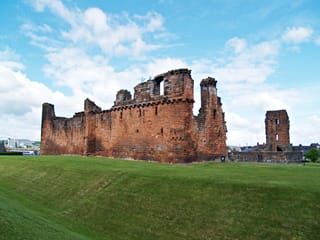
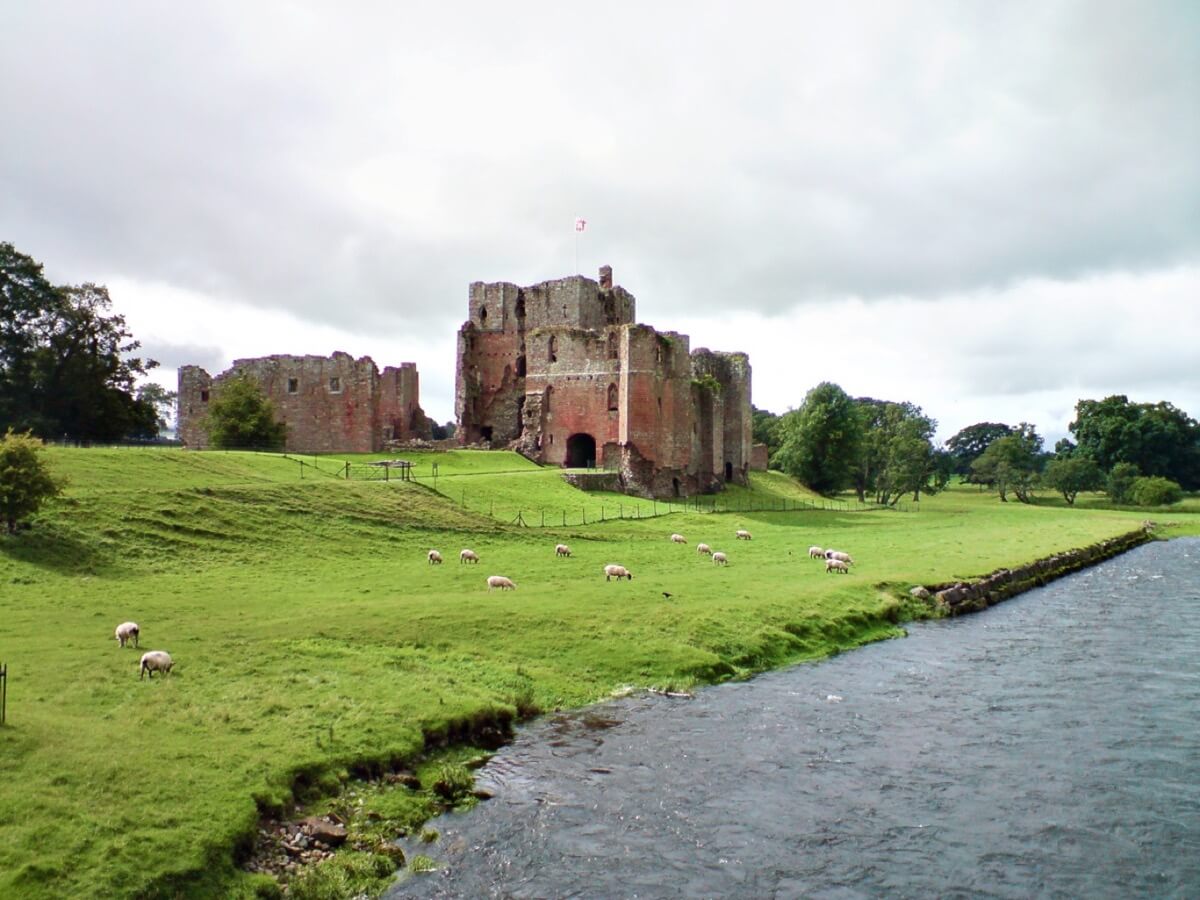
The path to Brougham Castle leads from east to west. To the south, or the left of someone approaching the castle, are the earthworks of the Roman fort and the location of the 17th-century garden. The ground is terraced, and to the north the land slopes down towards the River Eamont. A moat runs alongside the east, south, and west faces of the castle, its width varying between 10 and 15 metres (33 and 49 ft) and lying up to 3.4 metres (11 ft) deep. Although the moat is now dry it is likely that it used to be filled with water. The castle is an irregular polygon, measuring about 68 metres (223 ft) along the west side, 72 metres (236 ft) along the south, 48 metres (157 ft) wide in the east, and 54 metres (177 ft) on the north side.
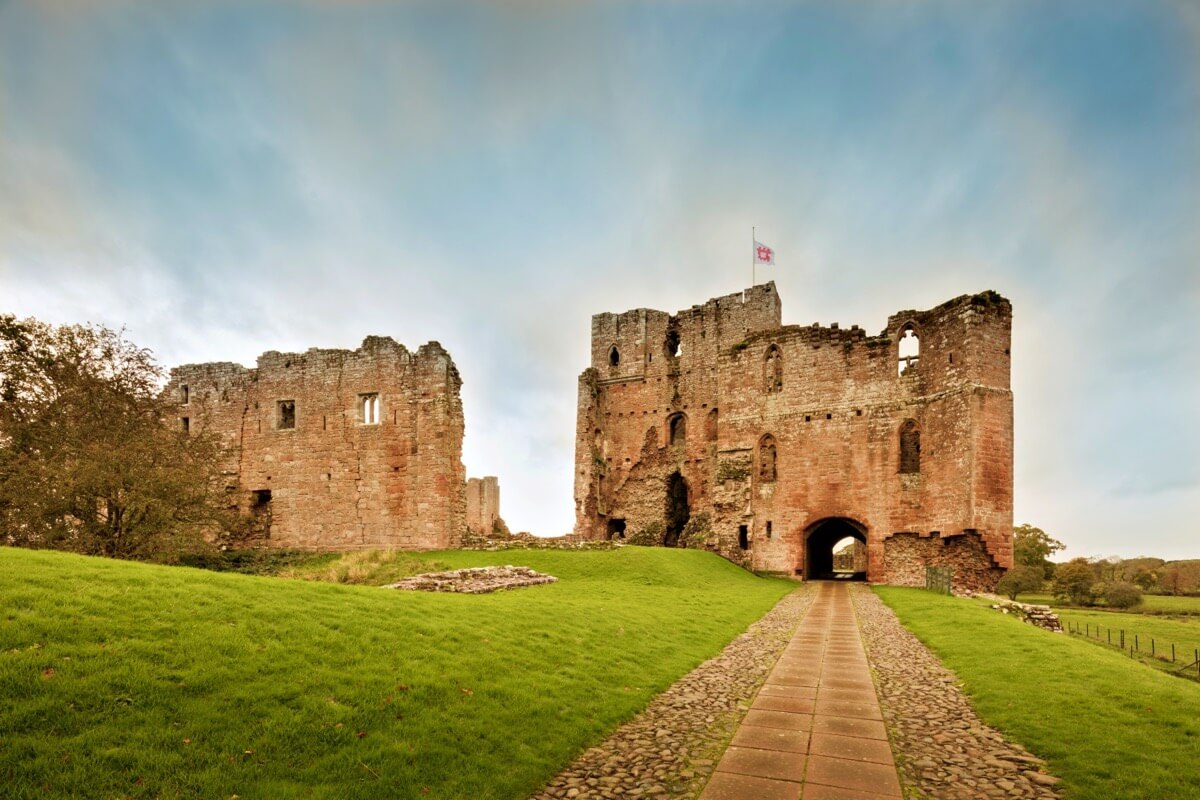
Brougham Castle is entered through a three-storey double-gatehouse. Originally the coat of arms of Roger Clifford and his wife was carved above the entrance to the gatehouse but in the 19th century this was replaced by the current inscription, "Thys Made Roger", by Henry Tufton, 11th Earl of Thanet. The inscription was originally above the entrance of the great hall built by Roger Clifford, 5th Baron Clifford. Erected on the slope inclining down to the river, the gatehouse was constructed in the early 14th century by Robert de Clifford, 1st Baron de Clifford. The complex has three components: the inner and outer gatehouses and a courtyard in between. The inner gatehouse survives to a height of 12.5 metres (41 ft) in the east. The ground-floor passage through the building is vaulted and there was a portcullis at the east end. A postern gate was hidden behind a buttress in the north side of the gatehouse and would have provided a discrete means of leaving the castle. The floors above the passageway each consisted of a single large room and were connected to the keep, allowing people to move between the two without having to go outside. In the 17th century Lady Anne Clifford converted the top floor into her bedroom. Like the inner gatehouse, the outer section had a square plan, and the upper floors would each have been occupied by a single room. The building survives to a height of 14.5 metres (48 ft) in the east. Below the outer gatehouse was a dungeon, and at ground floor level on the north side the guardroom. The large rooms in both gatehouses would have been used as residences. Although the very top of the gatehouse no longer survives, it would have been crested by machicolations.
Adjoined to the gatehouse is the 13th-century keep. A keep contained the main domestic accommodation in a castle, usually high-status, and also provided the last place of refuge if the surrounding enclosure fell during an assault. Brougham's keep has a square plan and is between 19 and 20 metres (62 and 66 ft) high, although originally would have stood taller. Access to each floor was granted by a spiral staircase in the north-east corner, with each floor consisting of a single large room. The garderobe was located in the north-west corner. It had long been assumed that the keep was built in the last quarter of the 12th century due to its simple design; the square design, use of narrow buttresses at each corner, and entrance through a forebuilding are consistent with other keeps built in the late 12th century. By the 13th century, Brougham's keep would have been old fashioned compared to the polygonal structures introduced in the 13th century. However, historian Henry Summerson who assessed the historic documents for the castle concluded that construction could not have begun earlier than the first quarter of the 13th century. The wooden floors no longer survive, and the use of the rooms in the keep is mostly conjectural, but it is likely that the ground floor would have served as a storage room, with the first floor being used as a hall and accommodation for the guards, and the second floor providing rooms for the lord. A final fourth storey was added in early 14th century. The keep would have been entered at first floor level, through the east side where it was abutted by a forebuilding. Despite the keep's importance to the castle structure, little survives of the building today.
South east of the keep was the hall, built by Roger Clifford in the late 14th century as a replacement for an earlier hall. It provided space for the castle's garrison, swelled by the Anglo-Scottish Wars, and was a location for the lord to eat with his soldiers. The hall had large windows which may have detracted from the building's defensive capability, although it has been postulated that casements bore large wooden shutters. The kitchen, which served the entire castle, was set in the south-east corner of the fortification. Along the south wall were arranged more lodgings, a well, and a chapel, the latter another addition by Roger Clifford. In the south-west corner of the castle was the Tower of League, built around 1300 by Roger Clifford. It included further rooms for accommodation, but notably would also have allowed defenders to fire on an enemy emerging from the gatehouse. Four storeys tall and with a single room at each level, the presence of a garderobe and fireplace on each floor suggests that the tower was reserved for high-status visitors.The tower's square plan is typical of such structures built in northern England at this time, as seen at castles such as Warkworth and Egremont, although it contrasts with rounded towers preferred in the south.
Useful information
No parking on site, but free parking available on the roadside.
http://www.english-heritage.org.uk/visit/places/brougham-castle/prices-and-opening-times
- Dogs on leads are welcome. Please note that they are not allowed on the private land by the river.
- No baby changing facilities.
- Wedding photographs may be taken on site. Charge applicable and must be booked in advance. Please call site for details.
External links
Nearby castles