Beeston Castle
Tarporley England England
castle, chateau
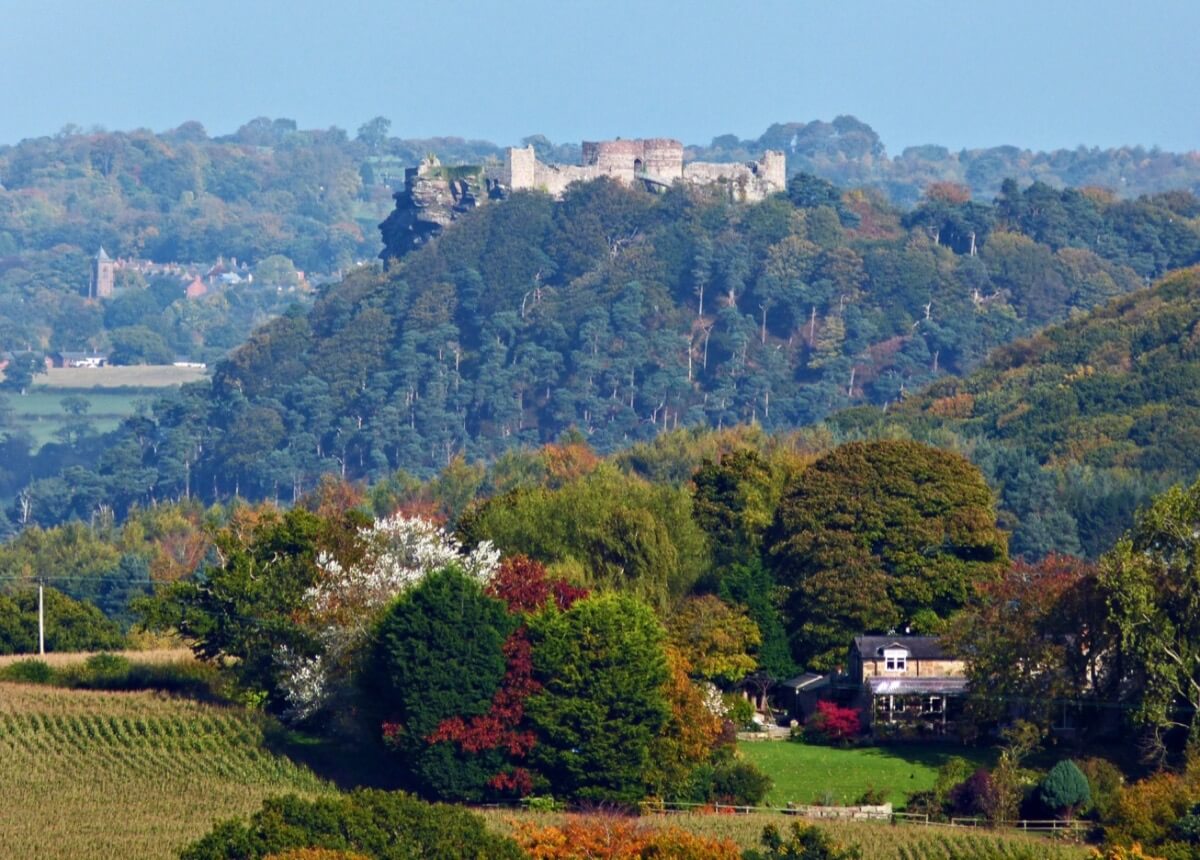
Beeston Castle is a former Royal castle in Beeston, Cheshire, England (grid reference SJ537593), perched on a rocky sandstone crag 350 feet (107 m) above the Cheshire Plain
Previous names
Beeston Castle
Description
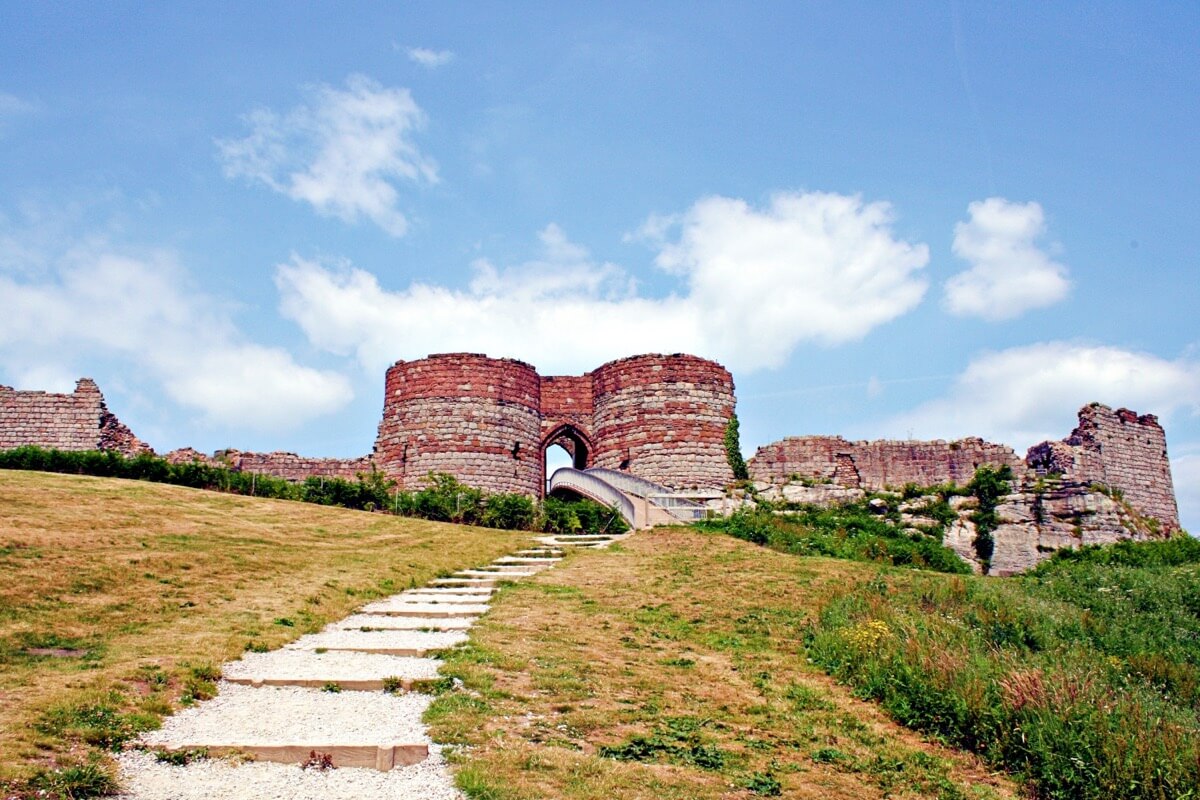
Beeston Castle is a former Royal castle in Beeston, Cheshire, England (grid reference SJ537593), perched on a rocky sandstone crag 350 feet (107 m) above the Cheshire Plain. It was built in the 1220s by Ranulf de Blondeville, 6th Earl of Chester, (1170–1232), on his return from the Crusades. In 1237, Henry III took over the ownership of Beeston, and it was kept in good repair until the 16th century, when it was considered to be of no further military use, although it was pressed into service again in 1643, during the English Civil War. The castle was slighted (partly demolished) in 1646, in accordance with Cromwell's destruction order, to prevent its further use as a stronghold.
The castle is now in ruins. The walls of the outer bailey, along with the walls and gatehouse of the inner bailey, are separately recorded in the National Heritage List for England as designated Grade I listed buildings. The castle is also a Scheduled Ancient Monument, owned by English Heritage. It is rumoured that treasure belonging to Richard II lies undiscovered in the castle grounds, but the many searches that have been carried out have failed to find any trace of it. During the 18th century the site was used as a quarry.
Prehistory
Pits dating from the 4th millennium BC indicate the site of Beeston Castle may have been inhabited or used as a communal gathering place during the Neolithic period. Archaeologists have discovered Neolithic flint arrow heads on the crag, as well as the remains of a Bronze Age community, and of an Iron Age hill fort. The rampart associated with the Bronze Age activity on the crag has been dated to around 1270–830 BC; seven circular buildings were identified as being either late Bronze Age or early Iron Age in origin. It may have been a specialist metalworking site.
Geology
Beeston crag, on which the castle is built, is one of a chain of rocky hills stretching across the Cheshire Plain. Like the neighbouring Peckforton Hills it is formed from easterly dipping layers of sandstone of Triassic age, part of a thicker sequence known as the New Red Sandstone. The main mass of the hill is formed from the Helsby Sandstone Formation which is around 245 million years old. It is capped by a small outcrop of sandstones assigned to the Tarporley Siltstone Formation (and formerly known as the Keuper Waterstones).
Along the eastern margin of the hill is the Peckforton Fault, a major north-south aligned geological fault which downthrows the strata to the east. A low ridge of glacial moraine extending east from the castle lodge is interpreted as marking an ice front during the retreat (or stagnation in situ) of the Irish Sea ice sheet which had invaded Cheshire from the northwest during the last ice age.
Later history
The 18th-century gatehouse
Quarrying was carried out in the castle grounds during the 18th century, and the gatehouse leading into the outer bailey was demolished to build a track for the stones to be removed from the site. In 1840 the castle was purchased by John Tollemache, 1st Baron Tollemache, at that time the largest landowner in Cheshire, as part of a larger estate. In the mid-19th century the castle was the site of an annual two-day fete, raising money for local widows and orphans and attracting more than 3000 visitors a day.
Present day
The castle is owned by English Heritage, and although in ruins, enough of the walls and towers are still in place to provide a clear picture of how it would have looked in its prime. It is open to visitors and has a small museum and visitor's centre. A lodge house was built by Tollemache in the 19th century, and was expanded in the 20th century. The lodge is two storeys high, with two circular towers either side of a central archway. It is designated as a Grade II listed building.
The views from Beeston stretch across eight counties from the Pennines in the east to the Welsh mountains in the west.
Useful information
Pay and Display car park (not operated by English Heritage). Entrance is located 10 metres across road from the site. Approx 100 parking spaces (more on event days). There is a parking charge of £3.00 (please ensure you have the correct change). This charge may vary on event days.
http://www.english-heritage.org.uk/visit/places/beeston-castle-and-woodland-park/prices-and-opening-times
http://www.english-heritage.org.uk/visit/places/beeston-castle-and-woodland-park/prices-and-opening-times
http://www.english-heritage.org.uk/visit/places/beeston-castle-and-woodland-park/prices-and-opening-times
External links
Nearby castles