Untere Burg Antweiler
Köln Nordrhein-Westfalen Germany
castle, chateau
Untere Burg Antweiler
Köln Nordrhein-Westfalen Germany
castle, chateau
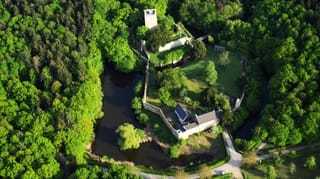
The age and historical significance of the place Antweiler have become almost completely unrecognizable due to the development since 1950; of the two former moated castles, the so-called lower castle is in good condition, while the upper castle was demolished except for the remains of the wall and a corner tower for the purpose of building a new Raiffeisen bank
Die Untere Burg Antweiler, bekannt auch als Unterburg Antweiler, ist eine Wasserburg, anfänglich aus dem 16
Previous names
Untere Burg Antweiler, Untere Burg Antweiler
Description
The age and historical significance of the place Antweiler have become almost completely unrecognizable due to the development since 1950; of the two former moated castles, the so-called lower castle is in good condition, while the upper castle was demolished except for the remains of the wall and a corner tower for the purpose of building a new Raiffeisen bank.
Noble rule and castle building in Antweiler were based, as is so often the case, on the administration of spiritual property by aristocratic bailiffs who, in the course of the Middle Ages, knew how to derive their own sovereign rights from the property entrusted to them for protection and preservation.
In 1002, property in Antweiler was donated to Deutz Abbey by Archbishop Heribert of Cologne, and in 1009 the church too. In 1250 the Dietkirche in Bonn also had property and rights here, including the parish. Both monasteries maintained hereditary bailiffs in Antweiler, whose aristocratic owners were able to work their way up to local lords and later even subordinates and named themselves after Antweiler. In 1345 Dietrich von Antweiler is named as the single husband of Count von Jülich, i.e. as a dependent of the sovereign, who had received from him the power of disposal over the castle and outer bailey, high and low court on the spot. This relationship of dependence corresponded less to a fiefdom than to a kind of long lease; from this the Antweiler sub-rule seems to have developed, over whose suzerainty Jülich and Cologne were permanently in dispute. In the early 15th In the 18th century Otto von Metternich (with the shell coat of arms) was the heir to Antweiler, then his son Johann and his son Karl, Herr zu Zievel. He sold the castle and hereditary bailiwick to his brother-in-law Johann von Ahr, apparently in 1488 (Eiks, archive, U 37). Thus the von Ahr sat as sublords and heirlooms of the Deutzer like the Dietkirchener Vogterei on the lower castle and in fact had the local government power.
At the beginning of the 16th century, an inheritance was divided between Johann and Dietrich von Ahr, on the occasion of which the upper castle was built as the seat of the younger line - comparable to the inheritance divisions in Nettersheim and Kleinbüllesheim, which also resulted in a second castle being built. Since then the Deutz Vogtei belonged to the upper castle, the lucrative Dietkirchener Vogtei to the lower castle, the status of subordinate rule and the greater part of the property.
In 1555 the lower castle property was awarded as a Jülich fiefdom, ie the medieval special position of the single man had been replaced by the usual, socially higher valued fiefdom relationship. Michael von Eynatten married the lower castle rule in the 16th century; his descendants sold them in 1708 to the Cologne canon Johann Arnold von Reux, who, because of his clerical status without legal heirs, was enfeoffed with his married sister. In 1716 the separated Deutzer Vogtei came back to the lower castle, which clearly got overweight compared to the upper castle.
In 1748 the canon died; his brother-in-law, privy councilor (von) Lapp, was now the sole owner. Johann Melchior von Solemacher zu Namedy married the heiress in 1765.
After losing their sovereignty rights in 1794, the von Solemacher continued to manage the lower castle in the 19th century as a manor in Prussia, which was allowed to call themselves von Solemacher - Antweiler since 1854 and were raised to the Prussian baron status in 1861. After Friedrich Freiherr von Solemacher - Antweiler, castle captain von Brühl and royal Prussian chamberlain, had been appointed to the Prussian mansion for life in 1876, he acquired the neighboring Wachendorf castle as a new representative seat in the Rhineland in 1877.
The manor house at Antweiler, unused by the rulers since the 18th century and consequently very dilapidated, only became a residence again with the hereditary transfer to Max Freiherr Raitz von Frentz, and the remaining wing of the manor house was restored.
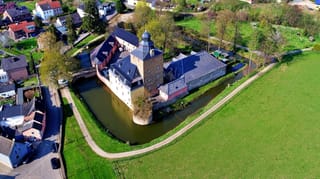
The groups of buildings connected today by walls clearly reveal the former two-part moated castle on closer inspection: the moats have been dry or leveled at least since the 18th century and have left hardly any traces in the surrounding area. The Krebsbach, used for the water supply, has long been characterized by its highly unreliable water supply and ultimately dried up completely without permanent maintenance. The outer bailey facing the village has only preserved medieval substance in the outer masonry; the quarry stone masonry stands on partly massive sandstone blocks and can be assigned to the oldest building of the 14th century. The strange access via the southeast corner does not correspond to medieval customs, but seems to be old at this point and has apparently been used since the 18th century. Century considerably simplified and built over with a half-timbered construction. According to the wall anchors, the house in the outer bailey was built in 1728 and is based on the old outer bailey wall; the other farm buildings in the outer courtyard are modern.
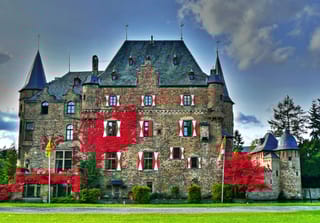
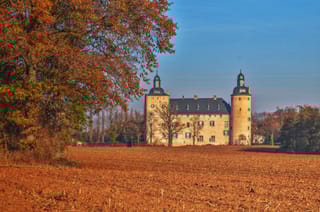
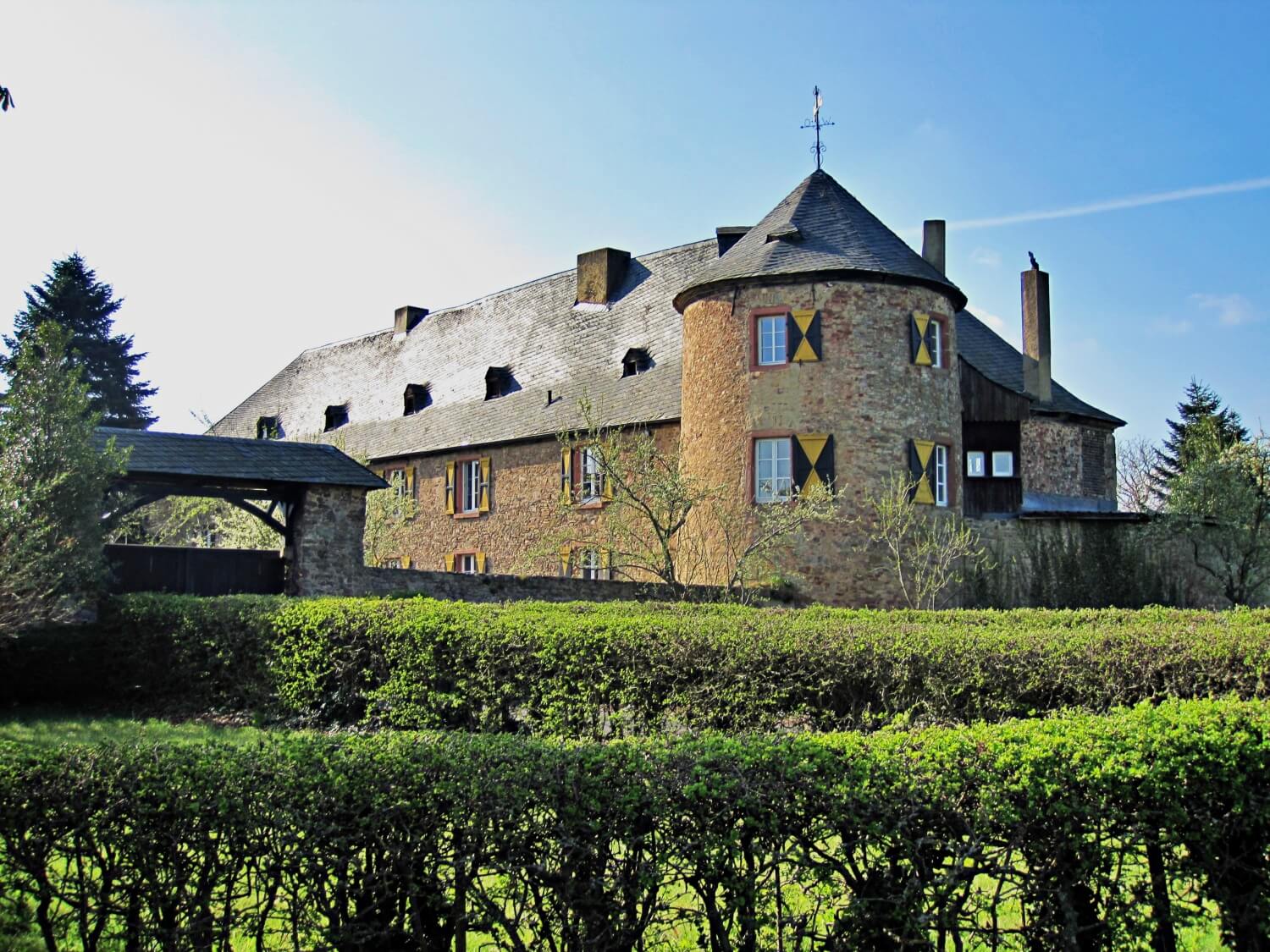
The main castle encompasses an unusually large area with the manor house on the east side. Starting from the manor house, quarry stone ring walls up to 6m high surround the entire main castle area; several square and shell towers suggest a comparison with the almost simultaneous construction of Zievel Castle. Buildings of lighter construction were originally built on the inside of the wall and can be seen on Roidkin's drawing and the Tranchot map; Whether the large open space in the courtyard, now a well-tended garden, once supported a central building, could only be determined by excavating - there are no news or old images on this, but it would suit the type of facility. In any case, today's mansion with its round corner tower cannot have been the main building of the medieval castle, from which two hereditary bailiffs and a subordinate rule were ruled. The building with its outer walls and parts of the roof structure undoubtedly still belongs to the late Gothic construction phase; The two-storey building with no basement not only accommodates the original gate passage, but also has mostly relatively (!) low and small rooms inside, which do not correspond to the lordly proportions of the early 16th century. (The keyhole loopholes, the arching of the gate, details of the roof construction and the square stair tower on the courtyard side refer to a dating to the 16th century.) Next to the stair tower there is the approach of another wing, so that it was originally an angular building could. The corner tower with its tufa domed vault on the bottom floor is much older; the entire residential building was revised in the 19th century and provided with new window openings.
The current owner has bricked up the gate passage, which has become inoperative, on both sides and placed a smaller portal in the arch, which, however, still documents its original promotional function through the preserved roller holes for the drawbridge chains.
https://burg-antweiler.de/geschichte/
Die Untere Burg Antweiler, bekannt auch als Unterburg Antweiler, ist eine Wasserburg, anfänglich aus dem 16. Jahrhundert. Sie liegt am nordöstlichen Rand der Eifel in Mechernich (Ortsteil Antweiler) im Kreis Euskirchen. Ihr Pendant war die Obere Burg Antweiler, die auf der gegenüberliegenden Seite des Krebsbachs lag.
Die zwei Burgen von Antweiler dokumentierten die historische Besitzteilung des Ortes vom Mittelalter bis zur Neuzeit. Grundbesitz in Antweiler hatten die Abtei Deutz und das Bonner Stift Dietkirchen. Ihre Vögte saßen auf der Unterburg, die sie wohl erst im 13. Jahrhundert gründeten, um ihre Herrschaft zu festigen. 1345 hatten die Herren von Antweiler vom Landesherrn, dem Grafen von Jülich, die Gerichtsbarkeit erhalten, woraus sich die Unterherrschaft Antweiler entwickelte. Deren Herren waren im 15. Jahrhundert die von Metternich, zugleich Erbvögte von Deutz und Dietkirchen. 1488 erwarben die Herren von Ahr Vogtei und Herrschaft, die sie Anfang des 16. Jahrhunderts auf zwei Linien aufteilten. Die jüngere Linie erbaute die Oberburg und erhielt die Deutzer Vogtei, die 1716 an die Unterburg zurückfiel. Die Oberburg wurde an den Jesuitenorden verkauft, 1777 an die Kölner Schulverwaltung und 1941 an die Raiffeisenbank, die das Herrenhaus abreißen ließ. An die Burg erinnern nur noch der runde Turm der Vorburg mit seinem zweigeteilten spätgotischen Helm und zwei Wappenkamine, einer heute in Burg Konradsheim und der andere museal im Vorgebäude der Unterburg in Antweiler wieder errichtet bzw. restauriert.
Beide Burgen waren ursprünglich wasserumgeben. Da sich der Krebsbach als unzuverlässige Wasserquelle erwies, sind die Gräben vermutlich bereits seit dem 18. Jahrhundert ausgetrocknet und spätestens im 19. Jahrhundert eingeebnet worden. Die Unterburg gehört heute den Freiherrn Raitz von Frentz. Die einst zweiteilige Burg zeigt in den Mauern noch mittelalterliche Spuren in Form Schlüsselschießscharten. Die Außenmauer steht auf der Wehrmauer des 14. Jahrhunderts, innen ist 1728 ein Halfenhaus angebaut worden. Die Hauptburg ist von einer Ringmauer umgeben, die mit Türmen verstärkt war und in deren Westecke das Burghaus gestanden haben dürfte. Das heutige Wohnhaus war der Torflügel des frühen 16. Jahrhunderts, angebaut an einen viel älteren Eckturm. Von einem weiteren Flügel ist nur noch ein Ansatz erhalten.
Useful information
Gratis
Privateigentum, nur außerhalb zu besuchen
-
Nearby castles