Stargard Castle
Mecklenburgische Seenplatte Mecklenburg-Vorpommern Germany
castle, chateau
Burg Stargard (Burg)
Mecklenburgische Seenplatte Mecklenburg-Vorpommern Germany
castle, chateau
Stargard Castle is the northernmost extant hill castle in Germany
Die Burg Stargard ist eine Höhenburg in Deutschland
Previous names
Stargard Castle, Burg Stargard (Burg)
Description
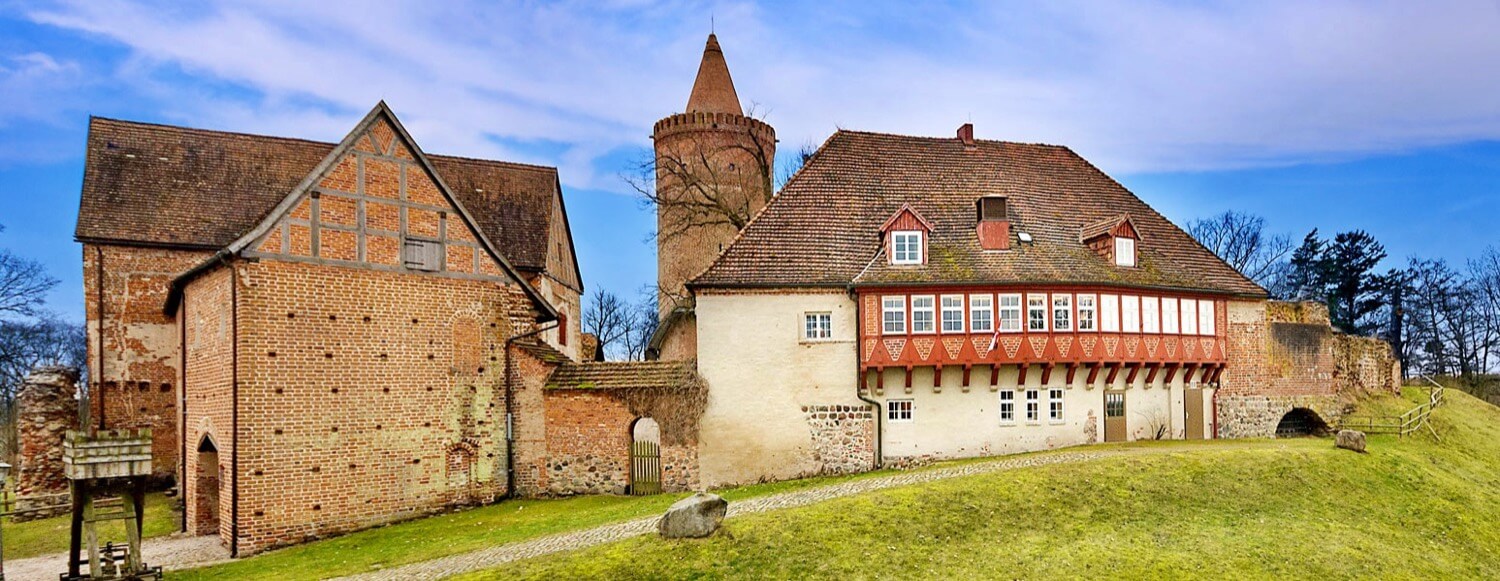
Stargard Castle is the northernmost extant hill castle in Germany. The 13th century castle, standing on a 90 m hill, and the eponymous small town in the valley below lie several kilometers southeast of Neubrandenburg, in the northeastern German state of Mecklenburg-Vorpommern. The complex consists of an outer and an inner bailey with eleven buildings preserved. The imposing castle keep serves as the city's landmark.
The castle hill was settled already before 3000 BC. When Slavic tribes advanced into the area during the Migration Period, they encountered remnants of an ancient fortification or settlement and thus called the place Stari Gard (Pomeranian: old castle). Since the 12th century, the area was conquered and colonized by Christian German princes. In 1237, Duke Wartislaw III of Pomerania, ceded the so-called "country of Stargard" (German: Stargarder Land, Latin: terra stargardiensis) to the Ascanian Margraves of Brandenburg, John I and Otto III, by the treaty of Kremmen. Under their orders, most of the present castle was being built between 1240 and 1270, to protect their northernmost territories. The hamlet of Stargard received its town privileges from Margrave Otto III in 1259. In 1292, by marriage of Margrave Albert's daughter Beatrix with Prince Henry II of Mecklenburg, the Lordship of Stargard was ceded to Mecklenburg as a dower and has remained part of that region ever since. After one of the many partitions of Mecklenburg, Stargard Castle became the residence of Duke John I of Mecklenburg-Stargard in 1352. After the Stargard line became extinct in 1471, their duchy was reunited with the rest of country again. The reign of Albert VII saw the significant modification and expansion of the castle in 1520, e.g. the gatehouse was remodeled into a chapel. During the Thirty Years' War, Stargard served as headquarters of General Tilly during the siege and capture of the nearby city of Neubrandenburg, but was heavily damaged itself during this time. In 1646, the keep was struck by lightning and burnt out. Even after becoming part of the newly-created duchy of Mecklenburg-Strelitz in 1701, the castle remained the seat of the local magistrate, as it had been for centuries. The last witch-hunt in Mecklenburg, if not the last in Northern Germany, took place here in 1726. A significant part of the complex, the Crooked House, which housed the magistrate's offices, burnt down in 1919. After surviving World War II without destruction, the castle's premises were used for educational purposes until 1963, then as a youth hostel till 1990. After the reunification, the whole complex was thoroughly restored. A museum was established, maintained by a Christian welfare work organisation. Today, it is also used for cultural events and for weddings in the restored castle chapel.
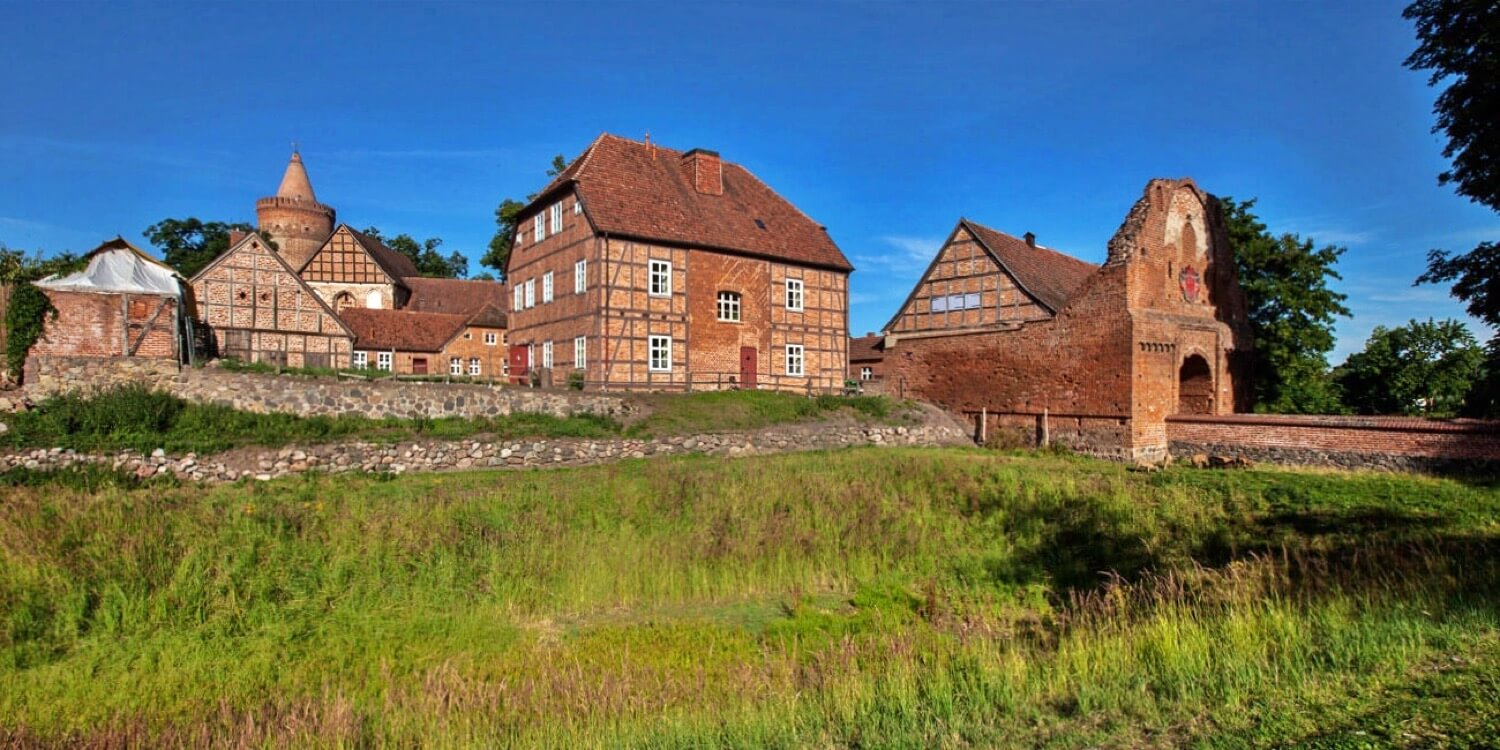
Stargard Castle consists of an outer and an inner bailey with eleven buildings in total. Both the inner one, roughly oval-shaped, and the outer one are surrounded by a moat. The keep is widely known as the town's landmark. All buildings were built out of brick, which is evidence for the castle's great importance in medieval times. The castle and the park can be visited for free. The museum (which also serves as the town museum) and the ascent to the top of the keep's tower are subject to a charge.
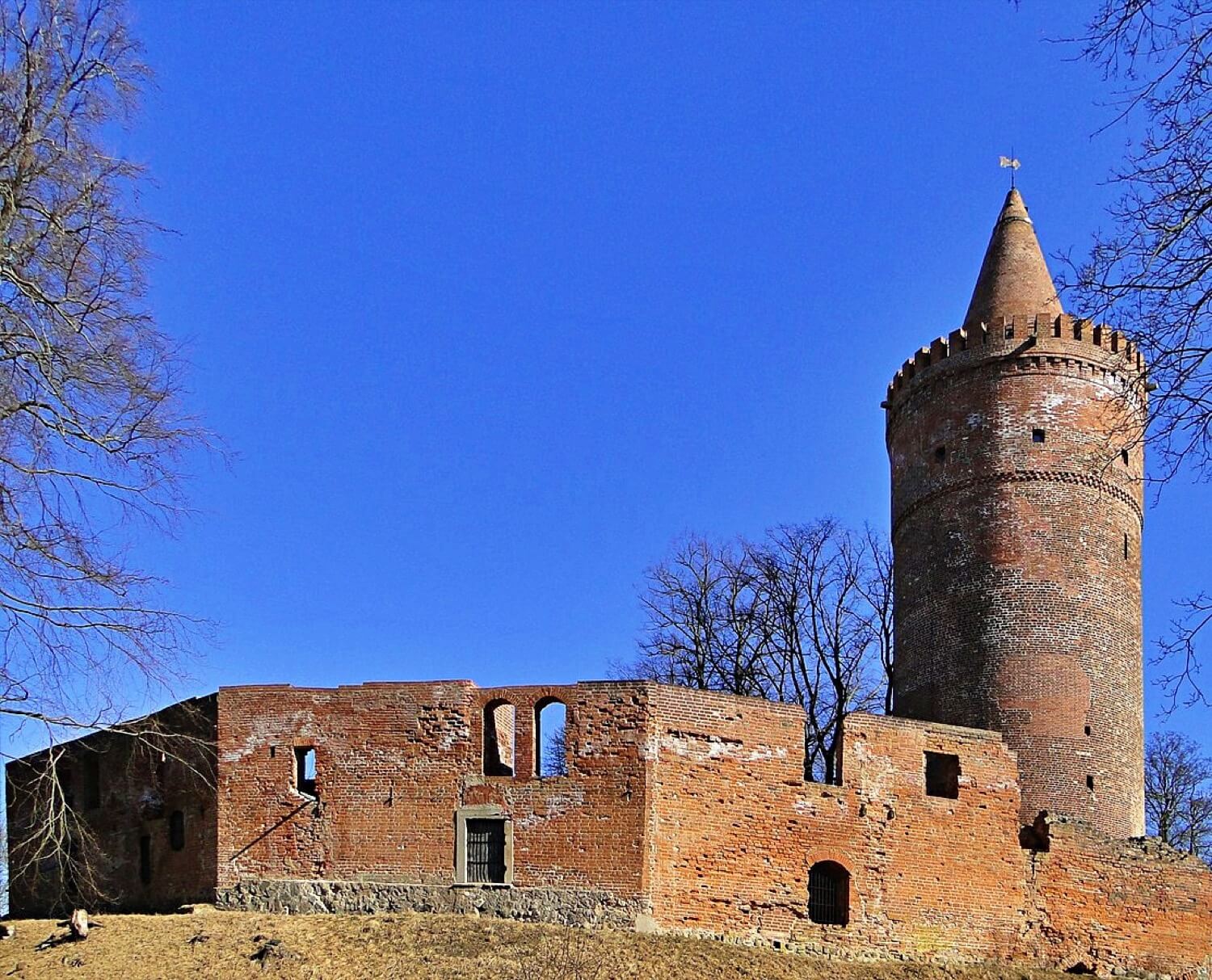
The keep was built ca. 1245 on a foundation of erratic boulders. In its lower parts, the walls are more than 4 m thick and have a circumference of 27 m. The entry is 9 m above ground and was accessed via a roofed wooden stairway (today a simple one out of metal). The dungeon is 13 m below the entry, i.e. also below the courtyard level. Above the dungeon, there were formerly three tower rooms. The keep burnt out due to a stroke of lightning in 1647. Grand Duke George entrusted F. W. Buttel, a student of the Prussian classicist architect Schinkel, with restoring and remodeling it into a viewing tower from 1821 to 1823. The tower is 38 m in height, including its 9 m tall cap. Under favourable conditions, it offers views up to 30 km all around, even as far as the windmills of Woldegk. The tower was restored in 1966.
The large building complex (German: Krummes Haus) in the inner bailey traditionally housed the magistrate's offices. It burnt down completely on 18 December 1919, due to arson. It has remained a ruin ever since, although part of it received a tentative roof and floor for hosting cultural events in the 1990s.
The Chapel developed as a three-storey gatehouse in the 1240s. The gate was inserted into the inner bailey's walls, but clearly protrudes out of them. After 1280, a chapel was established, at first in the upper storeys. Finally, in 1520, the drawbridge was dismantled, the gateway and the middle window were connected and then bricked up, and the building was refurnished as a chapel. Sixty years later, it was expanded towards the inner courtyard. In the 17th century, it was used as a garage and barn. Only between 1758 and 1770, it was used again, this time as a temporary municipal church, after most of the town had burnt down. Afterwards, it was again used for storage. The building shows a large pointed-arched window (now mostly bricked-up) and two smaller round-arched windows, one on each side, as well as a gable with 18th century framework. Remnants of the gate structure can be seen in the lesenes and the black glazed, round-arched friezes.
This gate was originally a brick building with a chapel in the upper storey, constructed about 1250. The gate was reinforced in the 16th century and remodeled in the 17th. Since 1755, it is partially destroyed, only the façade remained. The gable is edged by a round arch and once consisted of a staggered group of three windows, that are now walled up. As with the upper gate, there are lesenes and round-arched friezes next to the gateway. The former drawbridge was replaced by a stone causeway in the 16th century.
The building was erected in the 13th century, with one its walls also serving as an outer wall of the inner bailey, including a guards' walkway. It served as the local mint for a long time. After it was used as a restaurant during World War II, it continued as a youth hostel during Socialist times. After comprehensive restoration work, it re-opened as a hotel and restaurant in 1999.
Die Burg Stargard ist eine Höhenburg in Deutschland. Die auf dem etwa 90 Meter hohen Burgberg befindliche Burg und die zu ihren Füßen liegende gleichnamige Stadt Burg Stargard liegen südlich von Neubrandenburg im Bundesland Mecklenburg-Vorpommern. Die Anlage besteht aus einer Vor- und Hauptburg mit elf noch erhaltenen Gebäuden und prägt mit dem Bergfried als Wahrzeichen die Erscheinung der Stadt.
Bereits vor 3000 v. Chr. war der Burgberg bewohnt. Als während der Völkerwanderung slawische Stämme das Gebiet erreichten, fanden sie auf dem Burgberg Reste einer früheren Befestigung oder Siedlung vor und nannten den Ort daher Stari Gard (alte Burg).
Ab dem 12. Jahrhundert erfolgte die Eroberung und Besiedlung des Gebietes durch christliche Fürsten. In der Folge kam das Gebiet des heutigen Stargards an den Herzog Wartislaw III. von Pommern(-Demmin), der die Herrschaft Stargard im Vertrag von Kremmen 1236 den askanischen Markgrafen Johann I. und Otto III. von Brandenburg überließ. Zur Sicherung ihrer nördlichsten Landesteile ließen die Brandenburger ab 1236 die Burg Stargard erbauen. Der Ort Stargard erhielt 1259 durch den Markgrafen Otto III. das Stadtrecht. Durch die Heirat der Markgrafentochter Beatrix von Brandenburg mit Fürst Heinrich II. zu Mecklenburg kam die Herrschaft Stargard mit Stadt und Burg 1292 als Wittum in die Hand der Mecklenburger.
Mit der Landesteilung von 1352 wurde die Burg Stargard die Residenz des Herzogs Johann I. zu Mecklenburg-Stargard. Nach dem Aussterben der Stargarder Linie fiel das (Teil-)Herzogtum Mecklenburg-Stargard 1471 zurück an das Gesamthaus Mecklenburg. Herzog Albrecht VI. zu Mecklenburg ließ die Burg 1520 erheblich um- und ausbauen, so wurde zum Beispiel im ehemaligen Torgebäude die Burgkapelle eingerichtet.
Im Dreißigjährigen Krieg war die Burg 1631 das Hauptquartier von General Tilly während der Belagerung und Erstürmung von Neubrandenburg. In dieser Zeit wurde die Burg stark beschädigt. Im Jahr 1646 wurde der Bergfried von einem Blitz getroffen und brannte aus. Sitz eines herzoglich mecklenburgischen Verwaltungsamtes blieb die Burg Stargard auch nach der Errichtung des (Teil-)Herzogtums Mecklenburg-Strelitz 1701. Jahrhundertelang diente die Burg als Wohnsitz von Amtmännern, Amtshauptleuten bzw. Drosten. 1726 fand auf der Burg Stargard der letzte Hexenprozess Mecklenburgs statt. Die Malerin Mathilde Block arbeitete hier viereinhalb Jahre als Erzieherin.
Nach dem Zweiten Weltkrieg wurde die Burg bis 1963 als Landesjugendschule und bis 1990 als Jugendherberge genutzt. Nach der Schließung der Jugendherberge erfolgte ab 1990 eine umfangreiche Restaurierung der gesamten Burganlage. Weiterhin wurde ein Burgmuseum eingerichtet, das von den Diakonischen Werkstätten Neubrandenburg betreut wird. Außerdem werden auf der Burg kulturelle Veranstaltungen durchgeführt und Brautpaare getraut.
Die Burg Stargard teilt sich in eine Vor- und eine Hauptburg mit insgesamt elf Gebäuden. Die Hauptburg besitzt einen annähernd ovalen Grundriss und wird mit der östlich gelegenen Vorburg, die das Amtsreiterhaus beherbergt, von einem Graben umgeben. Der Bergfried ist das Wahrzeichen der Stadt. Die hohe Bedeutung der Burg zeigt sich daran, dass alle Gebäude als Backsteinbauten errichtet wurden.
Die Burg Stargard und der Burggarten können besichtigt werden. Museumsbesuch und Aufstieg auf den Bergfried sind kostenpflichtig.
Der Bergfried wurde um 1245 auf einem Fundament aus geschlagenen Findlingen erbaut. Im unteren Bereich sind die Mauern über vier Meter dick und haben einen Umfang von 27 Metern. Der Eingang befindet sich neun Meter über dem Boden und war ursprünglich über eine überdachte Holztreppe zu erreichen. Das Turmverlies wiederum liegt 13 Meter unter dem Eingang und damit weit unter dem Burghofpflaster. Über dem Verlies befanden sich einst drei Turmstuben.
Der Turm brannte 1647 nach einem Blitzeinschlag aus. Großherzog Georg zu Mecklenburg-Strelitz ließ Friedrich Wilhelm Buttel den Bergfried von 1821 bis 1823 zu einem Aussichtsturm umbauen. Inklusive der neun Meter hohen Spitze misst der Bergfried 38 Meter in der Höhe. Er bietet bei guter Sicht einen 30-Kilometer-Rundumblick bis zu den Mühlen von Woldegk. Im Jahr 1966 wurde der Turm renoviert.
Am 18. Dezember 1919 brannte das sogenannte Krumme Haus durch Brandstiftung bis auf die Grundmauern nieder; es ist bis heute eine Ruine.
Die Burgkapelle entstand zwischen 1240 und 1250 als dreigeschossiges Torhaus. Das Tor wurde in die Begrenzungsmauern der Burg eingelassen, ragt jedoch aus diesen deutlich heraus. Ab 1280 wurde eine Burgkapelle zunächst im Obergeschoss des Tors eingerichtet. Erst 1520 wurden die Zugbrücke entfernt, die Durchfahrt und das mittlere Fenster verbunden und zugemauert und das Gebäude zur Doppelkapelle umgestaltet. Sechzig Jahre später wurde die Kapelle zur Hofseite erweitert. Im 17. Jahrhundert diente sie als Wagenremise und Scheune. Nur zwischen 1758 und 1770 wurde das Gebäude als Stadtkirche wieder geistlich genutzt. Nach dieser Zeit war es wieder ein Lagerraum.
Das Gebäude besitzt mittig ein spitzbogiges Fenster mit zwei seitlichen Rundbogenfenstern. Der Giebel zeigt Steinfachwerk des 18. Jahrhunderts. Vom ehemaligen Tor sind die seitliche Lisenen und die schwarz glasierten Rundbogenfriese erhalten.
Das untere Tor entstand um 1250 als zweigeschossiger Backsteinbau, der eine Kapelle im Obergeschoss beherbergte. Im 16. Jahrhundert wurde das Tor verstärkt und im 17. Jahrhundert umgebaut. Seit 1755 ist es teilweise zerstört, heute ist nur noch die Fassade erhalten. Der Giebel wird von einem Rundbogen umfangen und bestand einst aus einer gestaffelter Dreifenstergruppe, die heute zugesetzt ist. Seitlich der Brücke befinden sich, wie am oberen Tor, Lisenen und Rundbogenfriese mit schwarzer Glasur. Die ehemalige Wippbrücke wurde im 16. Jahrhundert durch einen steinernen Damm ersetzt.
Im 13. Jahrhundert wurde das Gebäude errichtet, dessen Außenmauer zugleich Teil der Ringmauer der Hauptburg war, die den Wehrgang trug. Von 1938 bis 1944 war dort die Gaststätte „Zur Alten Münze“ untergebracht, danach zog eine Jugendherberge ein. Nach umfassender Renovierung wurde das Gebäude als Hotel und Restaurant 1999 neu eröffnet.
Useful information
1.00 EUR/Stunde
Burg: gratis
Burgturm: 2.00 EUR
Museum: 2.00 EUR
Kombi-Ticket: 3.00 EUR
Burg: gratis
Burg: gratis
ab 10 erwachsene Personen gibt es Rabatte
- Schlosspark
- Informationstafeln
- Wunderschöne Aussicht
- WC
ti@burg-stargard.de
- Es hat ein Museum
- Öffentliche Burgführungen: 3.00 EUR
- Audioguide (deutsch/englisch): 3.00 EUR (zzgl. 10.00 EUR Pfand)
- Für Rollstühle zugänglich
- Hunde sind nicht erlaubt
-
External links