Kransberg Castle
Darmstadt Hessen Germany
castle, chateau
Schloss Kransberg
Darmstadt Hessen Germany
castle, chateau
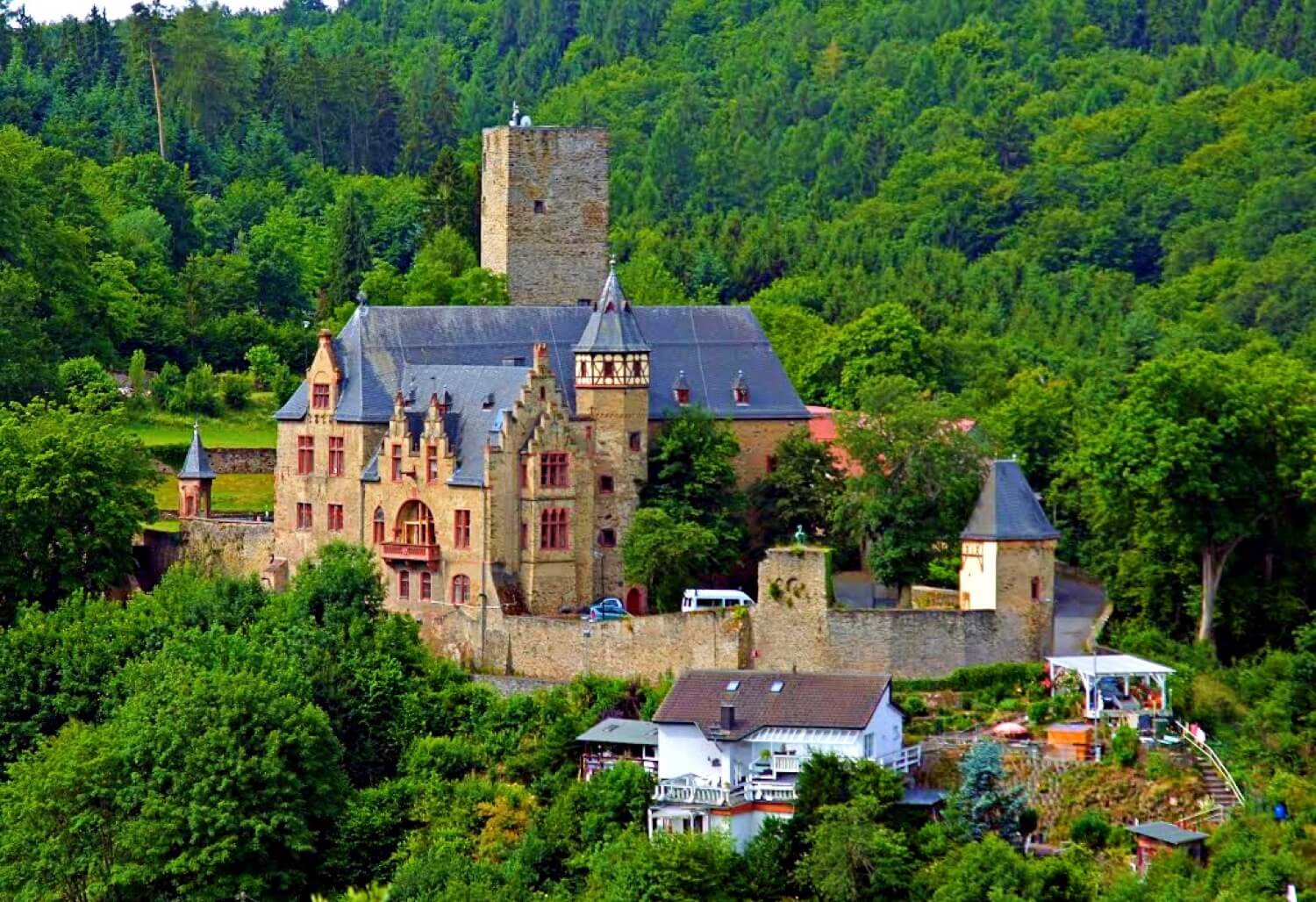
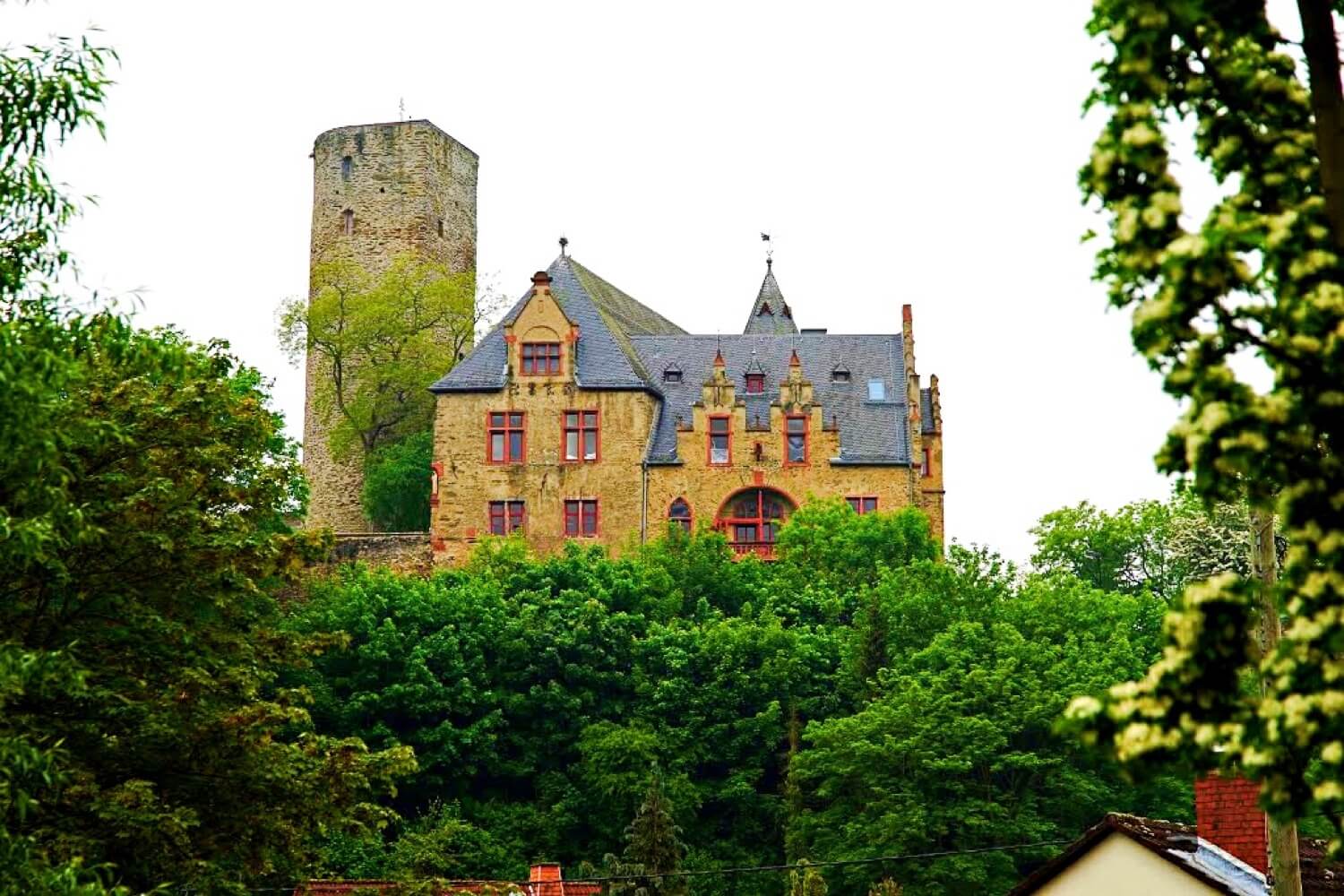
Kransberg Castle is situated on a steep rock near Kransberg (incorporated into Usingen in 1971), a village with about 800 inhabitants in the Taunus mountains in the German state of Hesse
Das Schloss Kransberg ist ein Schloss im Ortsteil Kransberg der Stadt Usingen, im hessischen Hochtaunuskreis, etwa 30 Kilometer nördlich von Frankfurt am Main und etwa 50 Kilometer nordöstlich von Wiesbaden
Previous names
Kransberg Castle, Schloss Kransberg
Description
Kransberg Castle is situated on a steep rock near Kransberg (incorporated into Usingen in 1971), a village with about 800 inhabitants in the Taunus mountains in the German state of Hesse. The medieval building, which acquired its current appearance in the late 19th century, served military and intelligence purposes in World War II and during the Cold War. It was returned to its original representation purposes during the second half of the 20th century, and briefly became a business park for small information technology and internet companies in the early post-millennium years.
The original Kransberg castle was constructed around 1170, presumably based on a fortification that dates back to the 11th century. The first documented owner (in 1250) was Erwinus de Cranichesberc (Middle High German for Kranichsberg = crane mountain). In 1310 the castle was sold to Duke Philipp IV. von Falkenstein. It was inherited by the nobility of Eppstein in 1433, and briefly fell to the Königstein line in 1522 when Gottfried X. von Eppstein died. It passed on to the County of Stolberg in 1535, to the Archbishopric of Mainz in 1581, and was sold to the Waldbott von Bassenheim family in 1654.
The castle fell into disrepair from the late 18th century onward until it was sold to the Duchy of Nassau in 1853. It fell to the state of Prussia in 1866 which in 1874 sold it to Arnold von Biegeleben, a Baron from Darmstadt who recreated and extended it in the neogothic style. Only parts of the outward fortifications and the central tower remained essentially unchanged.
Emma von Scheitlein, of Austrian nobility, acquired the castle in 1926 and used it for society events until the Nazi government appropriated it in 1939 and put it to military use.
From 1939-1941 Albert Speer adapted it for use as Adolf Hitler's main military command headquarters, under the title Adlerhorst. A compound of air-raid standard concrete bunkers were disguised as seven cottages, under which was an extensive bunker complex which linked them to the castle. But on completion the complex was dismissed by Hitler on a visit in February 1940, and Speer subsequently adapted it to serve as the Luftwaffe headquarters during Operation Sea Lion, the invasion of Great Britain. (Some characteristic elements of Speer's architectural style are still apparent in 2010.)
When plans for the invasion of Britain were abandoned in favor of Operation Barbarossa, the invasion of the Soviet Union, Kransberg was put to use as a rehabilitation center for soldiers of all ranks, and as the personal retreat for Hermann Göring.
From October 1944, the castle and Adlerhorst had become the headquarters of the Commander in Chief of OB West, Gerd von Rundstedt. After the failed 20 July plot attempt on Hitler's life, and the abandonment of the Wolfsschanze due to the advances of the Red Army, Hitler needed a new military base of operations for the forthcoming Ardennes Offensive. Hitler arrived at Giessen on the Führersonderzug (train) on 11 December 1944, taking up residence at the castle until 16 January 1945. Von Rundstedt who was to command Operation Wacht am Rhein set up his headquarters near Limburg, close enough for the generals and Panzer Corps commanders who were to lead the attack to visit the castle that evening. Von Rundstedt ran through the plans, that at 05:00 on December 15, envisaged the attack of three German armies consisting of over 250,000 men.
Shortly after Christmas, Göring arrived and took up residence in the castle. After an extremely downbeat briefing, Göring privately suggested to Hitler that a truce be sought via his Swedish contacts. Hitler flew into a rage, and after threatening to have Göring put before a firing squad, mentally dismissed him as deputy Fuehrer.
After giving his 1945 New Year's speech from the Adlerhorst, at 04:00 Hitler walked to the commaned centre to watch the development of Operation Nordwind, his counter-offensive on New Year's Day.
At midnight, nine Panzer divisions of Heeresgruppe G commanded by Generaloberst Johannes Blaskowitz had mounted an all-out attack on Bastogne. Then a faked diversionary attack was mounted by eight German divisions of Army Group Upper Rhine (Heeresgruppe Oberrhein) commanded by Heinrich Himmler, against the thinly stretched 110 kilometres (68 mi) line of the U.S. 7th Army and French 1st Army positions near Lembach in the Upper Vosges mountains in Alsace, 120 miles (190 km) to the southeast, to destroy them. However, as the Allies had cracked the Enigma code machines, each German manoeuvre was either prepared for or out-flanked by an allied counter-move. This resulted in a bitter attritional campaign that was lost from the 25th January onwards, by the German's running out of replacement manpower, machinery and supplies.
On 6 January 1945, a blockbuster bomb was jettisoned on Ziegenberg by a returning Allied bomber, damaging the church and several houses, killing four residents. With the Ardennes Offensive failed, and no new military plans or the resources by which to carry them out, the German military high command accepted that the western front was lost. Hitler left on his train for East Prussia on January 16, 1945 to bolster the defenders, with the Russians having already reached Danzig.
Having been made commander of OB West on March 11, on March 17 Kesselring ordered all classified documents and sensitive equipment removed from the castle. On March 19 the castle and surrounding area was subject to a 45-minute fire bombing air raid by a squadron of P-51 Mustangs. This resulted in the loss of 10 civilian lives, and the castle plus many of the surrounding buildings being damaged, destroyed or set on fire.
On March 28, with the American Army only 12 miles (19 km) away, Kesselring and his troops abandoned the castle complex. A U.S. Army unit took Kransberg Castle on March 30.
Soon thereafter a British-American detention center, commonly referred to as Operation Dustbin, for high-ranking German non-military prisoners of war, was established in parts of the complex. Focused on key industrialists, scientists and economists, among those interrogated here were Hjalmar Schacht, Wernher von Braun, Ferdinand Porsche, and the leaders of the IG Farben chemical conglomerate. The highest-ranking of these persons of interest was Albert Speer, the minister for armaments and wartime production who was detained in one of the buildings which he had redesigned as Hitler's chief architect a few years earlier. During his detention between June and August 1945 he provided very open and detailed accounts of the inner workings of the Third Reich and the impact of Allied bombing of Germany. "Dustbin" remained in operation throughout 1946.
In 1956 the Organisation Gehlen, the U.S.-German intelligence unit that later became the nucleus of the Bundesnachrichtendienst, moved in. It was later followed by the 5th U.S. Army Corps which operated an NCO academy, and by U.S. intelligence units which directed large parts of its espionage network in communist East Germany from here.
In the wake of the German reunification, the U.S. Army left Kransberg Castle in 1990 and returned it to the German government which sold it to Ulrike Brandis, a granddaughter of the disenfranchised Emma von Scheitlein, in 1993. Once again the complex became a center of culture and societal events. The costs of operating and maintaining the castle forced Brandis to sell her real estate to Klaus Landefeld, an information technology entrepreneur, in 2000. He converted parts of the complex into a business park for IT companies, and initiated the architectural reconversion of those parts that had been disfigured during the period of military use. When Landefeld's business suffered an economic downturn after the dot-com bubble had burst, these efforts were stalled. In 2007 he was forced to cede ownership to a real estate management company, which terminated the remaining business park operation at the end of 2008.
According to the company, which is seeking a buyer, some facilities at Kransberg castle will be reopened in 2010.
Das Schloss Kransberg ist ein Schloss im Ortsteil Kransberg der Stadt Usingen, im hessischen Hochtaunuskreis, etwa 30 Kilometer nördlich von Frankfurt am Main und etwa 50 Kilometer nordöstlich von Wiesbaden.
In der Gegend existierte bereits seit langer Zeit ein sogenanntes Feldgericht, das urkundlich bereits im 7. Jahrhundert erwähnt wurde. Es befand sich nur etwa 500 m Luftlinie vom Standort des heutigen Schlosses entfernt auf einem Hügel, auf dem noch heute eine Kapelle steht. Im 11. Jahrhundert wurde eine einfache Wehranlage in der Gegend der heutigen Burg betrieben, vermutlich an der gleichen, strategisch günstigen Stelle.
1170 wurde Kransberg durch die Staufer als Teil einer Verteidigungskette Friedberg-Kransberg-Königstein-Kronberg zur Verteidigung gegen die Limburger Bischöfe als eine der ersten Steinburgen erbaut. Als einziges und ältestes Element der Gesamtanlage ist aus dieser Zeit der Bergfried erhalten. Aus dem Jahr 1220 datiert die erste gesonderte urkundliche Erwähnung der Burg im Zusammenhang mit der Erweiterung der Anlage und dem Bau des Palas sowie des Treppenhausturmes. Beide Bauten existieren heute als Teil des Hauptgebäudes.
1310 ging das Geschlecht derer von Cransperk unter, und die Burg ging an das Geschlecht derer von Falkenstein. 123 Jahre später, 1433, fiel die Burg den Herren von Eppstein zu und wurde um das Zwischengebäude erweitert. Von 1522 bis 1533 gehörte die Burg kurzzeitig den Herren von Königstein und ging dann in den Besitz der Grafen von Stolberg über.
Im Zuge des Landfriedens 1590 gelangte die Anlage in den Besitz des Erzbischofs von Mainz. Der Wohnanbau an das Hauptgebäude wurde erstellt. Die Grafen Waldbott von Bassenheim erwarben 1654 den Besitz nach den Zerstörungen des Dreißigjährigen Krieges. Das Anwesen wurde um einen Gutshof und die Stallungen erweitert und diente vornehmlich landwirtschaftlichen Zwecken.
1854 wurde der Besitz an das Herzogtum Nassau verkauft und durch den verlorenen Krieg gegen Preußen 1866 preußisch. 1875 kaufte die Familie von Biegeleben das Anwesen und renovierte es grundlegend. Die ehemalige Burg wurde nun als Schloss Cransberg bekannt.
1920 erstand Frau von Scheitlein das Anwesen.
1939 wurde das Schloss durch das Nazi-Regime beschlagnahmt und als Teil des Komplexes Adlerhorst erneut grundlegend erweitert und renoviert. Der Tiefbunker, der Rittersaal und die Garagen wurden in dieser Zeit errichtet, bis Schloss Kransberg 1945 durch die Amerikanischen Streitkräfte erobert wurde.
Ab 1945 nutzten die britischen Streitkräfte den Komplex und betrieben dort das Vernehmungszentrum Camp Dustbin, wo im Vergleich zum Camp Ashcan eher die Spitzen der Wissenschaft, Technik und Rüstungsorganisation des Naziregimes, Albert Speer, Wernher von Braun, Hermann Oberth, Karl Saur, Hans Kehrl, Fritz Thyssen, Hermann Röchling und andere inhaftiert und befragt wurden. Im Sommer 1946 fand hier die erste Konferenz der Weltgeschichte über biologische Waffen statt.
In der Folge gab es wechselnde Belegungen, immer durch militärische Nutzer. Die Organisation Gehlen, der Vorläufer des Bundesnachrichtendienstes, nahm hier ihren Ursprung. Einheiten der Bundeswehr und der amerikanischen Streitkräfte nutzten die Anlage ebenfalls.
Die amerikanischen Streitkräfte verließen das Gebäude 1990. Es fiel zurück an die Bundesvermögensverwaltung, die es 1995 an die Erben der ehemaligen Besitzerin, Frau von Scheitlein, verkaufte. Ein Unternehmer erwarb das Anwesen 1999 von der Erbengemeinschaft. Eine zivile Nutzung wurde beantragt, das Objekt einer Mischnutzung aus Büro-, Veranstaltungs- und Wohnnutzung zugeführt. Aufgrund von finanziellen Schwierigkeiten des Eigentümers wurde das Schloss 2007 zwangsversteigert und kam an die HmcS Real Estate GmbH. Das Schloss diente 2011, ebenso wie das Dorf selbst, als Kulisse für die Tatort-Folge Das Dorf.
Ende 2012 wurde das Schloss an eine türkische Investorengruppe verkauft, die es als Bildungseinrichtung nutzen möchte. Dringend notwendige Unterhaltungsmaßnahmen unterblieben jedoch, so dass die Anlage immer mehr verfällt. Da diverse Mauerpartien und ein Balkon einsturzgefährdet sind, musste die unterhalb der Burg verlaufende Schloßstraße zwischenzeitlich gesperrt werden. Anfang Februar 2014 wurde mit ersten Sicherungsmaßnahmen begonnen. Am 28. März 2014 kam es im Inneren des Gebäudes zu einem Schwelbrand, der beträchtliche Schäden verursachte und einige Deckenbalken in Mitleidenschaft zog, die danach abgestützt werden mussten. Es gibt hier Konzerte und ein Standesamt.
Useful information
Gratis
- WiFi
- WC
- Schloßkapelle
sckr@web.de
- Ort der Organisation von Veranstaltungen
- Kein Besuch
-
External links
Nearby castles