Godesburg
Köln Nordrhein-Westfalen Germany
castle, chateau
Godesburg
Köln Nordrhein-Westfalen Germany
castle, chateau
The Godesburg is a castle in Bad Godesberg, a formerly independent part of Bonn, Germany
Die Godesburg wurde vermutlich als Fliehburg bei Bad Godesberg am Rhein – heute im Bonner Ortsteil Alt-Godesberg im Stadtbezirk Bad Godesberg – von den Franken erbaut
Previous names
Godesburg, Godesburg
Description
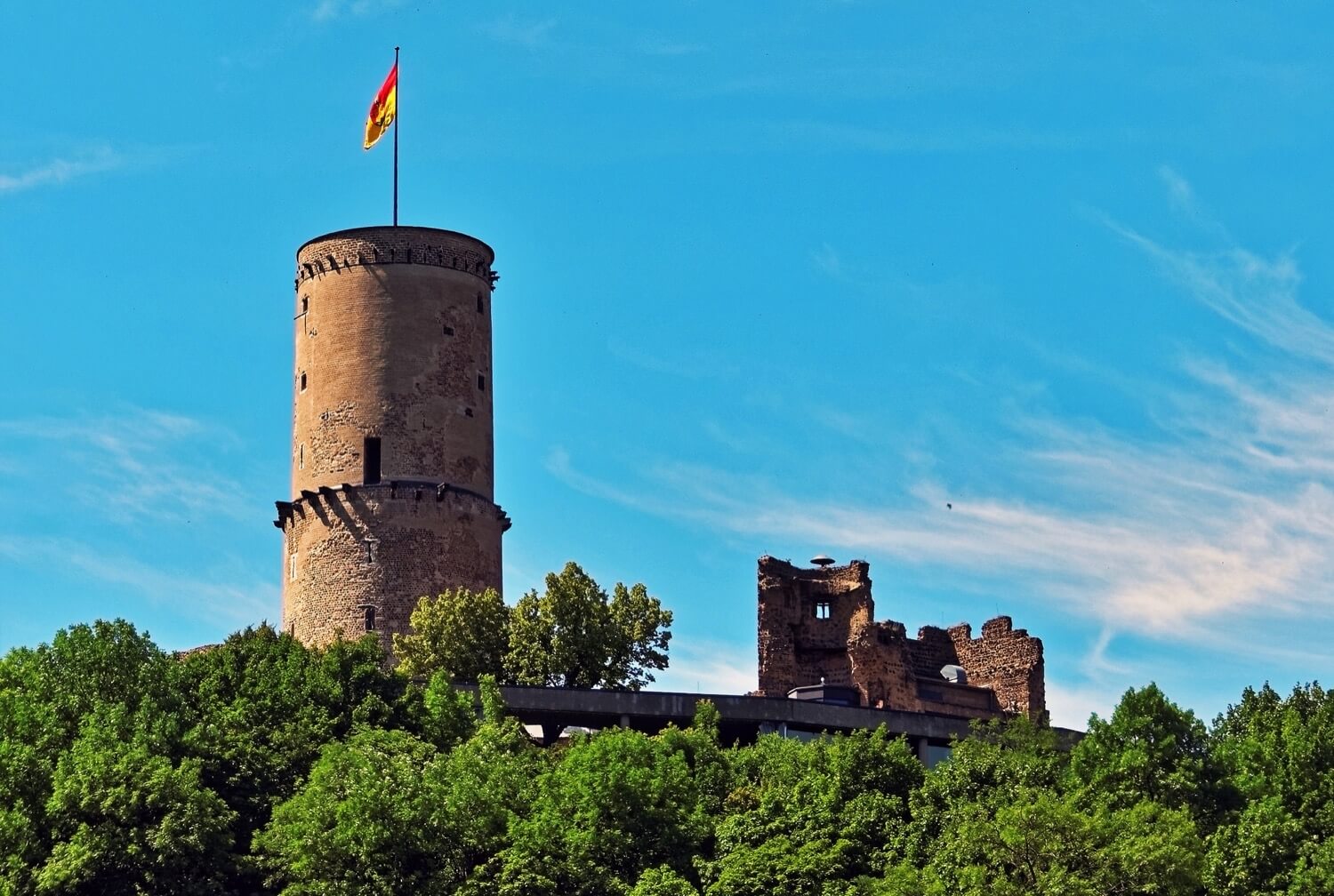
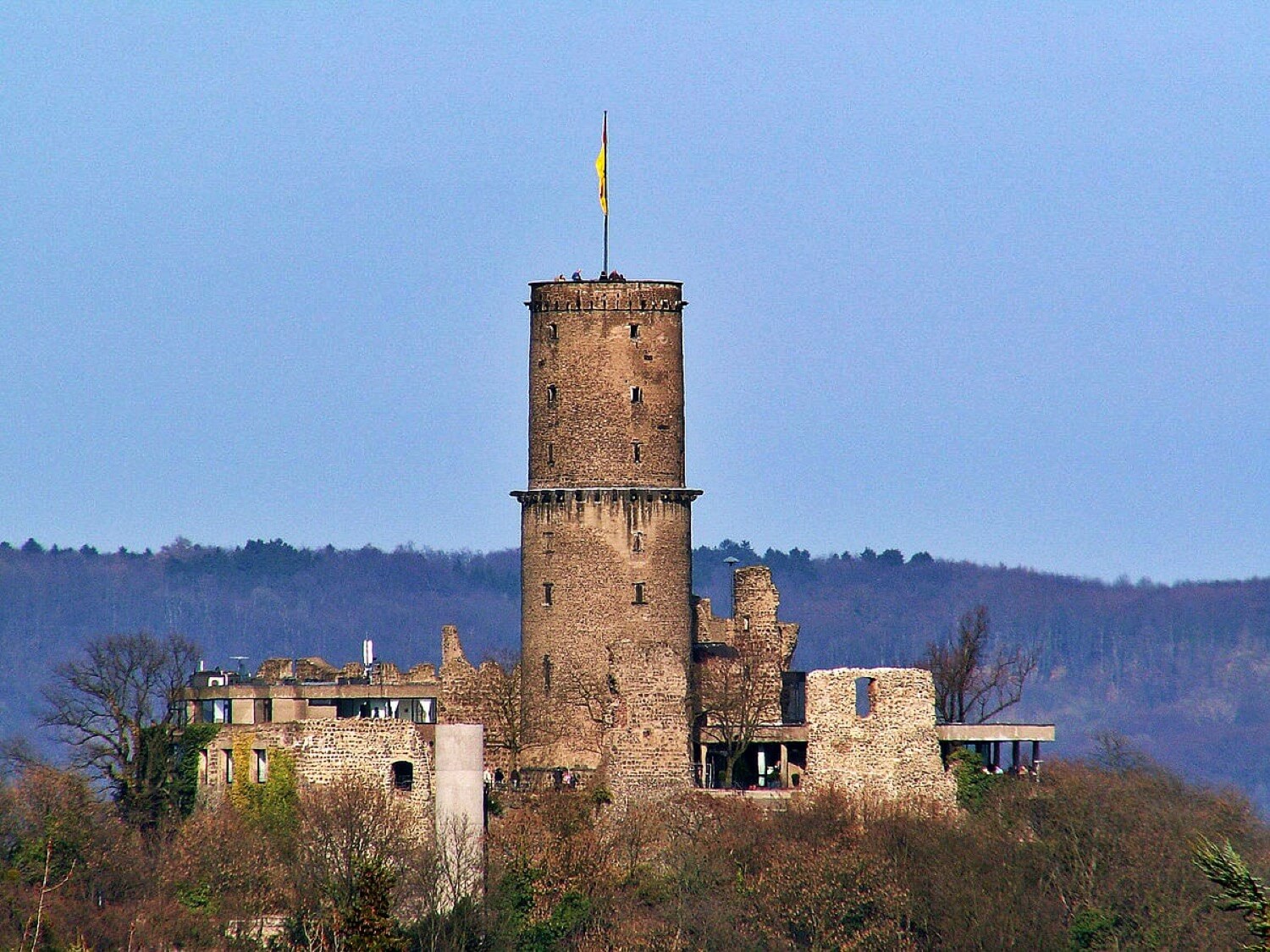
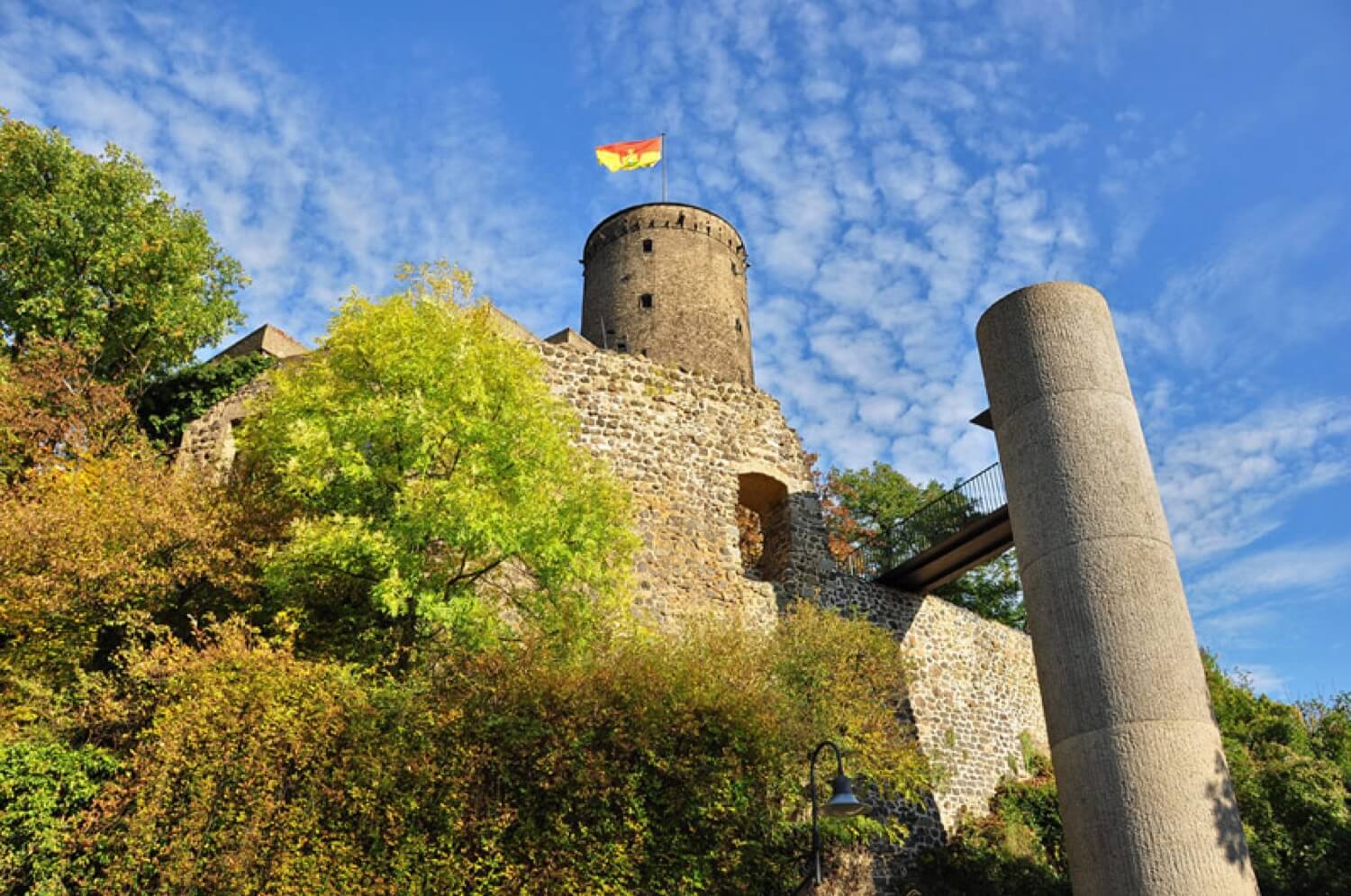
The Godesburg is a castle in Bad Godesberg, a formerly independent part of Bonn, Germany.
Built in the early 13th century on the Godesberg, a hill of volcanic origin, it was largely destroyed following a siege in 1583 at the start of the Cologne War. In 1891, the German emperor Wilhelm II donated the castle's ruin to the city of Bad Godesberg.
In 1959, the ruin was rebuilt according to plans by Gottfried Böhm, to house a hotel and restaurant. Today, the restaurant is still in operation, but the hotel tract has been divided into apartments.
The site has a controversial history. Growing out of the nineteenth-century Heimat movement, historians speculated that in the pre-Christian era, the inhabitants probably used the peak to call to the god Wotan, the god of war, death and the hunt, and other attributes, establishing a custom that led eventually to the erection of a house of prayer on the site. They found early mention of the site in 9th century documents, and again in the 12th century, documents continue to refer to it as Gotensberg, or Gotensperg. first mentioned in documents from the early 8th century, was supposedly built on an old cult site and its name derived from the old Germanic Wotansberg, Woudensberg, or Gotansberg. In the 10th century, documents from the reign of Otto I in 927, and Otto II in 974, suggested that a religious community had been located on the mountain peak, thus the name Gottesberg. From this speculation, the idea emerged that the fort itself was established on an ancient cult site.
The fortress foundation stones were laid by a vicar upon the order of Dietrich I, the Archbishop of Cologne, who was himself in disputed possession of the Electorate and fighting to keep his position. After Dietrich's death in 1224, his successors finished the fortress; it featured in chronicles of the 13th through 15th centuries as both a symbolic and physical embodiment of the power of the archbishop of Cologne in his many struggles for regional authority with the patricians of the imperial city of Cologne. By the late 14th century, the fortress had become the repository of the Elector's valuables and archives, and by the mid-16th century, was popularly considered the lieblingssitz, or the favorite seat (home), of the Electors.
The fortification had been originally constructed in the medieval style and in the reign of Siegfried II of Westwald (1275–1295) successfully resisted a five-week siege by Count William of Cleves. Successive archbishops continued to improve the fortifications with stronger walls and expanded moats, adding levels to the central Bergfried, which was cylindrical, not square like many medieval donjons, expanded the inner works to include a small residence, dungeons, and chapel, fortified the walls, added a curtain wall, and improved the roads. By the 1580s, it was an elaborate stone fortress, and it had been enhanced partially in the style made popular by Italian military architects. Although the physical location did not permit the star-shaped trace italienne, its cordons of thick, rounded walls and massive iron-studded gates still made it a formidable adversary. Its height, some 400 feet (122 m) above the Rhein (Rhine), on the peak of a steep hill, made artillery fire difficult.
Fortifications such as this, and the star-shaped fortresses more commonly found in the flatter lands of the Dutch Provinces, made warfare both difficult and expensive; victory was not simply a matter of winning a battle over the enemy's army, but of traveling from one fortified and armed city to another and investing time and money in one of two outcomes: ideally, with a show of extraordinary force, convincing the city leaders to surrender the city, or reducing the city to rubble and storming the ruins. In the case of the former, when a city capitulated, it would have to quarter troops at its expense, called execution, but the soldiers would not be permitted to plunder; in the case of the latter, no quarter was given to the defenders.
Die Godesburg wurde vermutlich als Fliehburg bei Bad Godesberg am Rhein – heute im Bonner Ortsteil Alt-Godesberg im Stadtbezirk Bad Godesberg – von den Franken erbaut. Die Spitze des Bergfrieds der heutigen Ruine befindet sich auf 122 Metern ü. NN, die dortige Plattform ermöglicht einen einzigartigen Blick über das Rheintal.
Die Höhenburg liegt auf einem in vorgeschichtlicher Zeit erloschenen Vulkan, der die einzige markante Erhebung innerhalb des Godesberger Rheintaltrichters darstellt. Eine bereits römische Besiedlung wurde durch einen in die Godesburg eingemauerten Altarstein nachgewiesen. 722 wurde der Berg als ubische Kultstätte Woudensberg (Wotansberg) urkundlich erwähnt.
Am 15. Oktober 1210 legte der Kölner Erzbischof Dietrich I. von Hengebach den Grundstein für einen Neubau. Erzbischof Konrad von Hochstaden erweiterte die Burg 1244 um die ersten fünf Geschosse des Bergfrieds. Erzbischof Walram von Jülich erhöhte diesen auf 32 Meter und ließ die Vorburg erbauen.
Während der Reformationszeit verstieß der Kölner Erzbischof Gebhard I. von Waldburg gegen den Augsburger Religionsfrieden, als er sich mit Gräfin Agnes von Mansfeld vermählte und zum Calvinismus übertrat. Er löste damit den Truchsessischen Krieg aus. Truppen des neu gewählten Kurfürsten Ernst von Bayern belagerten die Anlage 1583. Zerstört wurde die Godesburg durch die Sprengung der Mauer im Zuge eines Angriffes. Die Eroberung gelang am 17. Dezember 1583, als ein katholischer Söldner durch den Abort in die Burg gelangen konnte. Auf gleichem Weg folgten ihm weitere Angreifer, so dass sich die Besatzung, innerhalb und außerhalb der teilweise zerstörten Mauern bedroht, letztendlich ergeben musste.
1891 schenkte Kaiser Wilhelm II. die Ruine der damaligen Gemeinde Godesberg.
22 Kösener Corps gründeten im Mai 1951 auf der Godesburg die „Interessengemeinschaft“, den Vorläufer des rekonstituierten Kösener Senioren-Convents-Verbandes.
1959 wurde die Burg nach Plänen von Gottfried Böhm umgebaut. Eine Erweiterung beherbergte zu Beginn ein Hotel-Restaurant, heute ist nur noch das Restaurant in Betrieb. Der ehemalige Hoteltrakt ist – aufgeteilt in kleinere Wohnungen – vermietet. Die Stadt Bonn bietet an ausgewählten Terminen die Möglichkeit zur standesamtlichen Trauung in der Godesburg.
Auf dem Burgfriedhof Bad Godesberg bei der Michaelskapelle befinden sich viele reich gestaltete Grabstätten des Großbürgertums aus dem 19. Jahrhundert. Auch der Politiker Herbert Wehner, der Filmschauspieler Paul Kemp und die berühmte Wirtin Aennchen Schumacher fanden hier ihre letzte Ruhe.
In den letzten Jahren wurde die Godesburg in großen Teilen saniert. Bis 2003 wurden durch die Stadt Bonn 2,7 Millionen Euro für den Umbau der Gastronomie ausgegeben. Im Juni 2006 wurde die Sanierung des Bergfrieds abgeschlossen, in dem ein kleines Informationszentrum zur Geschichte der Burg eingerichtet wurde. Im Juli 2006 ließ die Stadt Bonn an der Aussichtsplattform auf der Turmspitze Orientierungstafeln in allen vier Himmelsrichtungen anbringen. Von September 2012 bis Februar/März 2014 wurde der Bergfried saniert und war dafür eingerüstet. Der Burghof der Godesburg ist über einen Aufzug zu erreichen.
Seit 1981 ist im Burghof die Nachbildung eines römischen Votivsteins aus der Zeit um 200 n. Chr. aufgestellt. Er war den Heilgöttern Äskulap und Hygia geweiht und wurde 1583 auf der Godesburg gefunden.
Nearby castles
Schloss Drachenburg
Köln
4.3km
castle, chateau
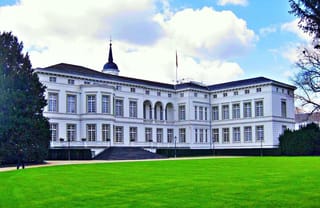
Palais Schaumburg
Köln
4.6km
castle, chateau
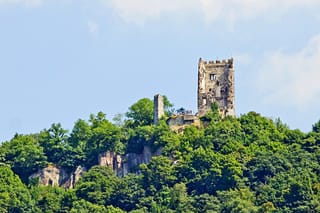
Burg Drachenfels (Siebengebirge)
Köln
4.7km
castle, chateau
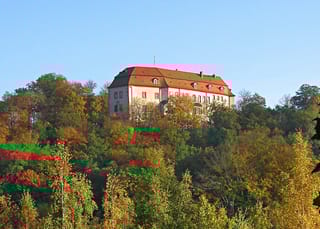
Wolkenburg
Köln
4.9km
castle, chateau
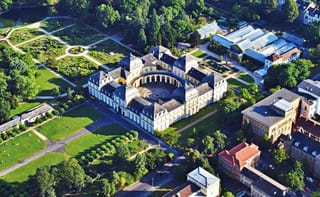
Poppelsdorf Palace
Köln
6.1km
manor, mansion
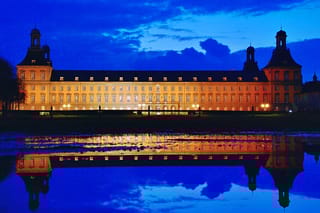
Electoral Palace (Bonn)
Köln
6.4km
manor, mansion
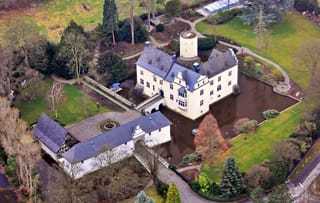
Burg Odenhausen
Köln
6.7km
castle, chateau