Burg Anholt
Münster Nordrhein-Westfalen Germany
castle, chateau
Burg Anholt
Münster Nordrhein-Westfalen Germany
castle, chateau
The Anholt was eponymous for the former town Anholt , now part of Isselburg in North Rhine-Westphalia
Die Burg Anholt war namensgebend für die ehemalige Stadt Anholt, heute ein Stadtteil von Isselburg in Nordrhein-Westfalen
Previous names
Burg Anholt, Burg Anholt
Description
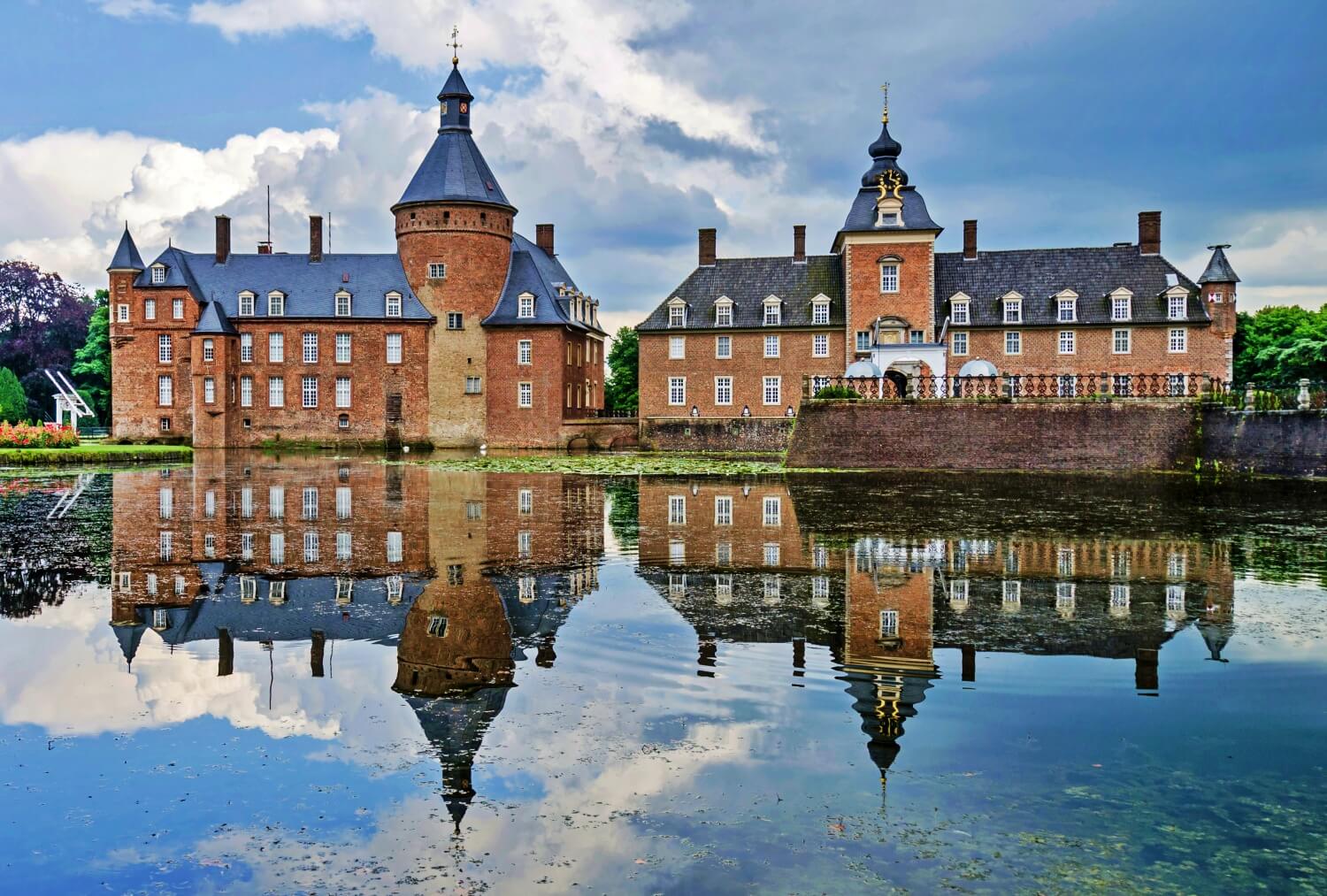
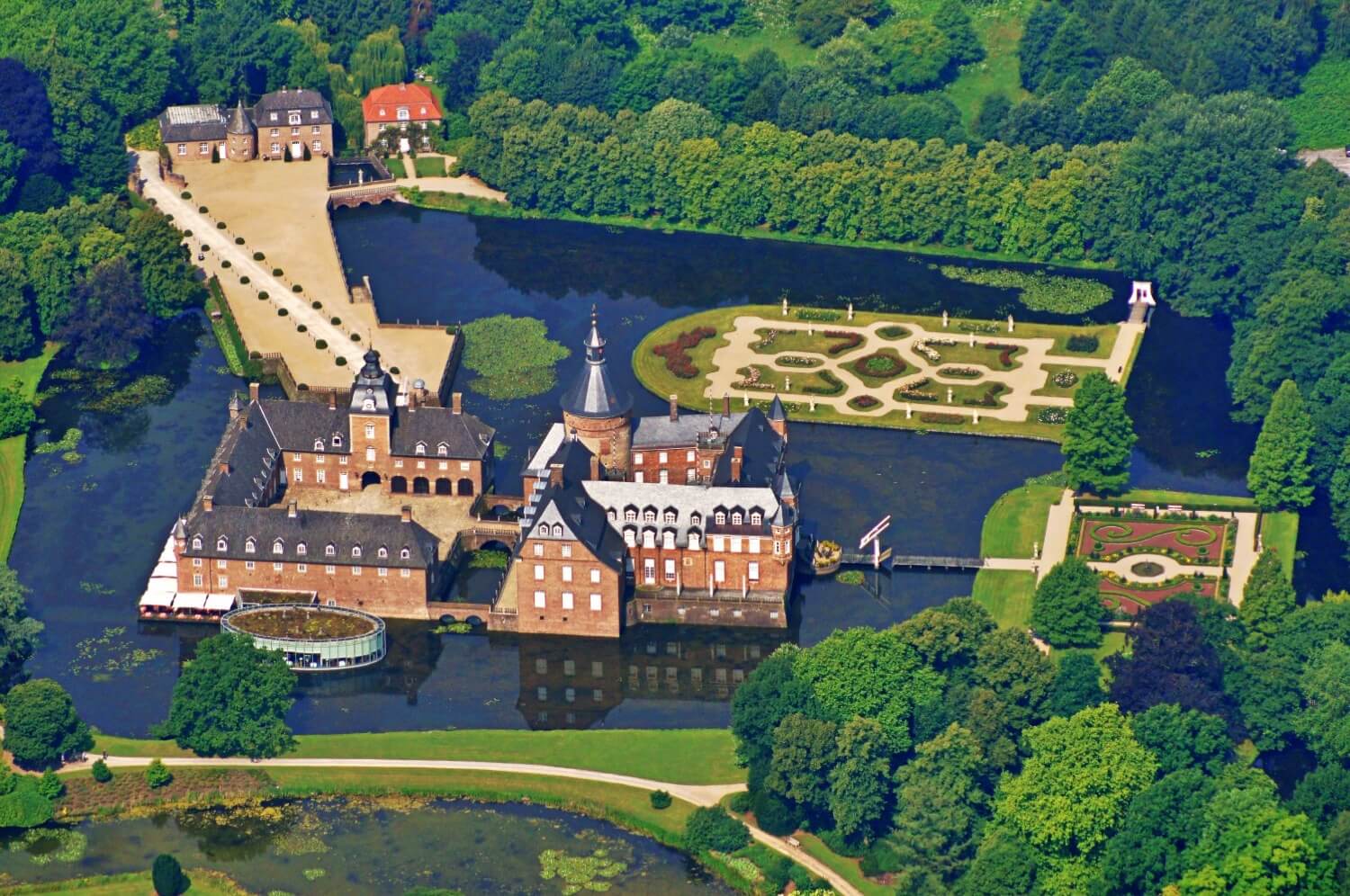
The Anholt was eponymous for the former town Anholt , now part of Isselburg in North Rhine-Westphalia . The complex is one of the largest moated castles in the Münsterland and is located on the border with the Lower Rhine . Its origins lie in a defense structure from the 12th century to secure the property of the diocese of Utrecht . The graves are fed by the Issel .
Even if the name suggests that Anholt is a castle , it is actually a castle .
Residents and owners
In 1169, a gentleman from Sulen "en Anholt" was named for the first time as a feudal man of the Utrecht bishop Gottfried von Rhenen , which is why historians today assume that the moated castle Anholt was built before that year to protect the extensive territories of the diocese. However, it is historically guaranteed that at the latest under Stephan III. von Sulen (1313–1347) the feudal relationship with Utrecht was ended, because at that time the castle and the surrounding village were an imperial glory that belonged to the Lower Rhine-Westphalian Empire .
When the Anholter branch of the Herren von Sulen in the male line became extinct in 1380, the castle and the glory of Herberga von Sulen fell to her husband Hermann III. of gems . However, since this couple did not have a male ancestor either, Anholt came to the family of her husband Gysbert von Bronkhorst -Batenburg in 1402 through the marriage of Margaretha von Gemen . Emperor Sigismund confirmed to the Bronkhorst-Batenburgs in 1431 the imperial direct rights of their glory.
During the Geldern feud , Gysbert's son, Jakob I, sided with the Roman-German King and later Emperor Maximilian I and fought together with Johann II. Duke of Cleves against the Geldern Duke Karl von Egmond . As a result, Duke Karl tried unsuccessfully to take Anholt Castle by surprise in 1499. Another attempt by Duke Charles in 1512 was successful. Weakened by a previous plague epidemic, the castle had to open its gates to its enemies after three months of siege .
The castle complex remained in the possession of Geldern for 25 years . Although Jacob's successor, his cousin Dietrich III, had his direct imperial rights as Lord von Anholt confirmed in 1531, he only managed to get the castle back through a treaty in 1537. In return for the release of the castle and its glory, the Geldrian duke demanded high contributions . In addition, the castle, town and country had to be kept open to the dukes, but only three years later Emperor Charles V released the Lords of Anholt from these obligations. However, the supporters of the Union of Utrecht during the Eighty Years' War paid no heed to this fact and, citing the treaty of 1537, demanded that Anholt join the alliance against Spain. The refusal of the Catholic Dietrich was followed by the siege of the city by the Geusen . Dietrich wanted to protect the poorly fortified city through negotiations and opened the city's gates for this purpose after the members of the Union had promised not to use any violence. But only moments after they passed the city gates, they broke their promises. They looted Anholt and set fires in many places. It was only when Duke Wilhelm V of Kleve sent troops for relief that the looters fled. The castle suffered a similar fate in the Thirty Years' War , when it was plundered and pillaged again.
Dietrich IV died as the last male representative of the family - meanwhile elevated to the rank of count by the emperor - after he had transferred the castle and county to the husband of his daughter Maria-Anna, the imperial count Leopold Philipp Carl zu Salm , Wild- und Rheingraf , in 1647 . In 1743 his descendant Nicolaus Leopold was given the hereditary title of Prince of Salm-Salm by the Emperor .
In 1802 the rule of Anholt was combined with the offices of Bocholt and Ahaus of the abolished Princes of Munster to form the Principality of Salm . In 1810 the Principality of Salm fell to France. In the course of the Congress of Vienna , the sovereignty of the Principality of Salm was not restored, but the areas were assigned to Prussia . Anholt Castle remained the residence of the princes. Today it is one of the few large privately owned facilities in North Rhine-Westphalia.
Building history
Core castle
The first verifiable castle complex, built before 1169, includes the almost eleven meter wide, round keep (the so-called thick tower ), a small residential building in the northeast corner of today's complex and a wall ring that once enclosed an oval area.
The entrance to the keep was a high entrance and at that time was almost seven meters above today's pavement of the inner courtyard and was only accessible via rope ladders. Below this entrance was the dungeon . Built in a swampy area, the entire complex was made of tuff stone on a foundation of wooden piles that had been driven into the boggy subsoil.
In the 14th century, the core castle was expanded considerably and was given dimensions that were only slightly smaller than today's. The extension buildings were also given post gratings made of oak wood as a foundation. The original house was raised and expanded to defend itself. Two-story residential wings were built on the east and south sides. After this expansion, the western and northern fronts of the castle consisted only of two-meter-wide, accessible defensive walls with hexagonal watchtowers.
During the 16th century, the west and north sides were expanded for residential purposes. The construction of two stair towers in the north-west and north-east corner of the main castle can also be dated to this time .
Around 1700, at the instigation of Prince Karl Theodor Otto zu Salm, the complex was expanded into a representative baroque residence with the character of a castle. The thick tower received its current, towering roof spire , and the other buildings were also crowned with a uniform slate roof. Along with the renovation, all facades were given a uniform plaster , in which - in keeping with the taste of the times - a pattern was carved that imitated large ashlar stones. In addition, a two-storey pavilion was placed in front of the north front to provide access to the first park .
Outer bailey
The origins of the so-called “Unterhoff” lie in the time of the first expansion of the core castle. Excavation results suggest that the dimensions of the outer bailey already at that time corresponded to their current dimensions . The entrance still leads through the so-called bell tower . The coat of arms of Emperor Charles V (from 1540) and Duke Karl von Egmond (from 1512) embedded in its walls remind of the occupation of the castle by Geldrian troops.
In the years 1697 to 1703 the outer bailey was rebuilt according to plans by the Milanese architect Tommaso Tommassini.
Outdoor facilities
The first gardens of Anholt Castle date back to the 18th century and were laid out in symmetrical shapes based on the Baroque model of French garden art .
According to garden plans, which were commissioned by Florentin zu Salm-Salm from 1831, areas of the park were redesigned into an English landscape garden first by the Düsseldorf court gardener Maximilian Friedrich Weyhe and from 1858 by the English garden architect Edward Milner , who laid out canals and ponds . In the process, the park was largely expanded. In 1945 the gardens were destroyed, but between 1962 and 1995 - partly again in the original baroque garden style - reconstructed and restored.
Inspired by the impressions of his honeymoon, Leopold zu Salm-Salm had Leopoldspark built for his wife in the south-western part of the outdoor area from 1892 to 1900, modeled on Lake Lucerne . It was equipped with a miniature lake, framed by an artificial rock landscape, and an original Swiss house . At the beginning of the 20th century, the popularly known "Leopoldspark" was converted into a game reserve. Rebuilt by Nikolaus Leopold Prince zu Salm-Salm after the destruction of World War II , it was opened to the public in 1966 under the name Anholter Switzerland .
Reconstruction and current use
In the spring of 1945, Anholt and Anholt Castle were badly damaged by fighting during World War II. The castle complex was 70 percent damaged. Near the castle there were launch pads for the V2 rockets bombed by British planes. The lord of the castle at the time, Nikolaus Leopold Heinrich zu Salm-Salm, began to take measures to save the castle immediately after the destruction. Since he had recognized that a new economic basis had to be found for the preservation of the castle complex and its treasures, he included the castle early on in the considerations for the development of shopping and excursion traffic in Anholt.
In 1947 and 1950, at the invitation of the owner, the so-called Anholt Circle, a group of well-known architects and town planners, met in the Anholt Castle, who had previously worked in the immediate vicinity of the Reich Minister of Armaments Albert Speer with the expansion of the Reich capital Berlin to the world capital Germania and with the preparation of the reconstruction bombed cities: Rudolf Wolters , Ernst Neufert , Friedrich Hetzelt , Friedrich Tamms and Konstanty Gutschow, among others . They gave numerous suggestions for the reconstruction of Anholt and its castle.
After the restoration of Anholt Castle, it could be inhabited again by the princely family. At the same time, many parts of the facility were made accessible to the public. In addition to a museum, the parks can also be visited for a fee. The castle also houses a hotel with a restaurant and a golf club.
Museum
A museum was opened in the castle in 1966. It gives the visitor an insight into social life and court culture on Anholt. Among other things, the largest private collection of paintings in North Rhine-Westphalia with numerous works by well-known Dutch masters such as Rembrandt (for example The Bath of Diana with Actaeon and Callisto ), Jan van Goyen and Gerard ter Borch (portrait of Gesina ter Borch as shepherdess), testimonials stately home decor, the armory and an extensive porcelain collection can be visited.
The museum also shows many original interiors, because they were moved to a tunnel during the Second World War and have therefore been preserved. For example, wooden floors that are over 400 years old can be seen in some rooms.
Library
The castle library is also open to visitors. It consists of a 230 m² hall in the classicism style and was completed in 1860. The holdings include the closed library of the Cistercian monastery Groß-Burlo, the library of the Counts of Bronckhorst-Batenburg from the period between 1400 and 1650 and the library of the Princes of Salm-Salm with documents from 1650 to today.
https://de.zxc.wiki
Die Burg Anholt war namensgebend für die ehemalige Stadt Anholt, heute ein Stadtteil von Isselburg in Nordrhein-Westfalen. Die Anlage ist eines der größten Wasserschlösser des Münsterlandes und befindet sich an der Grenze zum Niederrhein. Ihre Ursprünge liegen in einem Wehrbau aus dem 12. Jahrhundert zur Sicherung des Besitzes der Diözese Utrecht. Die Gräfte wird von der Issel gespeist.
Auch wenn der Name nahelegt, Anholt sei eine Burg, handelt es sich eigentlich um ein Schloss.
Baugeschichte
Kernburg
Zur ersten nachweisbaren, vor 1169 errichteten Burganlage gehören der nahezu elf Meter breite, runde Bergfried (der sogenannte Dicke Turm), ein kleines Wohnhaus in der Nordostecke der heutigen Anlage und ein Mauerring, der einst ein ovales Areal umschloss.
Der Eingang des Bergfrieds war ein Hocheingang und lag zu jener Zeit knapp sieben Meter über dem heutigen Pflaster des Innenhofs und war nur über Strickleitern zugänglich. Unterhalb dieses Zugangs befand sich das Verlies. Erbaut in einem sumpfigen Gebiet, stand die gesamte Anlage aus Tuffstein auf einem Fundament aus Holzpfählen, die in den morastigen Untergrund getrieben worden waren.
Im 14. Jahrhundert wurde die Kernburg erheblich erweitert und erhielt damit Ausmaße, die nur unwesentlich geringer waren als die heutigen. Auch die Erweiterungsbauten erhielten Pfahlroste aus Eichenholz als Fundament. Das ursprüngliche Wohnhaus wurde aufgestockt und wehrhaft ausgebaut. An seiner Ost- und Südseite errichtete man zweigeschossige Wohnflügel. Die West- und Nordfront der Burganlage bestanden nach dieser Erweiterung nur aus zwei Meter breiten, begehbaren Wehrmauern, die sechseckige Wachtürmchen besaßen.
Während des 16. Jahrhunderts erfolgte der Ausbau der West- und Nordseite zu Wohnzwecken. Ebenfalls in diese Zeit ist die Errichtung zweier Treppentürme in der Nordwest- und der Nordost-Ecke der Kernburg zu datieren.
Um 1700 erfolgte auf Veranlassung von Fürst Karl Theodor Otto zu Salm der Ausbau der Anlage zu einer repräsentativen Barockresidenz mit Schlosscharakter. Der Dicke Turm erhielt seinen heutigen, hochragenden Dachhelm, und auch die übrigen Bauten wurden mit einem einheitlichen Schieferdach bekrönt. Einhergehend mit dem Umbau erhielten sämtliche Fassaden einen gleichmäßigen Verputz, in den – dem Zeitgeschmack entsprechend – ein Muster eingeritzt wurde, das große Quadersteine imitierte. Außerdem wurde der Nordfront ein zweigeschossiger Pavillon vorgelagert, um so einen Zugang zur ersten Parkanlage zu schaffen.
Vorburg
Die Ursprünge des sogenannten „Unterhoffs“ liegen in der Zeit der ersten Erweiterung der Kernburg. Grabungsergebnisse lassen darauf schließen, dass die Abmessungen der Vorburg schon damals ihren heutigen entsprochen haben. Der Eingang führt noch heute durch den sogenannten Glockenturm. Die in dessen Mauern eingelassenen Wappensteine Kaiser Karls V. (von 1540) und Herzog Karls von Egmond (von 1512) erinnern an die Besetzung der Burg durch geldrische Truppen.
In den Jahren 1697 bis 1703 wurde die Vorburg nach Plänen des Mailänder Architekten Tommaso Tommassini umgebaut.
Außenanlagen
Die ersten Gärten der Burg Anholt stammen aus dem 18. Jahrhundert und wurden nach dem barocken Vorbild französischer Gartenkunst in symmetrischen Formen angelegt.
Nach Gartenplänen, die im Auftrag von Florentin zu Salm-Salm ab 1831 entstanden, wurden Bereiche des Parks zunächst durch den Düsseldorfer Hofgärtner Maximilian Friedrich Weyhe und ab 1858 durch den englischen Gartenarchitekten Edward Milner, der Kanäle und Teiche anlegte, zu einem englischen Landschaftsgarten umgestaltet. Dabei wurde der Park insgesamt weitläufig erweitert. 1945 wurden die Gartenanlagen zerstört, jedoch zwischen 1962 und 1995 – zum Teil wieder im ursprünglich barocken Gartenstil – rekonstruiert und wiederhergestellt.
Inspiriert durch die Eindrücke seiner Hochzeitsreise ließ Leopold zu Salm-Salm von 1892 bis 1900 für seine Frau im südwestlichen Teil der Außenanlagen den Leopoldspark nach dem Vorbild des Vierwaldstättersees anlegen. Er wurde mit einem Miniatur-See, umrahmt von einer künstlichen Felsenlandschaft, sowie einem originalen Schweizerhaus ausgestattet. Zu Beginn des 20. Jahrhunderts wurde der im Volksmund genannte „Leopoldspark“ in ein Wildgehege umgewandelt. Nach den Zerstörungen des Zweiten Weltkriegs durch Nikolaus Leopold Prinz zu Salm-Salm wiederaufgebaut, wurde er 1966 unter dem Namen Anholter Schweiz der Öffentlichkeit zugänglich gemacht.
Wiederaufbau und heutige Nutzung
Im Frühjahr 1945 waren Anholt und die Burg Anholt durch Kampfhandlungen des Zweiten Weltkriegs stark zerstört worden. Die Burganlage war zu 70 Prozent beschädigt. In der Nähe der Burg befanden sich Abschussrampen der V2-Raketen, die von britischen Flugzeugen bombardiert wurden. Der damalige Burgherr, Nikolaus Leopold Heinrich zu Salm-Salm, begann unmittelbar nach den Zerstörungen mit Maßnahmen zur Rettung der Burg. Da er erkannt hatte, dass für die Erhaltung der Burganlage und ihrer Schätze eine neue wirtschaftliche Grundlage gefunden werden musste, bezog er die Burg frühzeitig in die Überlegungen zur Entwicklung des Einkaufs- und Ausflugsverkehrs in Anholt ein.
1947 und 1950 traf sich auf Einladung des Eigentümers in der Burg Anholt der sogenannte Anholter Kreis, eine Gruppe namhafter Architekten und Stadtplaner, die sich zuvor im unmittelbaren Umfeld des Reichsrüstungsministers Albert Speer mit dem Ausbau der Reichshauptstadt Berlin zur Welthauptstadt Germania und mit der Vorbereitung des Wiederaufbaus bombengeschädigter Städte beschäftigt hatten: unter anderem Rudolf Wolters, Ernst Neufert, Friedrich Hetzelt, Friedrich Tamms und Konstanty Gutschow. Sie gaben zahlreiche Anregungen zum Wiederaufbau Anholts und seiner Burg.
Nach der Wiederherstellung der Burg Anholt konnte sie wieder von der fürstlichen Familie bewohnt werden. Zugleich wurden viele Teile der Anlage der Öffentlichkeit zugänglich gemacht. Neben einem Museum können auch die Parkanlagen entgeltlich besichtigt werden. Daneben beherbergt die Burg ein Hotel mit Restaurant und einen Golfclub.
Museum
Ein Museum wurde 1966 in der Burg eröffnet. Es vermittelt dem Besucher einen Einblick in das gesellschaftliche Leben und die höfische Kultur auf Anholt. Es können unter anderem die größte private Gemäldesammlung Nordrhein-Westfalens mit zahlreichen Werken bekannter niederländischer Meister wie Rembrandt (zum Beispiel Das Bad der Diana mit Aktäon und Kallisto), Jan van Goyen und Gerard ter Borch (Bildnis der Gesina ter Borch als Schäferin), Zeugnisse herrschaftlicher Wohnkultur, die Waffenkammer sowie eine umfangreiche Porzellansammlung besichtigt werden.
Das Museum zeigt außerdem viele original erhaltene Inneneinrichtungen, weil diese während des Zweiten Weltkriegs in einen Stollen ausgelagert waren und deshalb erhalten blieben. So sind zum Beispiel in einigen Räumen über 400 Jahre alte Holzfußböden zu sehen.
Bibliothek
Auch die Schlossbibliothek steht für Besichtigungen offen. Sie besteht aus einem 230 m² großen Saal im Stil des Klassizismus und wurde 1860 fertiggestellt. Die Bestände umfassen die aufgelöste Bibliothek des Zisterzienserklosters Groß-Burlo, die Bibliothek der Grafen von Bronckhorst-Batenburg aus der Zeit zwischen 1400 und 1650 sowie die Bibliothek der Fürsten zu Salm-Salm mit Dokumenten von 1650 bis heute.
Useful information
Gratis
Museum Kompakt: 12.00 EUR
Museum Premium: 15.00 EUR
Museum und Park Kompakt: 15.00 EUR
Museum und Park Premium: 18.00 EUR
Park: 5.00 EUR
0 - 16 Jahre: gratis
Ermäßigt:
Museum Kompakt: 10.00 EUR
Museum Premium: 13.00 EUR
Museum und Park Kompakt: 12.00 EUR
Museum und Park Premium: 15.00 EUR
Park: 4.00 EUR
ab 15 Personen:
Museum Kompakt: 10.00 EUR
Museum Premium: 13.00 EUR
Museum und Park Kompakt: 12.00 EUR
Museum und Park Premium: 15.00 EUR
Park: 4.00 EUR
WC
info@wasserburg-anholt.de
- Das Schloss beherbergt ein Museum
- Hunde sind nicht erlaubt
- Führungen nach Vereinbarung
-
External links
Nearby castles