Schloss Bruchsal
Karlsruhe Baden-Württemberg Germany
castle, chateau
Schloss Bruchsal
Karlsruhe Baden-Württemberg Germany
castle, chateau
Schloss Bruchsal is a palace complex built in the Baroque style in the town of Bruchsal, Baden-Württemberg
Das Schloss Bruchsal in der baden-württembergischen Stadt Bruchsal war Residenz der Fürstbischöfe von Speyer (als Ersatz für die im Pfälzischen Erbfolgekrieg zerstörte Bischofspfalz)
Previous names
Schloss Bruchsal, Schloss Bruchsal
Description
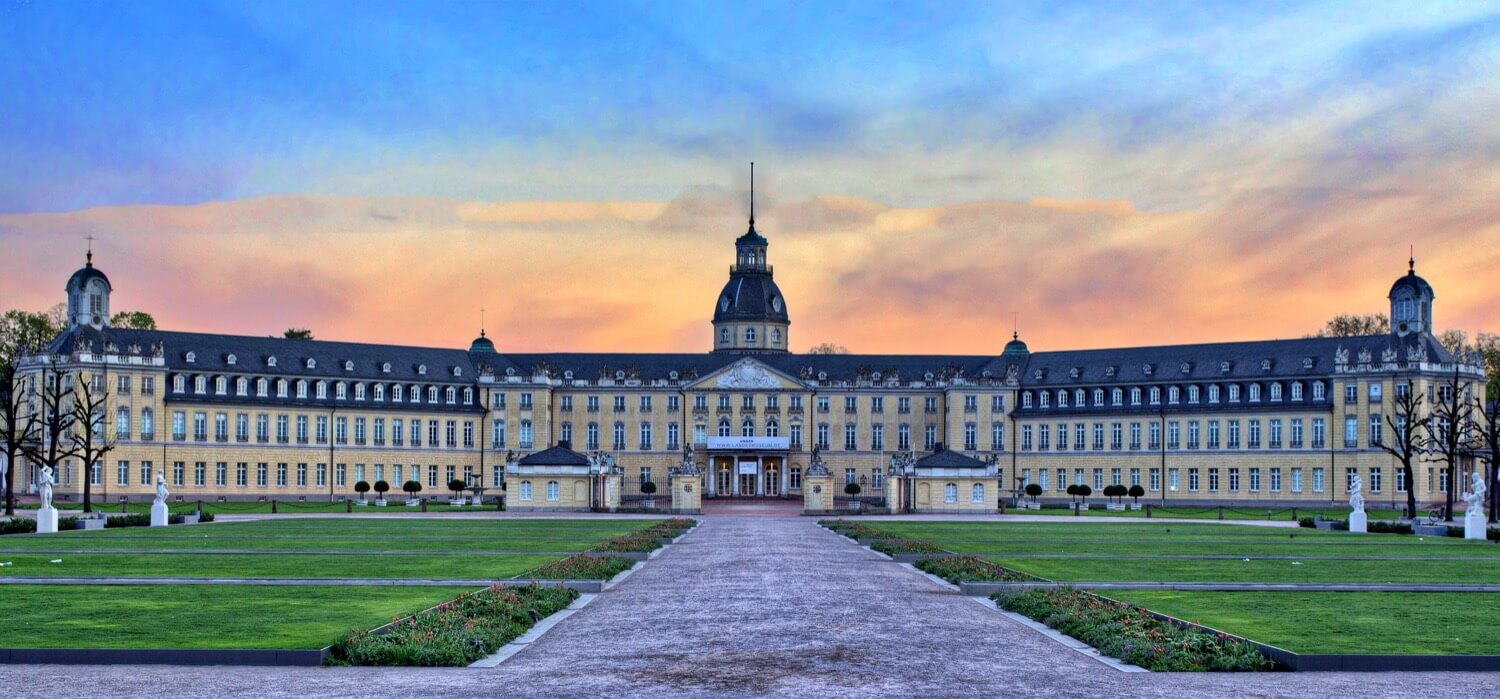
Schloss Bruchsal is a palace complex built in the Baroque style in the town of Bruchsal, Baden-Württemberg. It was built in the first half of the 18th century to serve as the lavishly decorated official residence of the Prince-Bishops of Speyer, though they occupied it for less than a century. Bruchsal was only a hamlet when construction began but grew to be a substantial town that now surrounds the complex. A three-winged palace decorated by some of the leading artists of the 18th century stands at the heart of the complex, alongside over fifty other buildings.
On March 1st, 1945, only two months before the end of the Second World War, much of the palace was destroyed in an American air raid directed against nearby railway installations. It has since been completely rebuilt in a restoration project that lasted until 1996. Its interiors have been partly restored and the palace now houses two museums. It is noted for its fine Roccoco decoration and in particular its grand Baroque entrance staircase, which is regarded as one of the finest examples of its genre.
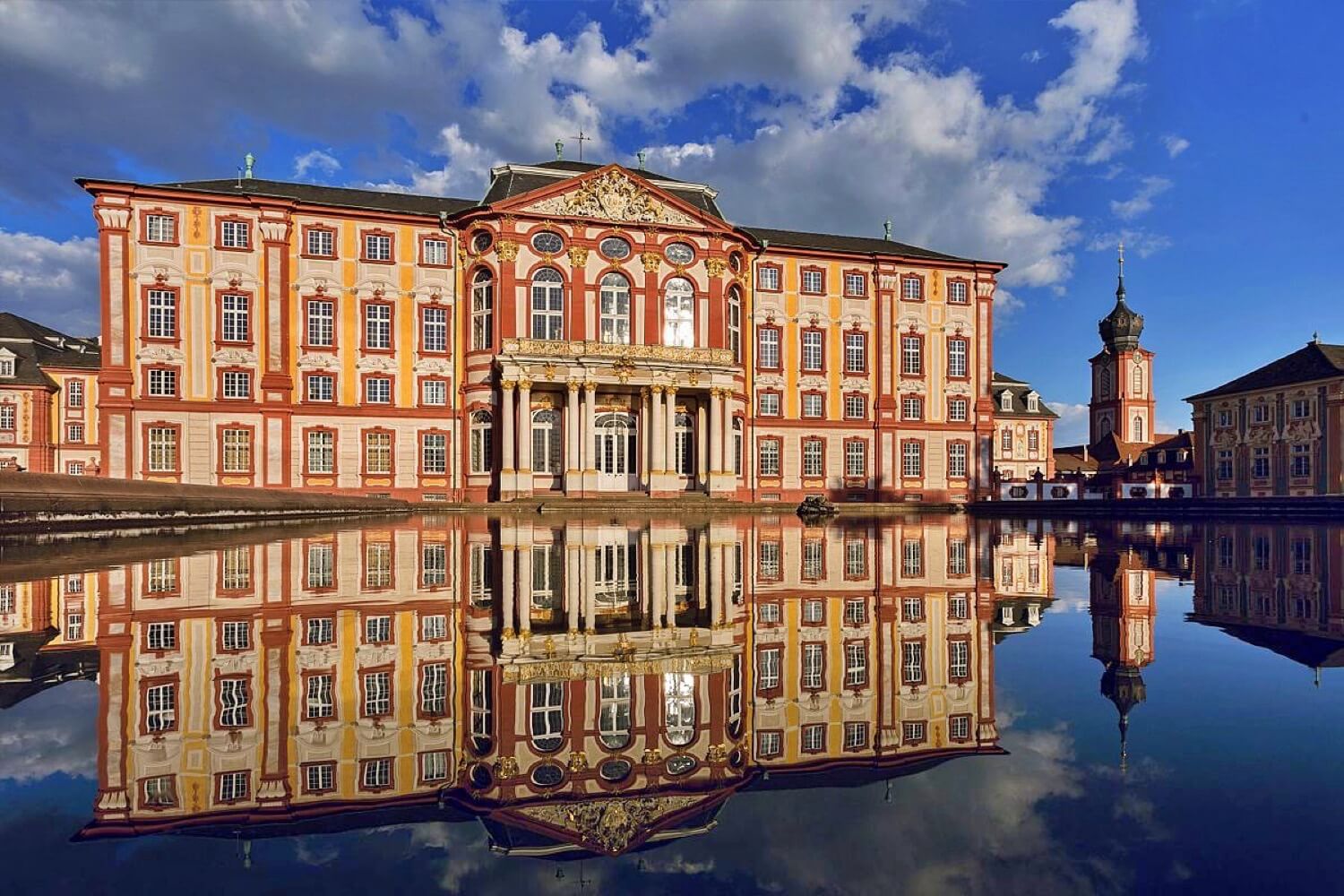
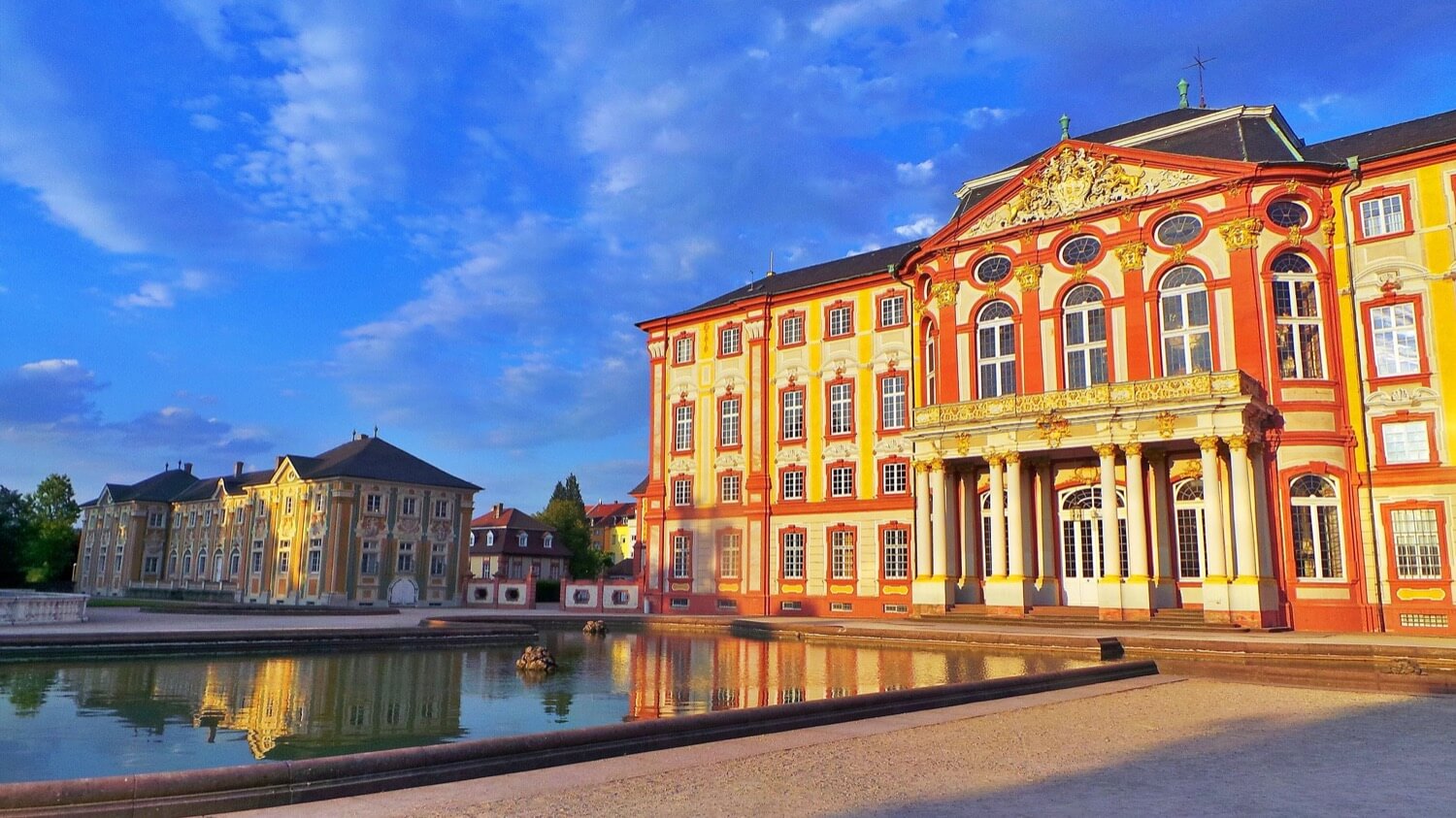
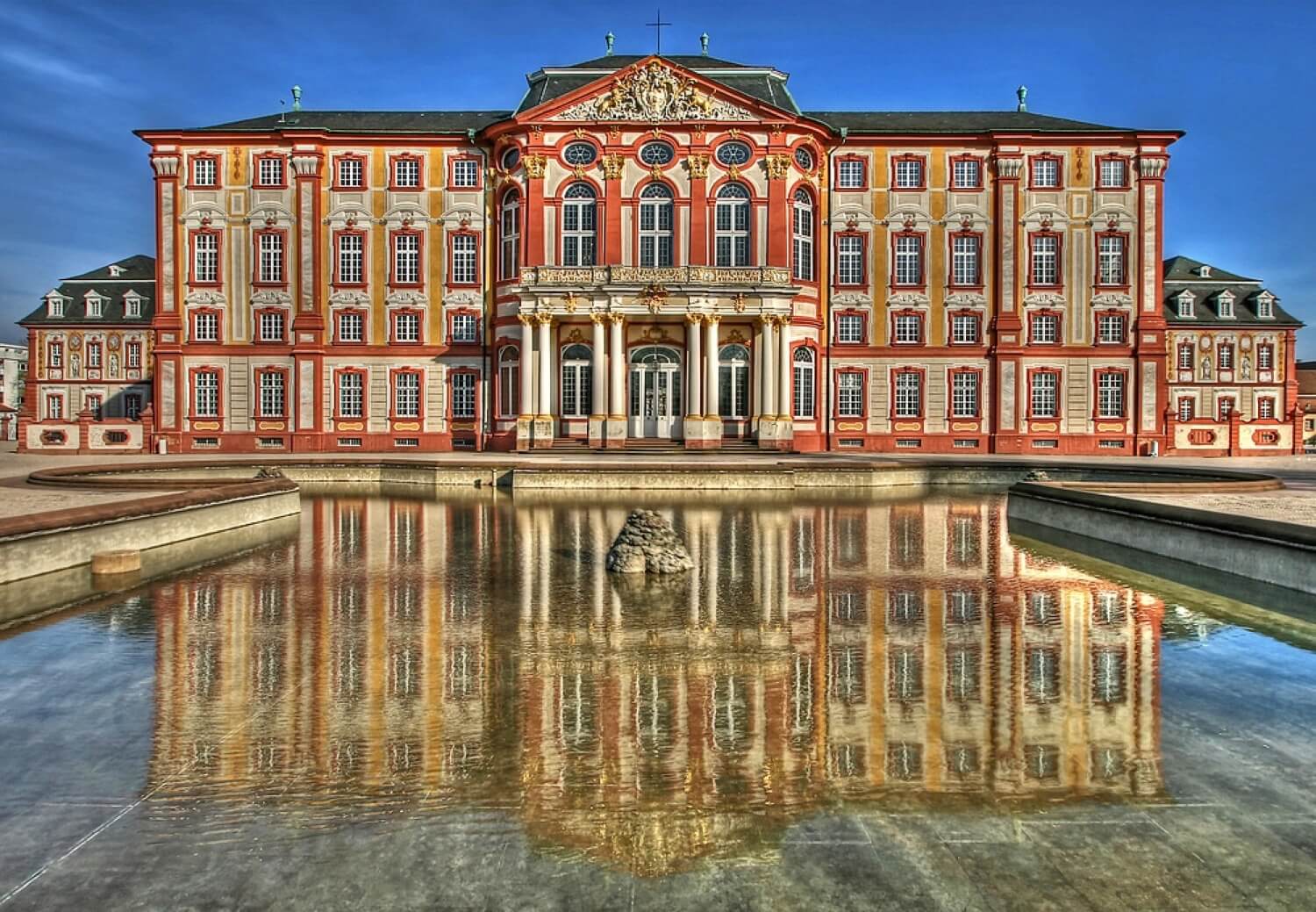
Schloss Bruchsal is dominated by a large three-winged building standing at the heart of a complex of over fifty buildings. Painted in a yellow, red and white colour scheme reflecting the state colours of the then Margraviate of Baden, the main building or Mittelbau comprises a central corps de logis flanked by residential and church wings. Around it and along the adjoining Schönbornstrasse are a series of administrative quarters for the Prince-Bishop's staff, the Damianstor, a triumphal arch leading to the main courtyard, the Hofkirche and the Kammerflügel, now used as a concert hall. A formal garden, the Hofgarten, is situated to the west and was designed by Johann Scheer in an austere French style.
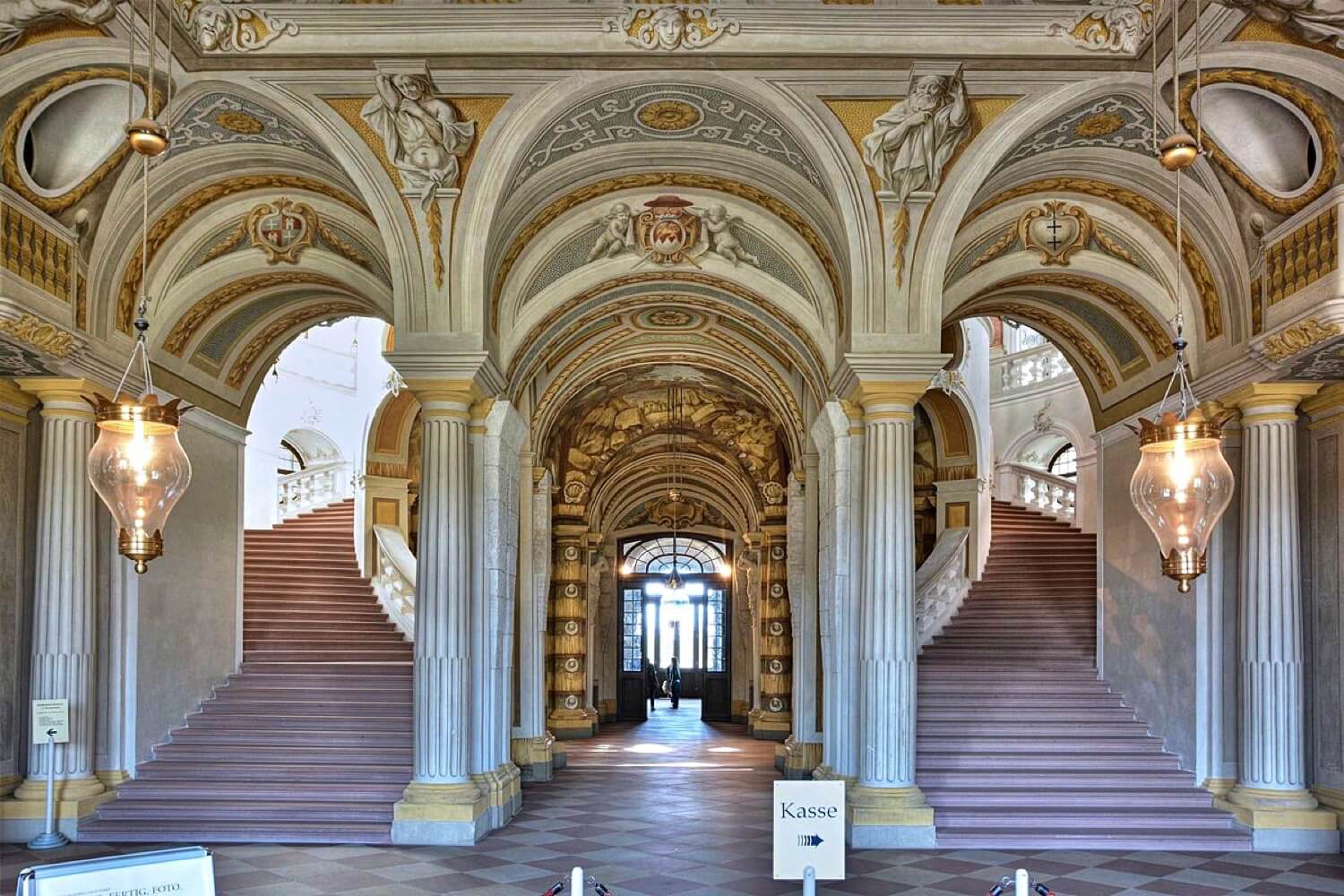
The corps de logis has been called "the high water mark of the Baroque style" with its "perfect unity of space and decoration". It is entered via a two-storey Baroque staircase which is considered to be one of the most important Baroque architectural features in Europe. Described as "ingenious and ravishing", it gives access to the upper floors and both wings. The architectural historian Nikolaus Pevsner described how the staircase appeared before the Second World War:
(The arms of the staircase) start in the rectangular vestibule. After about ten steps one enters the oval. On the ground floor it is a sombre room, painted with rocks in the rustic manner of Italian grotto imitations. The staircase itself then unfolds between two curved walls, the outside wall solid, that on the inside opened in arcades through which one looks down into the semi-darkness of the oval grotto. The height of the arcade openings of course diminishes as the staircase ascends. And while we walk up, it grows lighter and lighter around us, until we reach the main floor and a platform the size of the oval room beneath. But the vault above covers the larger oval formed by the outer walls of the staircase. Thus the platform with its balustrade separating it from the two staircase arms seems to rise in mid-air, connected only by bridges with the two principal saloons. And the vast vault above is lit by many windows, painted with the gayest of frescoes and decorated with a splendid fireworks of stucco.
The interior of the dome is covered by a trompe l'oeil painting by Johannes and Januarius Zick, renowned as the best German decorative painters of the time. It depicts the history of the diocese of Speyer with a perspective that makes it appear as if the dome extends into heaven. The adjoing Fürstensaal and Marmorsaal rooms were the product of collaborations by Zick and Balthasar Neumann, the main designer of the corp de logis. The first room portrays the bishops of Speyer, while the gilded and marble-inlaid Marmorsaal borrows from classical mythology by portraying the bishopric of Speyer as Mount Olympus, the home of the Greek gods.
St Peter's Church, within the palace complex, was designed by Naumann in 1736 and built between 1740 and 1749 by Johann Georg. Its interior houses the ornate Baroque tombs of the Prince-Bishop of Speyer.
Schloss Bruchsal was commissioned in 1720 by Cardinal Damian Hugo Philipp von Schönborn, Prince-Bishop of Speyer (1719–1743) and of Konstanz (1740). His predecessors' residence in Speyer had been destroyed by fire in 1689 but due to a bitter dispute with the townspeople of Speyer, it was never replaced or rebuilt. The dispute dragged on for thirty years before von Schönborn decided to establish a new residence across the Rhine at Bruchsal, which was a mere hamlet at the time. The newly established palace was one of only two ecclesiastical residences on the Upper Rhine, the other being the Bishop of Strasbourg's residence at Rohan Castle in Saverne.
The central three-winged building was based on the plans of Maximilian von Welsch but went through a number of design changes. He managed the construction for its first decade, erecting the right wing, while Michael Rohrer erected the left wing. The main part of the building was designed by Baron Anselm von Grünstein. Balthasar Neumann took over the role of Chief Engineer from 1731 and constructed the main building's staircase. It was created to resolve an architectural conundrum created by von Schönborn's late decision to add a mezzanine floor to the corp de logis. Originally, the plan had been for a circular staircase, but the addition of the mezzanine left no room for additional steps to link it to the staircase. Neumann resolved this with a novel helical staircase design that fitted into the gap.
Von Schönborn and his successors engaged some of Europe's finest sculptors, painters and stucco workers to decorate the interior. The stuccos were by Johann Michael Feuchtmayer and took until 1755 to be completed, while in addition to Zick, the Lombard painter Giovanni Francesco Marchini painted various interior spaces between 1731 and 1736. Work on the decoration continued until 1760 and in the Kammerflügel until 1776. Wolfgang Amadeus Mozart, his father Leopold and his sister Maria Anna visited in July 1763 while on a concert tour of Europe. Leopold expressed his admiration of the palace in a letter to his friend Lorenz Hagenauer, saying, "The residence of Bruchsal is worth seeing, its rooms being of the very best taste, not numerous, but so noble, indescribably charming, and precious."
After the Prince-Bishops of Speyer were deposed at the start of the 19th century and their secular powers were ended, the palace became a royal residence between 1806 and 1832 when it served as the residence of the widowed Princess Amalie of Hesse-Darmstadt, mother of Charles, Grand Duke of Baden. She shared the residential wing of the palace with the last Prince-Bishop, Wilderich of Walderdorf, who was permitted by the new secular government to live there and draw a pension of 200,000 guilders until his death in 1810. Many items from the palace were dispersed to other locations in the newly established Grand Duchy of Baden. The early 19th century traveller Charles Edward Dodd, who visited the palace around 1818, described its "deserted splendour" wherein "the gay ladies of (Princess Amalie)'s court complain bitterly of its magnificent dreariness.
The palace subsequently fell into disrepair and its artistic importance was not recognised until the end of the 19th century. Restorations were carried out in the 1900s and 1930s, but on 1 March 1945, two months before the end of the Second World War, the Schloss was badly damaged by a United States Army Air Force air raid that had been aimed at Bruchsal's rail facilities, leaving it completely burned out. More than 80 per cent of the palace was destroyed. The famous staircase largely survived, though it was badly damaged, but the dome above it did not. Many of the most valuable items of furniture had already been removed for safekeeping and so survived.
After lengthy discussions about whether and how it should be done, the corps de logis was restored to its original form to serve as a museum, while the church wing was modernised. The restoration work took almost 30 years, lasting into the 1970s. Fortunately for the restorers, the interior had been extensively photographed in colour before the war, enabling the destroyed frescoes to be recreated. The palace was reopened in 1975, while restoration elsewhere in the complex lasted until 1996.
Schloss Bruchsal now houses two museums. The Städtisches Museum displays tapestries, paintings and furniture from the part of the palace's collection that survived the war, and also houses examples of porcelain, faience, hunting weapons and gold objects. The palace also houses the separate Deutsche Musikautomatenmuseum which displays German-made self-playing musical devices, such as musical clocks and instruments which use piano rolls, such as player pianos and organs. The gardens are also open to the public.
Das Schloss Bruchsal in der baden-württembergischen Stadt Bruchsal war Residenz der Fürstbischöfe von Speyer (als Ersatz für die im Pfälzischen Erbfolgekrieg zerstörte Bischofspfalz).
Das Bruchsaler Schloss im barocken Stil wurde ab 1720 auf Wunsch des Fürstbischofs Damian Hugo Philipp von Schönborn-Buchheim aus Lossburger Sandstein errichtet. Es handelt sich im Kern um eine Dreiflügelanlage, die auf Planungen des kurmainzischen Oberbaudirektors Maximilian von Welsch zurückgeht. Nach mehrfachen Planänderungen wurde das zentrale Treppenhaus durch Balthasar Neumann errichtet, der seit 1731 die Bauleitung übernommen hatte. Es gilt gemeinhin als eine der gelungensten Lösungen einer barocken Treppenanlage. Sein genialer Entwurf sieht im Herzen des Corps de Logis ein zweiläufiges, vom Kuppelsaal überfangenes Treppenhaus vor, das zu den beiden Festsälen des Schlosses führt. Der Fürstensaal ist der zur Stadt gelegene Festsaal. Der Marmor- oder Kaisersaal liegt in Richtung des Gartens. Der Marmorsaal gehört zum architektonischen und programmatischen Zentrum der geistlichen Residenz.
Neben Neumann nahm der lombardische Kunstmaler Giovanni Francesco Marchini seine Tätigkeit im Schloss auf. Er malt in den Jahren 1731 bis 1736 die Fresken der Intrada, der düsteren Grotte sowie den Gartensaal. Auch die Fassadenmalerei des Corps de Logis und der Orangeriebauten stammen aus der Hand Marchinis. Die Scheinarchitektur aufgemalter Wandvorsprünge ist von überragender Perfektion.
Die Innenausstattung im Stil des Rokoko wurde hauptsächlich unter Hugo Damians Nachfolger Franz Christoph von Hutten zum Stolzenberg gefertigt. Die Fresken schildern in der Sprache der Mythologie eindrucksvoll Vergangenheit, Gegenwart und Zukunft des Fürstbistums Speyer. Die Stuckaturen wurden erst 1755 von Johann Michael Feuchtmayer, die Fresken von Johannes Zick vollendet.
Prunkwappen am Mittelrisalit des 'Kirchenflügels'
In den Jahren 1900 bis 1909 wurde die lange verlorene, farbige Fassadengestaltung als richtungweisender Akt der modernen Denkmalpflege von Fritz Hirsch wiederhergestellt. Die Schlossanlage umfasst zahlreiche Gebäudeteile, darunter das Damianstor und die Hofkirche. In den letzten Tagen des Zweiten Weltkriegs wurde das Schloss im Zuge der Luftangriffe auf die Stadt am 1. März 1945 schwer getroffen und brannte aus; die Substanz des Treppenhauses überdauerte im Gegensatz zur Kuppel aber weitgehend die Zerstörungen. Der Mittelbau (Corps de Logis) wurde nach längeren Diskussionen um das Ob und Wie des Wiederaufbaus bis in die 1970er Jahre hinein als Museum rekonstruiert, der Kirchenflügel hingegen modern gestaltet.
Schloss Bruchsal ist für Besichtigungen geöffnet. Im Schloss sind das Deutsche Musikautomaten-Museum und das Museum der Stadt Bruchsal untergebracht. Es zählt zu den landeseigenen Monumenten und wird von der Einrichtung „Staatliche Schlösser und Gärten Baden-Württemberg“ betreut. In zum Schloss gehörenden Gebäuden ist auch das Amtsgericht Bruchsal untergebracht.
Das Schloss Bruchsal wird über das komplette Jahr gelegentlich zu öffentlichen Veranstaltungen und Messen genutzt, wie die Schlossweihnacht oder die jährlich stattfindende Diga Gartenmesse im Bruchsaler Schlosspark.
Die Dauerausstellung Gebaut, Zerstört, Wiedererstanden dokumentiert die Zerstörung des Bruchsaler Schlosses am 1. März 1945. Trümmerfunde und Handwerkstechniken aus dieser Zeit und dem 18. Jahrhundert ergänzen diesen Ausstellungsteil.
Nur mit Sonderführungen ist das Lapidarium zu besichtigen, welches originale Überreste (Wappen, Kapitelle, Stücke von Balustraden, etc.) nach der Zerstörung der Anlage 1945 dem Besucher zur Schau stellt.
Dieses Museum gibt Einblick in die Geschichte Bruchsals von der Steinzeit bis heute. Schwerpunkte werden auf die Revolution von 1848/1849 und die Zerstörung der Stadt im Zweiten Weltkrieg gelegt. Daneben bietet das Museum für Schulklassen und Reisegruppen experimentelle Archäologie an, sowie einen weiteren Ausstellungsteil über die Strafvollzugsanstalt Bruchsal.
Im Deutschen Musikautomatenmuseum stellt das Schloss Bruchsal rund 500 Musikautomaten aus der Zeit des 17. Jahrhunderts bis in die Neuzeit dar.
Nearby castles