Gutštejn Castle
Tachov District Plzeň Region Czech Republic
castle, chateau
Hrad Gutštejn
Tachov District Plzeň Region Czech Republic
castle, chateau
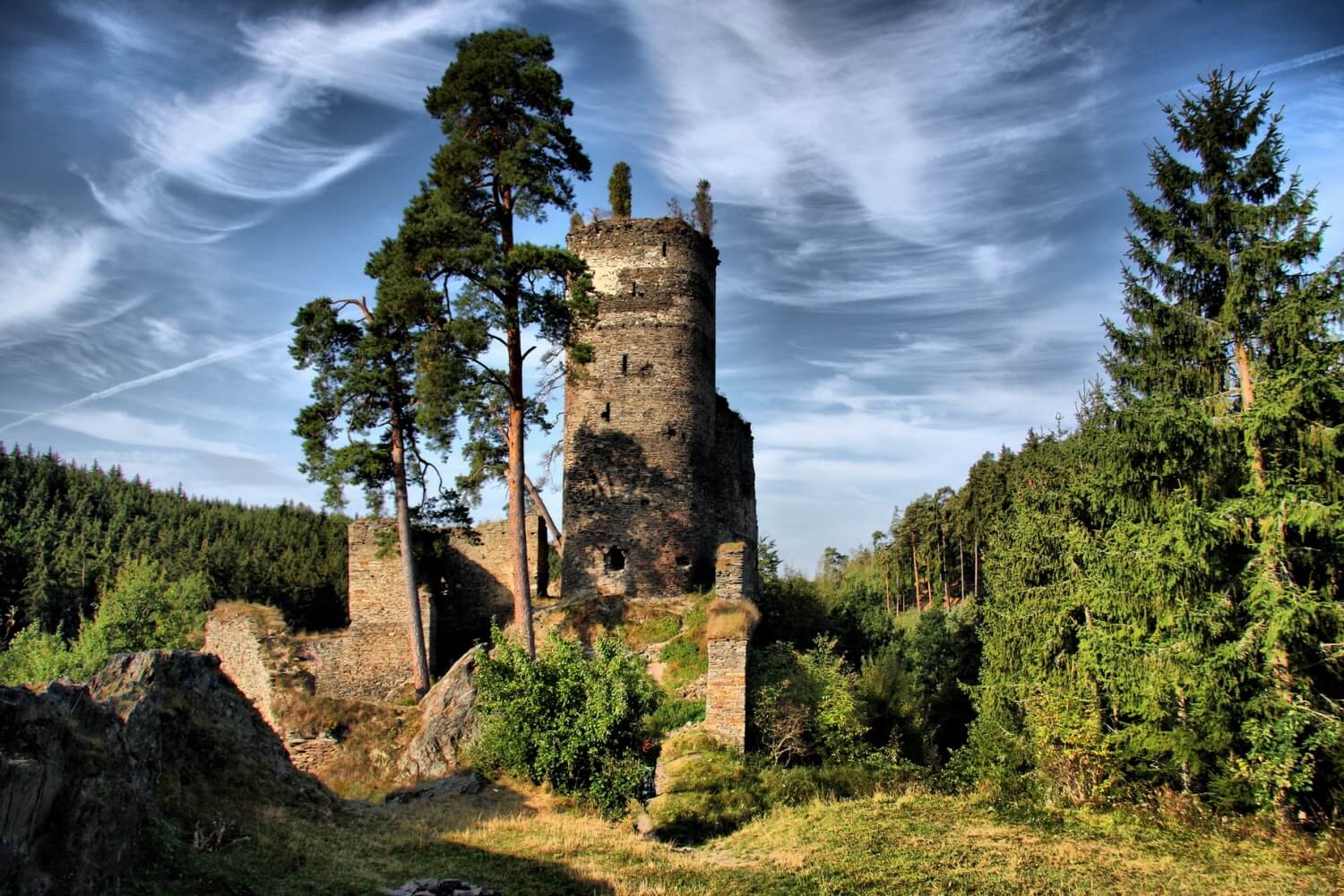
The ruin of Gutštejn castle rises on a steep cliff above the creek Hadovka near Konstantinovy Lázně (Spa Constantine)
První písemná zmínka o hradu a jeho vlastníku je z roku 1319, kdy tepelský opat pronajal Jetřichovi I
Previous names
Gutštejn Castle, Hrad Gutštejn
Description
The ruin of Gutštejn castle rises on a steep cliff above the creek Hadovka near Konstantinovy Lázně (Spa Constantine). The castle was built on phylitic greywacke and slate, which were formed at the bottom of the Proterozoic sea more than 500 million years ago. The original marine sediments were strengthened and then transformed during later orogenic processes.
The castle was founded in the early 14th century by Hroznatovci, who derived their origin from the beatific Hroznata, founder of important Premonstratensian monasteries in Teplá and Chotěšov. The first written record of the castle dates from 1319. The castle belonged to the Gutštejns until the mid-16th century. During the Hussite wars the owners of the castle stood on the Catholic side and served the king Zikmund (Sigismund). The castle lost its impregnability in 1422, when it was besieged by Hussite troops under the command of Jan Žižka. The Gutštejns family , faithful to the king Zikmund, had received a number of villages and monasteries in Chotěšov, Pivoň, Plasy and elsewhere . After the Hussite wars they belonged to the most powerful families in western Bohemia. Burian of Gutšetjn owned Bělá, Rabštejn, Nečtiny; Tachov, Komberk and for a short time also Stříbro. He was the regional governor to Žatec and Plzeň and managed the Chotěšov monastery. At the turn of the 15th century during wars between the Gutštejns and King Vladislav Jagelonský the castle became prison for the rich prisoners. The seat of the Gutštejns was moved to Bezdružice in the 16th century. Gutštejn family members had held important posts at that time. They died off in 1747.
The castle consisted of two main parts, the forecastle and the inside castle, separated by a deep moat. The forecastle, which had economic function, is practically lost. The only remain of the forcastle is a small cellar carved into the rock. The original castle had no tower and so the defense was provided by massive perimeter wall. The core of the castle consists of three parts: the trapezoidal first courtyard, the second courtyard with the remains of the palace and the main towers with the defense wall towards Hadovka. The castle dominant is the main square tower with rounded corners and high-lying entrance. According to the results of archaeological research the tower was completed at a later date, probably at the turn of the 14th century.
http://m.taggmanager.cz/
První písemná zmínka o hradu a jeho vlastníku je z roku 1319, kdy tepelský opat pronajal Jetřichovi I. z Gutštejna a jeho synu Sezemovi tři vesnice. Roku 1369 víme již o třech bratrech, Janovi, Jetřichovi II. a Půtovi z Gutštejna. Zakladatel rodu Jetřich II. zemřel v roce 1417. Jeho syn Burian sídlil na Rabštejně a Nečtinách, Jan na Bělé, oba později na hradě Gutštejn. Roku 1422 oblehl hrad Jan Žižka s Pražany a hrad dobyl. Oba bratři se o majetek rozdělili, přičemž Gutštejn připadl Janovi, který byl ženatý s dcerou Přibíka z Klenové. Jako přívrženec císaře Zikmunda získal za svou pomoc řadu vesnic z majetku klášterů v Chotěšově, Pivoni a Plasích.
Po jeho smrti v roce 1453 získal hrad jeho bratr Burian. Ten mezitím velmi zbohatl, patřila mu Bělá, Rabštejn nad Střelou, Nečtiny, Tachov a Komberk byl i krajským hejtmanem na Žatecku a Plzeňsku a spravoval chotěšovský klášter. Přestože byl katolík, po roce 1448 se přidal na stranu Jiřího z Poděbrad. V roce 1450 se mu podařilo u Stříbra zajmout posla s dopisem usvědčujícím Oldřicha II. z Rožmberka z organizování intervence cizích vojsk do Čech, a umožnil tak králi politickou izolaci jeho protivníka.
Jeho syn Burian zvaný „Bohatý“ získal další statky v Čechách a Bavorsku, roku 1465 se přidal k jednotě zelenohorské a vedl jednání s císařem Fridrichem III., který katolickým pánům udělil mincovní právo v Plzni. Pak krátce podporoval uherského krále Matyáše, ale po nástupu Vladislava II. Jagelonského na český trůn se přidal na jeho stranu. Již roku 1472 se stal vrchním komorníkem království a roku 1477 vedl Vladislavovo vojsko, kterému se nepodařilo dobýt Plzeň obsazenou Matyášovým vojskem. Roku 1485 se stal nejvyšším kancléřem a nadále se bezohledně obohacoval. Zanechal po sobě pět synů: Buriana, Jana, Jetřicha, Volfa, Kryštofa a Jindřicha.
Není známo, kdo z bratrů vlastnil Gutštejn. Postupně však zemřeli a zůstal jen Volf, ten ale sídlil v Chyši. Když roku 1545 Volf zemřel, zdědil hrad jeho syn Viktorin; ten ho roku 1549 prodal majiteli Bezdružic Hanušovi Elpognarovi z Dolního Šenfeldu. Pro potřeby mocného rodu Gutštejn už nevyhovoval a tak bylo v 16. století středisko panství přeneseno do Bezdružic a hrad byl opuštěn.
Useful information
The deadline for making the castle available to the public is not yet set
-
External links
Nearby castles