Torres de Oeste
Pontevedra Galicia Spain
castle, chateau
Torres de Oeste
Pontevedra Galicia Spain
castle, chateau
Torres de Oeste is a castle in Catoira, Galicia, Spain
Las Torres de Oeste se refieren a las defensas que mandó construir, tras repeler un ataque vikingo, el obispo Cresconio (c
Previous names
Torres de Oeste, Torres de Oeste
Description
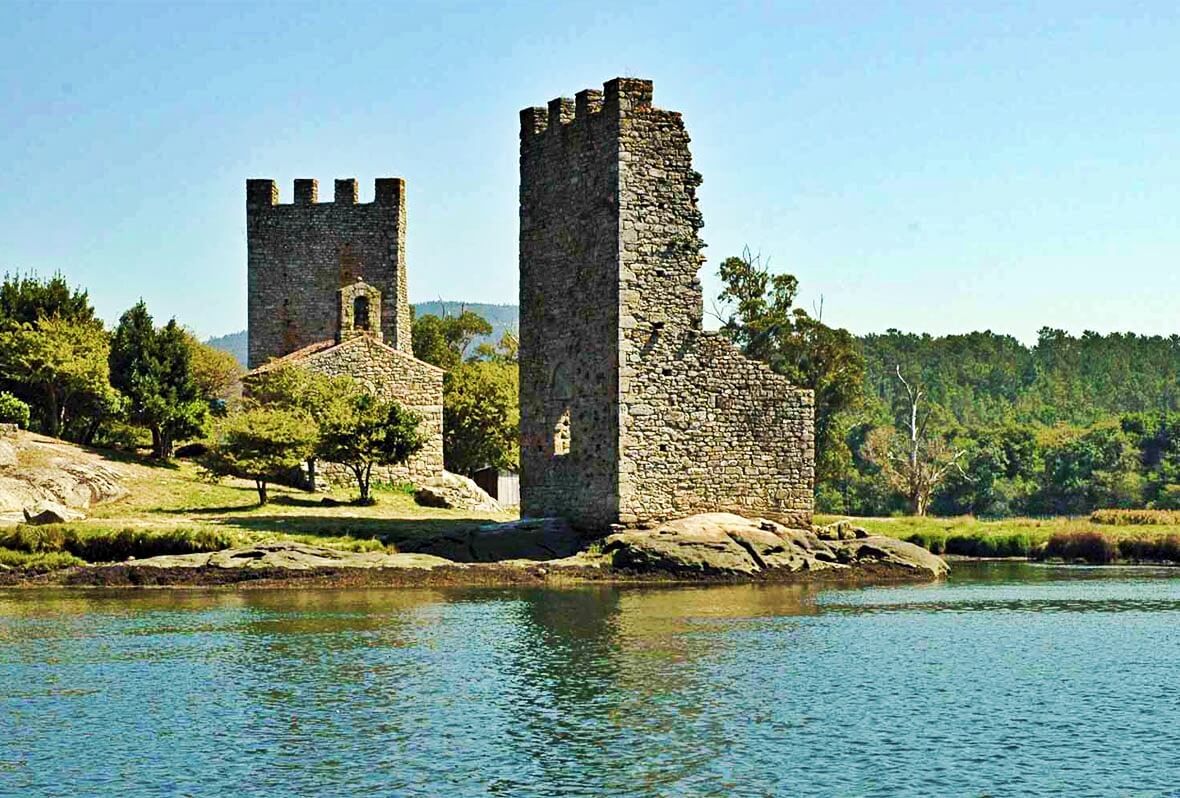
Torres de Oeste is a castle in Catoira, Galicia, Spain. It is located at the head of the Ría de Arousa. It is in the region of Caldas (Pontevedra), in the river Ulla estuary. The towers remaining today are the ruins of Castellum Honesti. Torres del Oeste has been declared a national monument.
In the 9th century, King Alfonso III of Leon built the castle as a defense against Viking attacks. The two remaining towers are from this period, and have a pre-Roman style. Pre-Roman ceramics and bronze tools have been discovered at the site. Two centuries later, King Alfonso V of Leon donates the fortress to the bishopric of Iria-Compostela, held at that moment by bishop Vestruarius. Subsequent bishops Cresconio, Diego Pelaez and Diego Gelmirez undertook the commitment to strengthen the Castle in order to protect the holy site of Santiago de Compostela. The structure of the Castle was defined in the 12th century. At that time, the enclosure of the Castle was formed by seven towers, and it was surrounded by marshes. The Castle has a 12th-century chapel built by Gelmirez to honor the apostle Saint James. The Castellum Honesti began its decline in the 15th century.
Each summer, the first Sunday of August, a celebration recalls the repulse of a Viking invasion.
Las Torres de Oeste se refieren a las defensas que mandó construir, tras repeler un ataque vikingo, el obispo Cresconio (c.1036-66) en Catoira, Galicia, para proteger Compostela de una incursión desde el Atlántico. Fueron declaradas Monumento histórico-artístico perteneciente al Tesoro Artístico Nacional mediante decreto de 3 de junio de 1931) y a partir de 1970 fueron restauradas.
En 1719 también protegieron el puerto de Padrón contra un ataque de los ingleses.
External links